Category: AI Automation

  • Claude Opus 4.8 Just Killed No-Code Marketing Automation

    Claude Opus 4.8 Just Killed No-Code Marketing Automation

    —

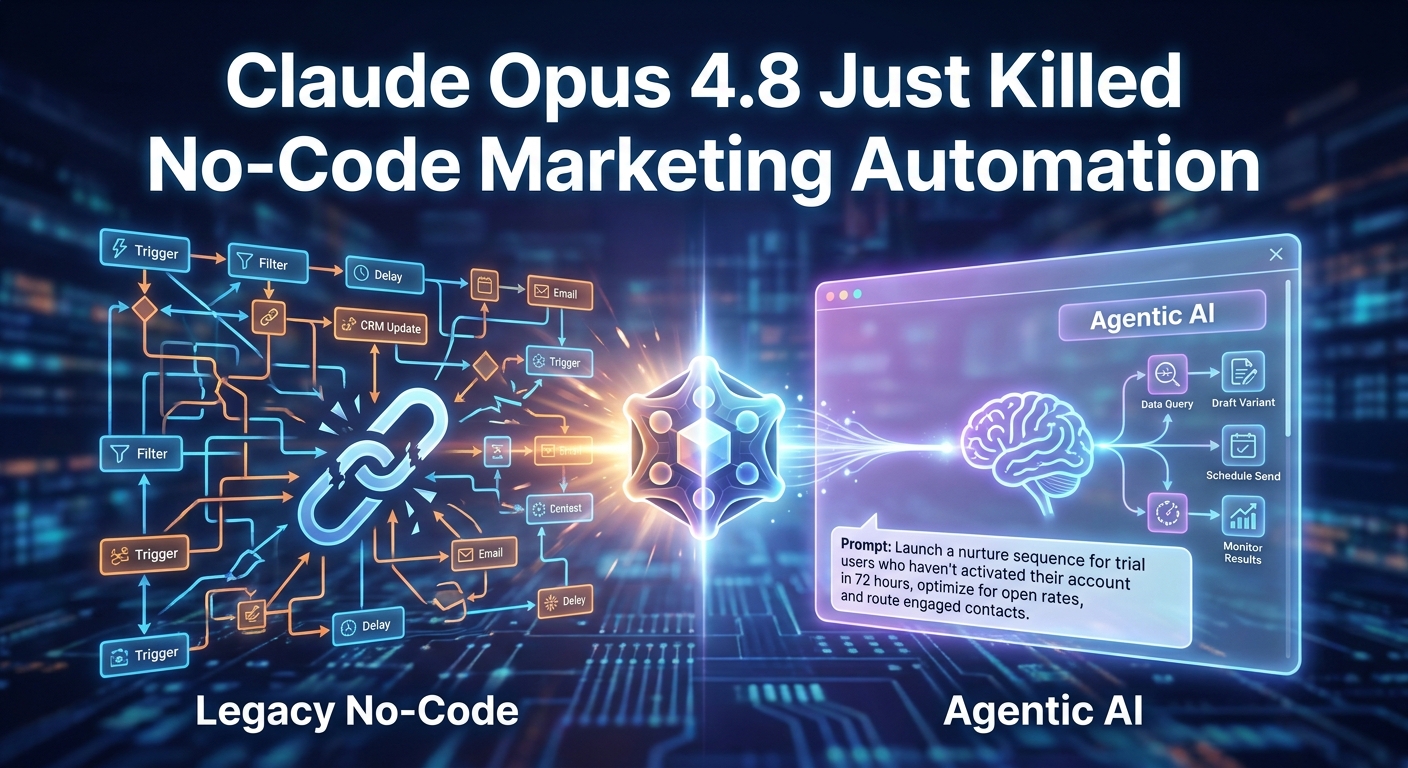
    Claude Opus 4.8 introduces agentic AI capabilities that enable marketers to orchestrate complex workflows through natural language rather than visual builders, fundamentally shifting how B2B teams approach marketing automation. This post examines what changed in Opus 4.8’s architecture, why traditional no-code tools now face existential pressure, and what marketing teams should prioritize this quarter to capitalize on AI workflow automation before competitors do.

    What Claude Opus 4.8 Actually Changed (And Why It Matters)

    Anthropic’s Claude Opus 4.8 release centers on three architectural improvements: extended context windows to 500K tokens, native function calling with state persistence, and multi-step reasoning that doesn’t require human checkpoints between actions.

    The extended context window means Claude Opus 4.8 marketing automation can ingest your entire customer data platform schema, campaign taxonomy, and brand guidelines in a single prompt. Previous models required chunking or summarization, which introduced errors and limited workflow complexity.

    Native function calling with state persistence allows the model to execute API calls, store intermediate results, and make conditional decisions across multiple tools without returning to the user. This is what transforms Claude from a chatbot into an agent—it can complete a 12-step campaign workflow autonomously.

    Multi-step reasoning removes the bottleneck that plagued earlier AI marketing tools: the need for human approval at each decision point. Opus 4.8 can evaluate outcomes, adjust parameters, and proceed through branching logic based on real-time data. That’s the difference between a task assistant and a workflow orchestrator.

    For B2B marketers, this means you can describe a desired outcome in natural language—”launch a nurture sequence for trial users who haven’t activated their account in 72 hours”—and the agent constructs the workflow, pulls the segment, writes the emails, sets the triggers, and monitors performance.

    Why Traditional No-Code Tools Are Now Legacy Infrastructure

    No-code automation platforms like Zapier, Make, and HubSpot Workflows were built on a drag-and-drop paradigm: users connect pre-built modules to create linear or branching sequences. This model thrived when the alternative was hiring developers to write custom integrations.

    Agentic AI for marketers eliminates the visual builder entirely. Instead of spending 45 minutes configuring triggers, filters, delays, and actions in a UI, you describe the workflow once and the agent generates the execution path. The time-to-value collapses from hours to minutes.

    Traditional no-code tools also struggle with context switching. Each workflow exists in isolation. If you need to modify ten related automations because your lead scoring model changed, you’re clicking through ten separate builders. AI agents operate across your entire workflow ecosystem simultaneously, applying changes consistently.

    The economic model shifts too. No-code platforms charge per task or per seat, creating predictable but scaling costs. Embedded AI marketing tools charge per API call or token consumption, which initially feels opaque but trends toward commodity pricing as model costs decline. More importantly, agentic systems reduce total workflow volume by consolidating redundant tasks.

    The real obsolescence isn’t technical—it’s cognitive. No-code tools require users to translate business logic into the platform’s visual syntax. AI workflow automation accepts business logic in its native form: plain language descriptions of desired outcomes. The cognitive overhead vanishes.

    The Agentic Performance Leap: From Task Execution to Workflow Orchestration

    Earlier AI marketing tools performed isolated tasks: write an email, generate a subject line, summarize a report. They required humans to connect the outputs into coherent workflows. Claude Opus 4.8’s architecture enables true orchestration—chaining dependent tasks, making conditional decisions, and adjusting based on intermediate results.

    Here’s what orchestration looks like in practice. A B2B demand gen team wants to re-engage cold leads from last quarter’s webinar. Traditional workflow: segment the audience in your MAP, export to CSV, upload to email tool, write three variants, set up A/B test, configure send schedule, monitor open rates, trigger follow-up sequences based on engagement.

    With agentic AI, the prompt is: “Re-engage 2024 Q1 webinar attendees who didn’t convert, using three email variants tested for open rates, sending follow-ups based on engagement tier.” The agent queries your data warehouse, drafts variants aligned to your brand voice (already in context), configures the test, schedules sends optimized for recipient time zones, monitors results, and routes engaged contacts into appropriate nurture tracks.

    The performance leap isn’t speed alone—it’s decision quality. AI agents can evaluate hundreds of conditional paths and select optimal routing in real time. A human builder might configure three or four branches before complexity becomes unmanageable. An agent can manage dozens.

    This matters most for account-based campaigns where workflow complexity grows exponentially with personalization depth. Customizing outreach across account tier, industry vertical, buying committee role, and engagement history creates thousands of potential paths. Agents handle this natively; visual builders collapse under combinatorial explosion.

    What B2B Marketing Teams Should Do This Quarter

    First, audit your current automation stack for redundant workflows that exist only because visual builders make consolidation too painful. Identify clusters of similar automations—welcome sequences, re-engagement campaigns, event follow-ups—that could collapse into a single agent-orchestrated workflow with natural language parameters.

    Second, invest in structured data infrastructure. B2B marketing AI agents are only as effective as the data they can access. If your lead scoring exists as tribal knowledge or your campaign taxonomy lives in scattered spreadsheets, agentic tools can’t leverage them. Document your data schema, standardize naming conventions, and expose clean API endpoints.

    Third, establish governance for agent-generated workflows. Decide which actions require human approval (budget commitments, external communications) versus which can run autonomously (internal reporting, data enrichment). Build approval checkpoints into your prompts where judgment calls matter.

    Fourth, train your team on prompt engineering for workflow orchestration, not content generation. The skill isn’t “write a better blog post”—it’s “describe a multi-step campaign workflow with sufficient context, constraints, and success criteria that an agent can execute it reliably.” This is closer to writing technical specs than creative briefs.

    Fifth, prototype in production. Don’t sandbox agentic AI projects indefinitely. Run one live campaign this quarter where Claude Opus 4.8 marketing automation handles the entire execution from segmentation through analysis. Learn from real performance data, not hypothetical use cases.

    The Real Competitive Advantage: Structured Data + AI Agents

    The competitive moat for B2B marketing teams isn’t access to AI models—those are commodity infrastructure now. The moat is proprietary structured data combined with agents that can act on it.

    Companies with clean customer data models, documented campaign taxonomies, and API-first martech stacks can deploy agentic workflows in days. Companies with messy CRMs, siloed tools, and manual processes will spend months on data cleanup before agents deliver value.

    This creates a compounding advantage. Teams that operationalize AI workflow automation faster generate more structured data from automated workflows (activity logs, decision trees, performance metrics), which makes subsequent agent deployments more effective. The feedback loop accelerates.

    The shift also rewards integrated platforms over best-of-breed tools. Agents perform best when data and actions live in connected systems with consistent schemas. The decade-long trend toward specialized point solutions reverses as embedded AI marketing tools favor consolidation.

    Strategic investments shift from buying more tools to instrumenting existing ones for agent access. That means prioritizing APIs, webhooks, and structured outputs over UI-based features. Marketing technology selection criteria now include “can an AI agent use this autonomously?” as a first-order question.

    For marketing leaders, this is the quarter to audit data quality, document workflows, and prototype agentic automation in one high-value use case. The teams that move now build structural advantages before agentic AI for marketers becomes table stakes.

    FAQ

    What makes Claude Opus 4.8 different from previous AI marketing tools?
    Opus 4.8 introduces state persistence and multi-step reasoning, allowing it to complete complex workflows autonomously rather than requiring human intervention between tasks. Previous models could assist with individual steps but couldn’t orchestrate end-to-end campaigns.

    Do we need to replace our existing marketing automation platform?
    Not immediately. Agentic AI layers on top of existing tools through API connections, automating workflow creation and management rather than replacing the execution infrastructure. However, platforms that don’t expose robust APIs will become limiting factors.

    How do we measure ROI on agentic AI implementations?
    Track time saved on workflow configuration, reduction in manual task volume, and improvement in campaign complexity (number of personalization variables or conditional paths). Early adopters report 60-80% reduction in setup time for multi-touch campaigns.

    What are the biggest risks with AI-orchestrated marketing workflows?
    Data quality issues compound quickly when agents make autonomous decisions based on flawed inputs. Poor segmentation or incorrect attribution models will propagate errors across connected workflows. Start with high-confidence data sets and expand gradually.

    Can smaller marketing teams benefit or is this enterprise-only?
    Smaller teams often benefit more because they lack dedicated marketing ops resources. Agentic AI eliminates the need for specialized automation expertise, letting generalists orchestrate sophisticated workflows. The barrier is data cleanliness, not team size.

    —

    Want practical guidance on implementing AI workflow automation in your marketing stack? Subscribe to Alington Media’s weekly newsletter for hands-on frameworks and deployment playbooks.
  • n8n vs Make vs Zapier: AI Agents Are Replacing Workflows

    n8n vs Make vs Zapier: AI Agents Are Replacing Workflows

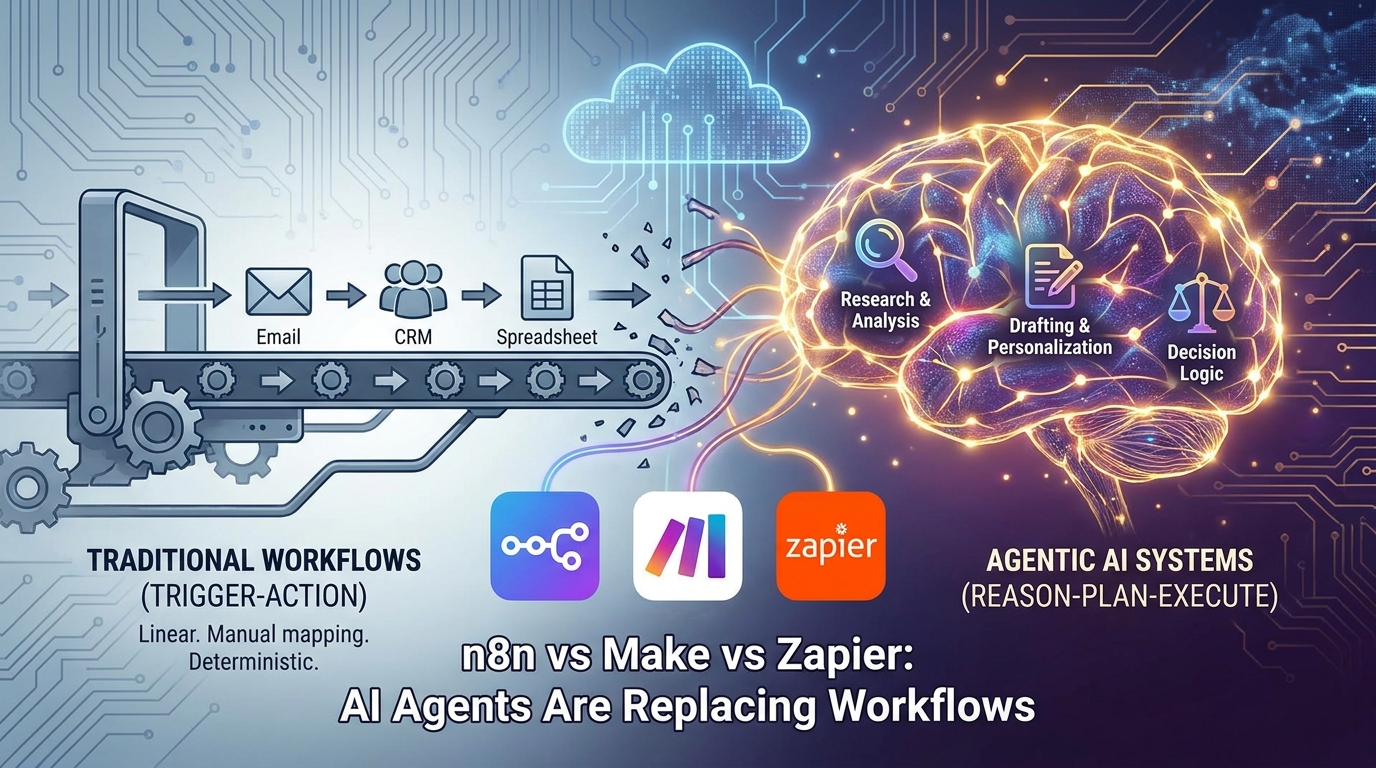
    The three leading AI marketing automation tools—n8n, Make, and Zapier—are pivoting from simple trigger-action workflows to agentic systems that reason, plan, and execute multi-step tasks autonomously. This post evaluates their current AI capabilities, what agentic features actually deliver for B2B marketing operations, and how to restructure your automation stack before the next budget cycle.

    The Shift From Workflows to AI Agents

    Traditional automation platforms execute pre-defined sequences: when X happens, do Y. Agentic AI workflows flip that model. Instead of mapping every conditional branch yourself, you define a goal and constraints—then the agent decides which tools to use, in what order, adapting based on intermediate results.

    For marketing ops, this means you can replace a 47-step Zapier workflow with a prompt like “research this lead, score fit, draft a personalized email, and add to the nurture sequence if they match our ICP.” The system handles API calls, data parsing, and decision logic without manual flow design.

    The shift is already underway. Zapier launched Central AI agents in late 2024. Make introduced autonomous scenario execution in early 2025. n8n rolled out its AI execution layer in Q1 2025, letting users build no-code AI automation that writes its own workflow steps at runtime.

    n8n’s New AI Execution Layer

    n8n’s approach emphasizes transparency and control. Its AI execution mode exposes the reasoning chain—you see which nodes the agent selected, why it chose them, and the data passed between steps. This matters for compliance-conscious teams who need audit trails.

    n8n AI features include tool-use orchestration (the agent can call any API you’ve configured), memory persistence across executions, and the ability to fall back to human approval for high-stakes actions. The platform remains self-hostable, which appeals to enterprises with data residency requirements.

    The trade-off: n8n’s interface assumes technical literacy. Non-technical marketers often need developer support to configure custom nodes or debug agent behavior. It’s the choice for teams already running backend automation or those who want full infrastructure control.

    Make and Zapier’s Agentic Features Compared

    Make automation AI leans into visual workflow design, letting you mix deterministic steps with agentic blocks. You might hard-code data enrichment but delegate lead scoring to an AI module that adapts its criteria based on recent win/loss patterns. Make’s strength is granular control—you decide where agents intervene and where logic stays fixed.

    Zapier AI agents prioritize speed and accessibility. Central allows non-technical users to describe goals in plain language, then auto-generates workflows combining Zapier’s 6,000+ app integrations with LLM reasoning. The platform handles error recovery and retries automatically.

    Zapier’s limitation: less transparency into agent decision-making. You get results, but the intermediate reasoning is often opaque. For high-volume, low-risk tasks—social scheduling, list cleanup, CRM data entry—that’s fine. For strategic ops like budget allocation or campaign personalization, many teams want more visibility.

    Make sits between n8n’s control and Zapier’s simplicity, offering modular agent blocks within a familiar interface. Teams migrating from traditional automation often find Make’s hybrid model easiest to adopt incrementally.

    What This Means for B2B Marketing Operations

    Agentic systems collapse role boundaries. Tasks that required a marketing ops specialist, a data analyst, and a copywriter can now run end-to-end autonomously—prospect research, competitive intelligence gathering, draft generation, sequence enrollment, and performance tracking.

    This creates two immediate challenges. First, governance: who approves agent actions that touch customer data or brand voice? Second, skill shift: marketing ops roles move from building workflows to prompt engineering, QA, and exception handling.

    The upside is velocity. Teams report cutting campaign launch timelines from weeks to days by delegating repetitive research and setup tasks to agents. Content operations become continuous rather than batched—agents monitor triggers, generate drafts, route for approval, and publish without manual handoffs.

    The strategic shift: as agents handle execution, human focus moves to strategy, edge cases, and quality control. Budget and headcount allocations need to reflect that rebalancing.

    How to Adapt Your Automation Stack Now

    Start with inventory. Which existing workflows involve multi-step research, content generation, or decision logic? Those are agentic candidates. Which require perfect accuracy or regulatory compliance? Keep those deterministic or add human-in-the-loop checkpoints.

    Run parallel pilots. Choose one low-risk use case per platform—n8n for a self-hosted lead enrichment agent, Make for a hybrid campaign builder, Zapier for social automation—and measure speed, error rate, and setup time against your current approach.

    Plan for observability. Agentic systems fail differently than traditional workflows. Build logging, output review queues, and feedback loops so you catch hallucinations or logic errors before they reach customers.

    Budget for iteration. First-generation agent implementations rarely work at scale without tuning. Reserve 20-30% of your automation budget for refinement cycles and edge case handling.

    —

    FAQ

    Are AI agents really replacing traditional marketing automation workflows?
    Not entirely—yet. Agentic systems handle unstructured, multi-step tasks better, but deterministic workflows still win for high-volume, predictable processes like email sends or CRM syncs. Most teams will run hybrid stacks for the next 12-18 months.

    Which platform is best for non-technical marketing teams?
    Zapier’s Central AI offers the lowest technical barrier, with natural language setup and broad app coverage. Make works well for teams comfortable with visual workflow builders who want more control than Zapier provides.

    Can I self-host any of these AI agent platforms?
    Only n8n offers full self-hosting, which matters for data residency and compliance. Make and Zapier are cloud-only, though both offer enterprise SOC 2 and GDPR compliance.

    What’s the biggest risk when adopting agentic automation?
    Output variability. Unlike deterministic workflows, agents can produce different results for similar inputs. Teams need QA processes and guardrails, especially for customer-facing or brand-sensitive tasks.

    How much can I realistically automate with AI agents today?
    Expect to automate 40-60% of repetitive research, draft generation, and data routing tasks. High-judgment work—strategic positioning, creative direction, stakeholder negotiation—still requires human leadership.

    —

    Ready to rebuild your automation stack around AI agents? [Subscribe to Alington’s weekly brief](https://alingtonmedia.com/newsletter) for platform comparisons, implementation guides, and real-world pilot results from B2B marketing teams.

  • Agentic AI Is Killing Bloated Marketing Teams

    Agentic AI Is Killing Bloated Marketing Teams

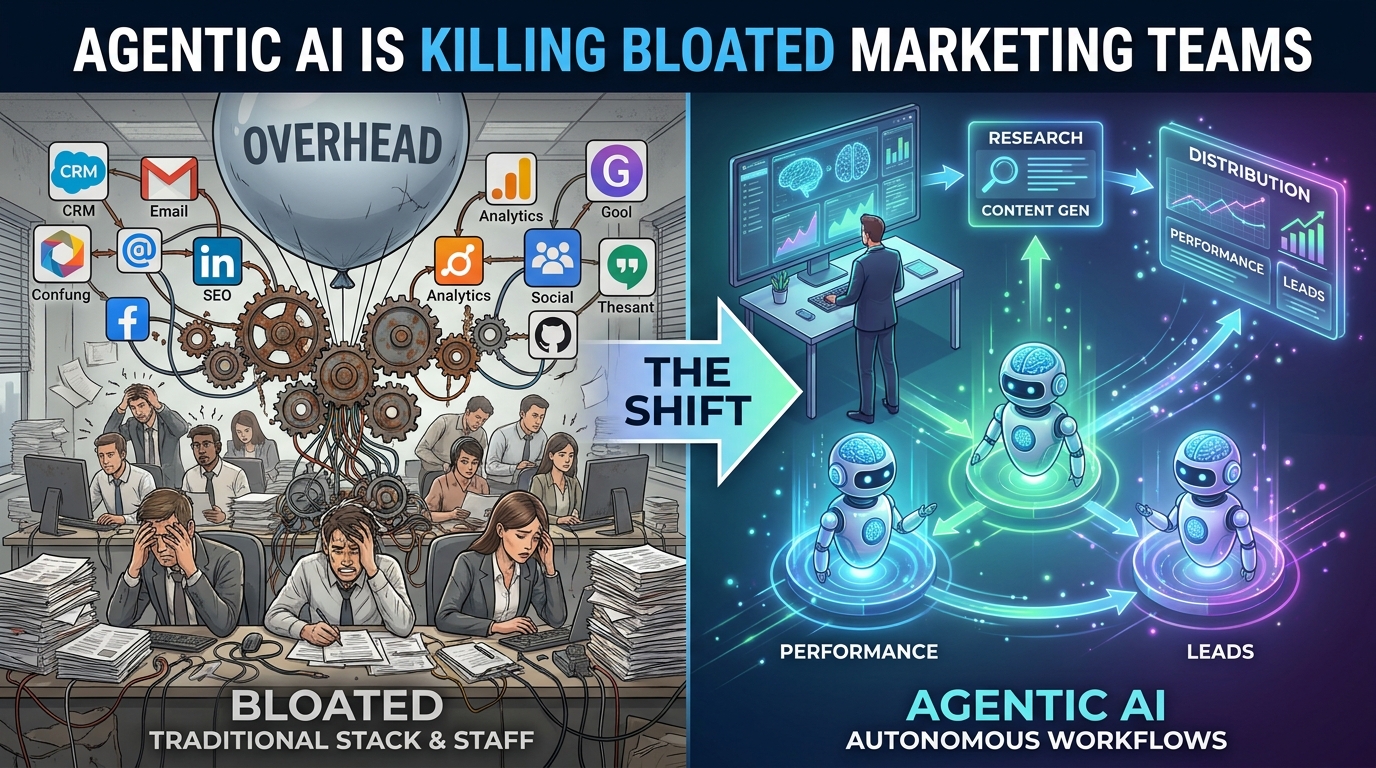
    Agentic AI marketing is replacing the traditional stack-and-staff model that defined B2B marketing for the last decade. This post explains how agentic AI systems differ from standalone tools, why they’re collapsing marketing tech stacks from 15 platforms to 3 autonomous agents, and what that means for content production, team structure, and adapting SEO and lead-gen to AI-native discovery.

    What Agentic AI Actually Means for Marketing Operations

    Agentic AI systems don’t just respond to prompts. They execute multi-step workflows autonomously: researching competitors, drafting content, publishing to CMS platforms, analyzing performance, and iterating without human intervention at each decision point.

    The difference matters for marketing ops. A standard AI tool like ChatGPT waits for your next instruction. An agentic system pulls data from your CRM, identifies accounts showing buying signals, drafts personalized outreach sequences, schedules sends, monitors replies, and routes qualified responses to sales—all from a single triggering event.

    This shift from assistant to operator changes team design. Marketing leaders no longer need specialists to manage each stage of a workflow. They need strategists who can architect agent behavior and QA outputs at scale.

    The Core Capabilities That Define Agentic AI

    Agentic AI marketing platforms integrate three capabilities that standalone tools can’t: autonomous decision-making, tool use, and memory across sessions.

    Autonomous decision-making means the system chooses next steps based on goals, not prompts. If organic traffic drops for a target keyword, the agent decides whether to refresh existing content, create net-new assets, or adjust internal linking—without waiting for a human to diagnose and delegate.

    Tool use means agents can operate your existing stack. They log into analytics platforms, pull performance data, write SQL queries, update spreadsheets, push content to WordPress, send Slack notifications, and trigger Zapier workflows. You’re not copying and pasting between systems.

    Memory across sessions means context persists. An agent tracking a campaign remembers what it tested last week, which variants underperformed, and why it chose the current approach. That continuity replaces the institutional knowledge that used to live in a marketing manager’s head.

    Why Standalone AI Tools Are Already Obsolete

    The 2023–2024 wave of AI adoption centered on point solutions: an AI writing tool here, an image generator there, a chatbot for customer support. That model is collapsing because integration overhead kills the efficiency gains.

    Every standalone tool requires onboarding, login management, data export/import, and manual handoffs between systems. A content marketer using separate tools for ideation, drafting, SEO optimization, image creation, and publishing spends more time managing tools than creating value.

    Agentic systems collapse those handoffs. One agent handles the entire content pipeline because it can access all necessary tools and make decisions about when to use each one. The ROI equation shifts from “does this tool save time on Task X?” to “does this agent eliminate Job Function Y?”

    The Integration Tax Is Higher Than You Think

    Most marketing teams underestimate how much time disappears into tool-switching and context-loading. A demand gen manager might touch 12 platforms in a single campaign: CRM for account lists, enrichment tools for firmographics, ad platforms for targeting, landing page builders, email sequencers, analytics dashboards, and reporting tools.

    Each switch costs cognitive load and manual data transfer. Agentic AI systems don’t eliminate all those platforms overnight, but they drastically reduce how often humans need to touch them. Agents handle the repetitive data movement and status-checking that fills 60–70% of a marketing coordinator’s day.

    That’s why standalone tools feel obsolete once you’ve worked with a functional agent. Going back to manual workflow orchestration feels like returning to fax machines after using email.

    The New Marketing Stack: From 15 Tools to 3 Agents

    The modern B2B marketing stack averages 10–15 platforms: marketing automation, CRM, ad platforms, content management, analytics, SEO tools, social schedulers, design software, and more. Agentic AI marketing doesn’t replace all of these, but it collapses roles and reduces the number of platforms humans actively manage.

    A realistic near-term stack looks like this: one agent for content production (research through publishing), one for demand generation (ad creative, targeting, lead scoring, and nurture), and one for performance monitoring (analytics, attribution, reporting). Each agent uses existing platforms as tools but handles all coordination autonomously.

    This isn’t theoretical. AI workflow automation tools like Relevance AI, Zapier Central, and n8n already let teams build agents that span multiple platforms. The constraint isn’t technology—it’s willingness to redesign processes around agent capabilities instead of retrofitting agents into old workflows.

    What This Means for Hiring and Team Structure

    Smaller teams running agentic systems outperform larger teams running traditional stacks. That’s not a productivity platitude—it’s a structural consequence of removing coordination overhead.

    A five-person team managing three agents can produce more content, run more experiments, and analyze more data than a 15-person team coordinating across specialists. The bottleneck shifts from execution capacity to strategic judgment: what to build, which segments to target, how to position against competitors.

    This creates a hiring inversion. Instead of adding junior coordinators to scale execution, teams hire senior strategists and give them agents that execute at coordinator speed. Compensation concentrates in fewer, more experienced roles.

    How Content Production Scales Without Hiring

    Content has always been a linear scaling problem: double your output, double your headcount. Agentic AI systems break that relationship by automating research, drafting, optimization, and distribution as a continuous workflow.

    An agent assigned to maintain a content cluster can monitor keyword rankings, identify declining posts, analyze top-ranking competitors, draft refreshed content, optimize on-page SEO, update internal links, and republish—completing in hours what used to take a writer and SEO specialist days.

    The quality bar matters here. Early AI content was obvious and low-value. Current agentic systems produce usable first drafts when trained on your brand voice, fed proprietary research, and constrained by detailed briefs. The human role shifts from writing to editing, fact-checking, and injecting perspective that only comes from customer conversations.

    The New Content Workflow

    A functional agentic content workflow starts with strategic direction: which topics, which audience segments, which stage of awareness. The agent handles everything downstream.

    It researches search intent and competitor positioning. It drafts long-form content following your style guide. It generates or sources visuals. It optimizes for target keywords. It formats for your CMS. It schedules publication. It monitors performance and proposes updates based on ranking changes.

    Human intervention happens at two points: approving strategic direction and QA-ing outputs before publication. Everything else runs autonomously. One strategist can oversee content production that previously required a team of four.

    Adapting SEO and Lead-Gen for AI-Native Discovery

    The shift to agentic AI marketing changes how prospects discover and evaluate vendors. AI-powered search and research tools don’t click through ten blue links—they synthesize information and present direct answers.

    That breaks traditional SEO. Ranking #1 for a keyword matters less if ChatGPT Search or Perplexity never surfaces your content in its synthesized answer. The new game is being cited as a source in AI-generated summaries.

    This requires different content signals: structured data markup, clear authorship and expertise indicators, citation-friendly formatting (definitions, comparisons, step-by-step guides), and authoritative backlink profiles that AI systems trust.

    Lead-Gen in an AI-Mediated Buying Process

    B2B marketing AI tools are also changing how prospects engage before contacting sales. Buyers use AI assistants to research vendors, compare features, and draft shortlists—often without visiting your website directly.

    This shifts lead-gen strategy toward being present in the datasets and sources those AI systems query. That means appearing in authoritative directories, earning citations in industry reports, getting mentioned in analyst content, and maintaining detailed, structured product information that AI can parse.

    Gated content and form-fill lead capture lose effectiveness when prospects can get answers from AI without surrendering contact information. The new lead-gen model emphasizes signal-based identification: tracking which accounts show research behavior, even if individuals don’t convert through traditional forms.

    FAQ

    What is agentic AI marketing?
    Agentic AI marketing refers to autonomous AI systems that execute multi-step marketing workflows end-to-end without human intervention at each decision point. Unlike standalone AI tools that respond to individual prompts, agentic systems research, decide, act, and iterate across entire campaigns.

    How does agentic AI differ from marketing automation platforms?
    Traditional marketing automation executes predefined rules you configure (if/then logic). Agentic AI systems make contextual decisions based on goals, adapting their approach as conditions change. They operate existing tools rather than replacing them, functioning as the orchestration layer above your stack.

    Can small marketing teams realistically use agentic AI systems?
    Yes—agentic AI systems are particularly valuable for small teams because they eliminate the coordination overhead that typically requires additional headcount. A three-person team with well-configured agents can match the output of much larger traditional teams, provided they focus on strategy and QA rather than execution.

    What skills do marketers need to work with agentic AI?
    Marketers need strategic thinking (setting goals and success criteria), process design (mapping workflows for agents to execute), and critical evaluation (QA-ing outputs and iterating on agent instructions). Technical implementation often requires some familiarity with API connections and workflow automation platforms, though no-code tools are reducing this barrier.

    How should marketing teams start adopting agentic AI?
    Start with one repetitive, multi-step workflow that currently consumes significant coordinator time—content refresh processes, lead enrichment and scoring, or performance reporting. Build an agent for that single workflow, measure impact, and expand from there rather than attempting to transform your entire operation simultaneously.

    —

    Alington Media helps B2B marketing teams design and implement agentic AI workflows. [Get our weekly breakdown of what’s working in AI marketing automation](https://alingtonmedia.com/newsletter).

  • How DeepSeek V4-Pro Is Reshaping AI Lead Gen Economics

    How DeepSeek V4-Pro Is Reshaping AI Lead Gen Economics

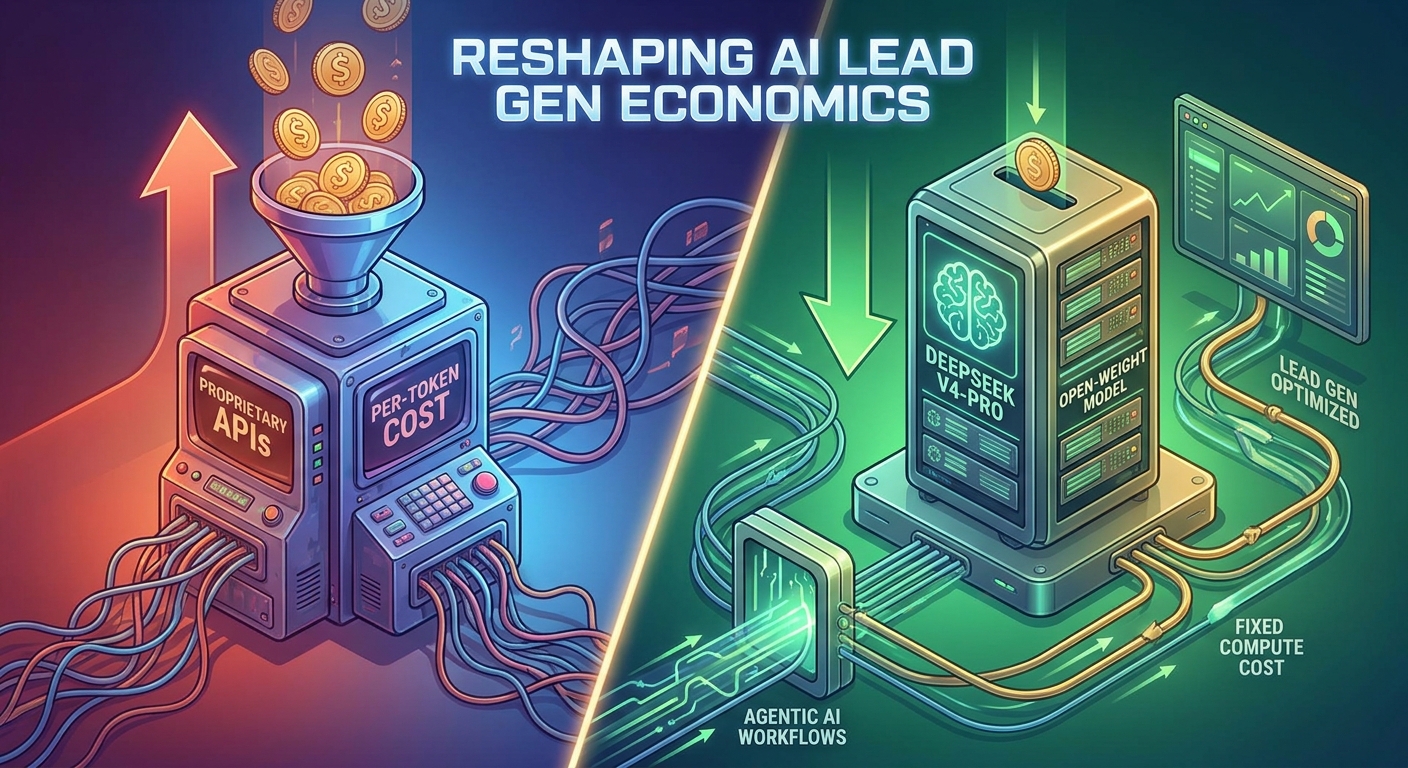
    Open-weight AI models for lead generation are fundamentally changing the cost structure of B2B marketing automation. DeepSeek V4-Pro and similar models now deliver near-proprietary performance at a fraction of the inference cost, enabling marketers to deploy agentic AI systems that execute multi-step workflows without the per-token economics that made automation prohibitive. This post examines what open-weight models are, how DeepSeek V4-Pro compares to closed alternatives, and what B2B teams should consider when implementing these systems for lead generation.

    What Are Open-Weight AI Models?

    Open-weight AI models release their trained parameters publicly, allowing anyone to download, run, and modify them without licensing fees or API rate limits. Unlike open-source software, the training code and data often remain proprietary—only the final weights are shared.

    This distinction matters for marketers. You can host DeepSeek V4-Pro on your own infrastructure or use third-party providers who compete on price. You’re not locked into a single vendor’s API pricing or usage policies.

    The term “open-weight” replaced “open-source” in AI circles because most models don’t meet the Open Source Initiative’s definition. The weights are open; the full training stack usually isn’t.

    Why This Matters for Lead Generation

    Most B2B lead gen workflows involve repetitive tasks: enriching contact data, drafting personalized outreach, scoring leads based on intent signals, summarizing call transcripts. These tasks rack up API costs quickly when you’re processing thousands of records monthly.

    Open-weight models let you run inference locally or on cheaper cloud instances. You pay for compute time, not per token. For high-volume automation, this shifts economics dramatically.

    DeepSeek V4-Pro vs. Proprietary Models

    DeepSeek V4-Pro is a mixture-of-experts model trained by the Chinese AI lab DeepSeek. It activates only a subset of parameters per inference call, reducing compute costs while maintaining competitive accuracy on reasoning and coding benchmarks.

    Performance Comparison

    Independent benchmarks show DeepSeek V4-Pro performs comparably to GPT-4 and Claude 3.5 Sonnet on tasks like structured data extraction, multi-step reasoning, and function calling—all core capabilities for agentic AI systems.

    The model handles tool use natively. It can call APIs, parse responses, and decide next actions without brittle prompt engineering. This makes it suitable for lead gen workflows that require chaining together CRM lookups, web scraping, and email drafting.

    Cost Structure Differences

    Proprietary APIs charge per million tokens. At scale, a lead enrichment pipeline processing 10,000 contacts weekly can cost $500–$2,000 monthly depending on prompt length and model tier.

    With open-weight models, you pay for GPU time. Running DeepSeek V4-Pro on a rented A100 instance costs roughly $1–$3 per hour. Most lead gen batches finish in minutes, dropping monthly costs to double-digit figures for equivalent throughput.

    This cost gap widens as usage scales. For demand gen teams running 24/7 monitoring or real-time lead scoring, the savings compound.

    The Shift to Agentic AI Systems

    Chat-based AI answered questions. Agentic AI executes tasks. This distinction defines the current market shift.

    Agentic systems use models as reasoning engines that decide which tools to invoke, interpret results, and chain actions autonomously. For marketers, this means moving from “ask AI to write an email” to “AI monitors inbound leads, scores them, enriches contact data, drafts personalized outreach, and queues it for review.”

    What Enables Agentic Workflows

    Two technical advances made agentic systems viable: reliable function calling and improved context retention across multi-turn interactions.

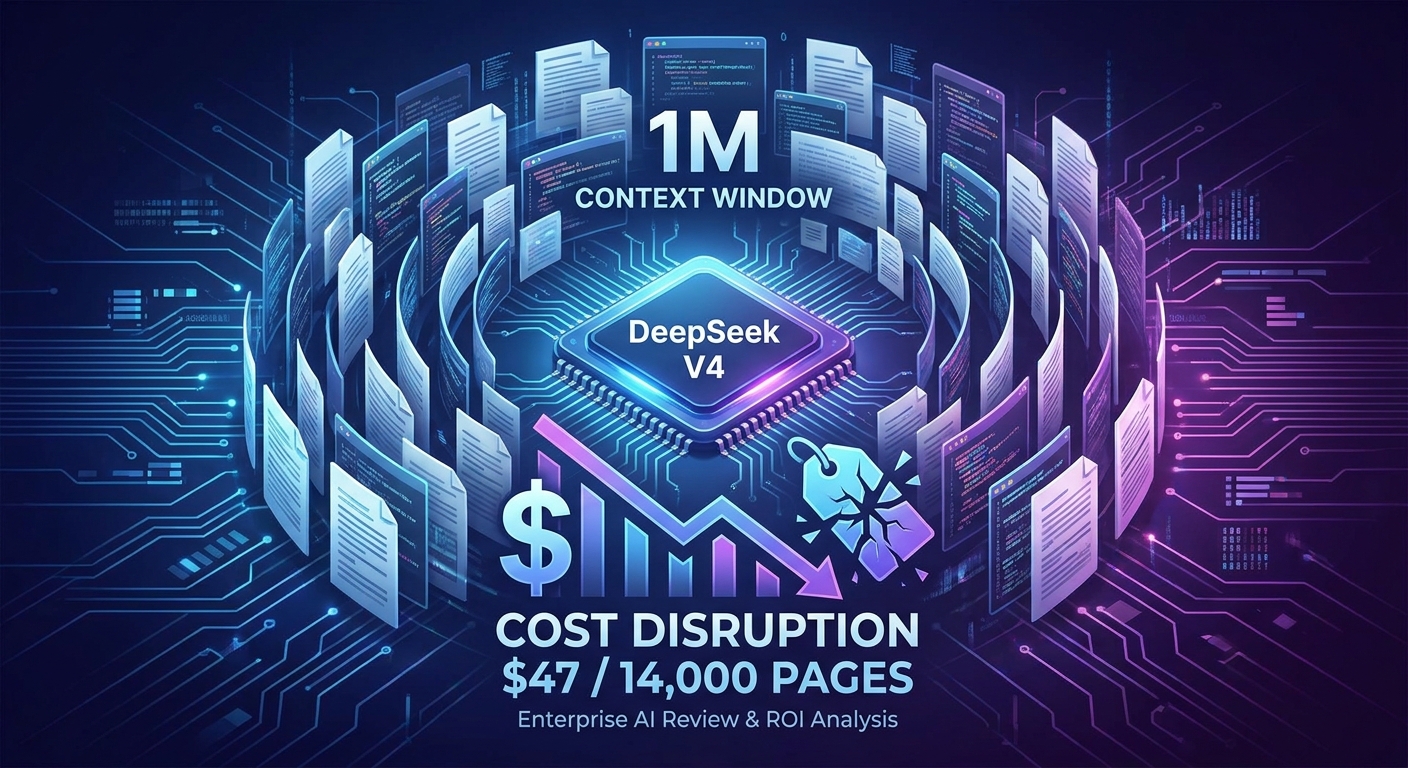
    DeepSeek V4-Pro and similar models ship with native function-calling support. They output structured JSON that directly invokes APIs without parsing hacks. Context windows now exceed 128,000 tokens, letting agents maintain state across dozens of steps.

    These capabilities weren’t reliable 18 months ago. Now they’re table stakes.

    Implications for Lead Generation

    Agentic AI collapses multi-tool workflows into single automated sequences. A typical B2B lead gen process involves CRM queries, intent data lookups, news monitoring, contact enrichment, and outreach drafting—each previously requiring manual handoffs or fragile Zapier chains.

    An agent built on open-weight models can handle this end-to-end, triggering on inbound form fills or intent spikes, executing the full workflow, and surfacing results in Slack or your CRM. Setup takes days, not months. Costs stay fixed as volume grows.

    Cost Impact on B2B Lead Generation

    The economics shift from variable to fixed. Instead of paying per lead processed, you pay for infrastructure and initial setup.

    Breaking Even on Self-Hosted Models

    A mid-market B2B team processing 2,000 leads monthly hits breakeven on self-hosted DeepSeek V4-Pro within weeks. After that, incremental cost per lead approaches zero—just compute amortization.

    Proprietary APIs make sense for low-volume experimentation or unpredictable workloads. For repeatable, high-throughput processes like lead scoring or enrichment, open-weight models deliver 10x–50x cost efficiency.

    Labor Cost Considerations

    Running your own models requires infrastructure expertise. You need someone who understands GPU provisioning, model serving, and observability. For teams without ML engineers, managed open-weight providers like Together AI or Replicate offer middle-ground pricing—still far cheaper than OpenAI or Anthropic APIs.

    The real savings come from automation density. Agentic systems eliminate tasks that previously required human handoffs, reducing operational overhead beyond just model costs.

    Implementation Best Practices

    Start narrow. Pick one repeatable workflow where you process hundreds of similar records monthly: lead enrichment, outreach personalization, or call summarization.

    Build vs. Buy Decision Framework

    Use managed APIs (OpenAI, Anthropic) for prototyping and low-volume workflows under 500 operations monthly. Switch to managed open-weight providers (Together AI, Replicate) once volume crosses 1,000 operations. Consider self-hosting only if you exceed 10,000 monthly operations and have ML infrastructure expertise.

    Most teams overestimate their volume initially. Start with the simplest deployment path, then optimize for cost as usage proves durable.

    Observability and Quality Control

    Agentic systems fail silently. A lead scoring agent might misinterpret intent data or an enrichment workflow might hallucinate contact details. Implement logging at every tool call, track success rates per workflow step, and sample outputs weekly.

    Use structured outputs (JSON schemas) to constrain model responses. Open-weight models support this natively, reducing hallucination risk in high-stakes workflows like CRM updates.

    Data Privacy and Compliance

    Self-hosted models keep data on your infrastructure. This simplifies GDPR and SOC 2 compliance compared to third-party APIs. For industries with strict data residency requirements—healthcare, finance, government—open-weight models may be the only viable path for AI automation.

    Document your data flows and retention policies. Even self-hosted models log inputs for debugging; ensure logs exclude PII or get purged on schedule.

    FAQ

    What is the main advantage of open-weight AI models for lead generation?
    Cost efficiency at scale. Once you process thousands of leads monthly, hosting your own model costs 10x–50x less than proprietary APIs. You also control data privacy and aren’t subject to usage limits or pricing changes.

    How does DeepSeek V4-Pro compare to GPT-4 for B2B marketing tasks?
    DeepSeek V4-Pro matches GPT-4 on structured data extraction, function calling, and multi-step reasoning—the core capabilities for lead gen automation. It lacks GPT-4’s creative writing polish but excels at repeatable, tool-driven workflows where consistency matters more than style.

    What are agentic AI systems?
    Agentic AI systems autonomously execute multi-step tasks by deciding which tools to use, interpreting results, and chaining actions without human intervention. For marketers, this means AI that enriches leads, drafts outreach, and updates CRMs end-to-end rather than just answering questions.

    When should a marketing team self-host an AI model?
    Self-hosting makes sense above 10,000 monthly operations if you have ML infrastructure expertise. Below that threshold, managed open-weight providers like Together AI offer better cost-performance tradeoffs without operational overhead. Start with APIs, optimize for cost as volume scales.

    Are open-weight models safe for sensitive B2B data?
    Yes, when self-hosted. Running DeepSeek V4-Pro on your infrastructure keeps data on-premise, simplifying compliance with GDPR and SOC 2. Ensure you log responsibly, exclude PII from debugging outputs, and document data flows for audits.

    —

    Want practical AI automation insights for B2B teams? Subscribe to Alington Media’s newsletter for implementation guides and market analysis without the hype.

  • Social Algorithms Now Favor AI-Native Content Formats

    Social Algorithms Now Favor AI-Native Content Formats

    Major social platforms are shifting their ranking algorithms to detect and prioritize AI-native content formats—posts and media structured explicitly for machine interpretation, not just human consumption. This means B2B marketers must now optimize for both audience engagement and algorithmic legibility, rebuilding content workflows around structured data, agentic AI systems, and format templates that platforms can parse, categorize, and distribute more effectively.

    How Social Algorithms Detect and Prioritize AI Content

    Social media algorithms have evolved beyond engagement metrics. Platforms now analyze content structure, metadata consistency, and machine-readable formatting to determine distribution potential. AI-native content formats include schema markup in posts, structured JSON-LD annotations, and template-driven media that platforms can automatically categorize.

    LinkedIn, X, and emerging B2B platforms are building detection layers that identify content generated or formatted through agentic AI systems. Rather than penalizing this content, algorithms increasingly reward it—provided it meets structural standards that enable better content understanding and targeting.

    The shift reflects platform economics. Machine-readable content reduces moderation costs, improves ad targeting precision, and enables platforms to build more granular interest graphs. For B2B marketers, this means format choices now carry algorithmic weight equal to messaging quality.

    Why Structured Metadata Matters Now

    Posts with clean metadata structures—topic tags, entity recognition markers, and explicit content type declarations—receive preferential treatment in feed ranking. This isn’t speculation. Platform API documentation increasingly references “content classification confidence scores” that influence distribution.

    B2B content automation tools that output consistent schema markup are becoming table stakes. Marketing teams building in-house workflows should prioritize structured output over natural language variation. The algorithmic advantage comes from parsability, not linguistic creativity.

    Why Platforms Are Rewarding AI-Native Formats

    Platform incentives have shifted from maximizing raw engagement to maximizing monetizable, advertisable moments. AI-native content formats enable better ad insertion, improved content recommendations, and more reliable brand safety controls.

    For B2B LinkedIn strategy, this means carousel posts with structured data fields outperform traditional text-only updates—even when engagement rates are similar. The algorithmic boost comes from format legibility, not audience response. Platforms can confidently insert sponsored content around posts they fully understand.

    AI-generated content that follows platform-preferred templates gains distribution advantages. This doesn’t mean formulaic posting wins. It means marketing teams should reverse-engineer what platforms consider “well-formed content” and build workflows that reliably produce it.

    The Template Economy

    Platforms are quietly building template libraries that guide content creation. LinkedIn’s post composer now suggests structured formats based on topic detection. X’s API documentation reveals preferred JSON structures for thread posts. These aren’t mandatory—yet—but they carry algorithmic weight.

    B2B marketers should treat these templates as content infrastructure. Building workflows around platform-preferred formats is now optimization work, not creative compromise. The distribution upside justifies the structural constraints.

    LinkedIn’s Shift Toward Structured AI Content

    LinkedIn has rebuilt core ranking systems around content categorization confidence. Posts that clearly signal topic, intent, and content type through structured formatting receive measurably better organic reach—even before engagement signals accumulate.

    The platform’s B2B focus makes this shift particularly relevant for marketing teams. LinkedIn can better match structured content with advertiser targeting needs, creating an economic incentive to boost well-formed posts. Company pages and individual accounts using consistent formatting templates report improved baseline impressions.

    This affects B2B content automation strategies directly. Marketing teams using agentic AI systems to generate LinkedIn content should prioritize tools that output platform-native structures. Custom LLM prompts should include template adherence as a primary directive, not an afterthought.

    Practical Implementation

    Marketing ops teams should audit existing content workflows for structural consistency. Are post formats predictable? Do they include clear topic signals? Can platforms easily extract key entities and themes? If not, algorithmic distribution suffers regardless of engagement quality.

    The fix isn’t standardizing all content—it’s ensuring each content type follows a recognizable pattern. Thought leadership posts should have consistent structural elements. Company updates should follow repeatable formats. Product announcements should use schema markup that platforms can parse.

    X and the Rise of Agentic Posting Systems

    X has accelerated toward agentic AI systems that directly publish content based on real-time triggers, workflow events, and context changes. The platform’s API now explicitly supports automated posting from agent systems, with built-in rate limits and verification designed for machine-generated content.

    B2B marketers experimenting with agentic posting should understand X’s algorithmic preferences. Thread posts with structured reply chains receive better distribution than single long-form posts. Media attachments with proper alt-text and metadata fields rank higher than images without machine-readable context.

    The platform is moving toward a model where human and agent-generated content coexist with equal algorithmic treatment—provided agent content meets structural standards. This fundamentally changes content planning. Marketing teams can now build always-on posting systems that respond to external triggers without manual approval loops.

    Building Agent Workflows

    Effective agentic posting systems require context management and output formatting layers that ensure platform compliance. Marketing teams should focus on tool-calling reliability and structured output validation before scaling agent-driven content.

    The operational advantage comes from speed and context awareness, not volume. Agents that can respond to product updates, industry news, or customer conversations in real-time provide competitive advantage—if output quality remains high.

    Rethinking Short-Form Video for AI Workflows

    Short-form video platforms are building algorithmic preference for AI-generated content that follows predictable structural patterns. Template-based video workflows—where scenes, transitions, and text overlays follow consistent schemas—receive algorithmic boosts over highly variable creative approaches.

    For B2B content teams with limited video production resources, this is enabling. AI-native video tools that generate from structured scripts and asset libraries can now compete algorithmically with custom production. The constraint is format adherence, not production budget.

    Marketing teams should evaluate video workflows through an algorithmic lens. Can platforms easily extract key topics? Are text overlays machine-readable? Do video descriptions include structured metadata? These factors increasingly determine distribution potential.

    Implementation Priorities

    Start with template libraries that balance brand consistency with platform requirements. Build content briefs that specify both creative direction and structural formatting needs. Measure distribution performance separately from engagement performance to understand algorithmic impact.

    —

    FAQ

    What are AI-native content formats?
    AI-native content formats are posts, videos, and media designed with structured data, consistent schemas, and machine-readable elements that platforms can easily parse and categorize. They prioritize algorithmic legibility alongside human readability, enabling better platform distribution and targeting.

    Do social algorithms penalize AI-generated content?
    No—major platforms increasingly reward AI-generated content that meets structural quality standards. The key is format consistency, metadata completeness, and template adherence. Platforms penalize low-quality content regardless of generation method, not AI usage itself.

    How should B2B teams adjust LinkedIn strategy for these changes?
    Focus on structured post formats with consistent templates for each content type. Use schema markup where possible, ensure clear topic signals, and build workflows that produce platform-native formatting. Prioritize parsability in content automation tools.

    What are agentic AI systems for content posting?
    Agentic AI systems are autonomous workflows that generate and publish content based on real-time triggers, context changes, or external events without manual approval. They use tool-calling capabilities to directly interact with platform APIs and publishing systems.

    Should marketing teams prioritize algorithmic formatting over creative quality?
    Both matter, but the relationship has changed. Algorithmic formatting is now foundational infrastructure—without it, creative quality can’t reach audiences effectively. Teams should build structured workflows that enable creative execution within platform-preferred formats.

    —

    Ready to rebuild your content workflows for algorithmic advantage? [Subscribe to Alington Media’s newsletter](https://alingtonmedia.com) for weekly B2B AI strategy analysis.

  • Microsoft Copilot Wave 3: AI Agents Transform B2B Sales

    Microsoft Copilot Wave 3: AI Agents Transform B2B Sales

    —

    Microsoft Copilot Wave 3 agents introduce autonomous AI capabilities directly into Excel, Word, and PowerPoint, enabling B2B teams to automate sales reporting, document creation, and marketing operations without custom development. This post examines what these Excel AI agents and Word automation tools mean for revenue teams, how they differ from previous Copilot iterations, and practical implementation paths for marketing operations leaders evaluating Microsoft 365 productivity tools.

    What Microsoft Copilot Wave 3 Brings to B2B Teams

    Microsoft Copilot Wave 3 agents represent a fundamental shift from assisted AI to autonomous execution. Unlike earlier versions that required prompt-by-prompt guidance, these agents can complete multi-step workflows independently once configured.

    The core innovation lies in persistent agent capabilities. Previous Copilot versions operated as stateless assistants—you’d ask for help, receive output, then start fresh next time. Wave 3 agents maintain context across sessions, learn organizational patterns, and execute recurring tasks without human intervention.

    For B2B sales and marketing teams, this translates to autonomous agents marketing ops can deploy for repetitive, high-volume work. A configured agent can monitor data sources, generate reports on schedule, update stakeholder documents, and flag anomalies—all within the familiar Microsoft 365 environment most enterprises already use.

    The integration depth matters here. These aren’t third-party tools bolted onto Office apps. They’re native features accessing the Microsoft Graph, your organization’s permissions structure, and existing workflow infrastructure. That reduces implementation friction compared to standalone automation platforms.

    Excel Agents: Automating Sales Reports and Data Analysis

    Excel AI agents handle the analytical grunt work that consumes hours from revenue operations teams weekly. B2B sales reporting automation now happens through agents that connect to CRM exports, financial systems, and campaign data to produce formatted analyses.

    Configure an agent once to pull pipeline data, calculate conversion metrics, identify trends, and format executive dashboards. It runs that sequence every Monday morning without prompts. The agent applies your organization’s specific calculation logic, terminology, and presentation standards because it learns from examples you provide during setup.

    The practical impact shows up in three areas. First, speed—reports that took analysts three hours now generate in minutes. Second, consistency—the same logic applies every time, eliminating the errors that creep in with manual processes. Third, accessibility—non-technical stakeholders can request custom cuts of data using natural language rather than learning pivot table syntax.

    For marketing operations specifically, Excel agents streamline campaign performance analysis across channels. An agent can consolidate data from advertising platforms, normalize metrics, calculate attribution, and populate performance scorecards. Previously, this required either dedicated analytics resources or marketing ops professionals spending significant time in spreadsheets instead of strategic work.

    The limitation worth noting: these agents work within Excel’s existing capabilities. They don’t create new analytical methods, but they execute established ones reliably and repeatedly. If your current reporting relies on specialized statistical tools or requires processing beyond Excel’s scope, agents won’t replace those systems.

    Word Agents: Streamlining Proposal and Document Creation

    Word automation for marketing addresses the document production bottleneck B2B teams face. Proposals, case studies, sales collateral, and executive briefings all follow templates but require customization for specific prospects, industries, or use cases.

    Wave 3 Word agents generate these documents by pulling relevant content from your knowledge base, adapting messaging to context, and maintaining brand standards. Point the agent to opportunity details in your CRM, specify document type, and it produces a first draft incorporating appropriate customer references, product details, and positioning angles.

    The quality bar has shifted substantially. Earlier AI writing tools produced generic content requiring heavy editing. These agents access your organization’s actual materials—past proposals, approved messaging, customer data—to create output that reflects your specific approach and voice. The editing requirement drops from “rewrite most of this” to “refine and personalize.”

    Marketing teams use Word agents primarily for three workflows. First, sales enablement content that needs prospect-specific customization. Second, internal documentation like campaign briefs or project plans that follow standard structures but vary in details. Third, stakeholder communications that synthesize information from multiple sources into executive-appropriate formats.

    The human role evolves from document assembly to editorial judgment. You’re verifying accuracy, adding strategic insight, and ensuring the right emphasis rather than building documents from scratch. This shift frees capacity for work that genuinely requires human expertise—positioning decisions, relationship building, strategic planning.

    Real-World Impact on Marketing Operations and Revenue Teams

    Microsoft 365 productivity tools with embedded agents change resource allocation for marketing operations. Tasks that previously justified headcount now become automated workflows, pushing the hiring conversation toward strategic roles rather than execution support.

    Revenue teams see the impact in forecast accuracy and pipeline visibility. When sales reporting happens continuously through automated agents rather than weekly manual pulls, leadership has current data for decisions. Deal reviews focus on strategy instead of questioning whether the numbers reflect reality.

    The collaboration dynamic shifts as well. When agents handle routine document production and data preparation, meetings become more productive. Teams discuss what the data means and what actions to take rather than walking through how reports were built or waiting for someone to pull numbers mid-meeting.

    Implementation reality check: the efficiency gains materialize for teams with established processes. If your sales reporting lacks standard methodology, or your document production doesn’t follow templates, agents amplify chaos rather than creating order. The prerequisite work involves documenting how things should work, not just deploying AI and hoping for improvement.

    Implementation Strategy: Getting Started with Copilot Agents

    Starting with Microsoft Copilot Wave 3 agents requires a process-first approach. Identify the repetitive workflows consuming the most time from your marketing ops and revenue teams. Document the exact steps, data sources, and decision logic involved.

    Begin with one high-volume, low-complexity workflow. Weekly pipeline reports or monthly campaign performance dashboards make better starting points than annual strategic plans. Configure the agent using existing examples of correct output. The agent learns your organization’s standards from these training samples.

    Test thoroughly before trusting automation. Run the agent’s output alongside manual processes for several cycles. Verify accuracy, identify edge cases the agent handles poorly, and refine configuration. This parallel operation phase builds confidence and surfaces issues before you rely entirely on automated output.

    Governance matters more with autonomous agents than assisted AI. Define clear ownership for agent oversight, establish review cadences, and create escalation paths when agents encounter situations outside their training. Someone needs responsibility for monitoring what agents produce and updating them as business requirements evolve.

    The licensing consideration: Copilot agents require Microsoft 365 enterprise subscriptions with Copilot add-ons. Calculate ROI based on hours recovered from high-cost resources, not just efficiency gains. If agents free senior marketing ops professionals from ten hours of reporting weekly, that’s strategic capacity worth significantly more than the subscription cost.

    FAQ

    What’s the difference between Copilot Wave 3 agents and previous Copilot versions?
    Previous Copilot versions operated as interactive assistants requiring prompts for each task. Wave 3 agents work autonomously, executing multi-step workflows independently once configured. They maintain context across sessions and can run scheduled tasks without human initiation.

    Do Excel AI agents replace data analysts on B2B teams?
    No, they handle routine report generation and standard analyses, freeing analysts for complex work requiring judgment. Agents execute established analytical processes reliably but don’t create new methodologies or interpret strategic implications. They shift analyst time from production to insight.

    Can Word agents maintain brand voice and messaging standards?
    Yes, when trained on your organization’s approved content and examples. Word agents learn from the materials you provide during configuration, replicating terminology, tone, and structural patterns. Quality depends on the training corpus—better examples produce better output.

    What Microsoft 365 license level is required for Copilot Wave 3 agents?
    Copilot agents require Microsoft 365 E3 or E5 enterprise licenses plus Copilot for Microsoft 365 subscriptions. Availability varies by region and tenant type. Check Microsoft’s licensing documentation for current requirements and pricing, as this continues evolving.

    How long does implementation typically take for a B2B marketing team?
    Initial agent configuration for a single workflow takes 2-4 hours, but effective implementation requires several weeks of parallel operation and refinement. Teams typically see reliable autonomous operation within 4-6 weeks for straightforward workflows. Complex processes with many variables require longer adjustment periods.

    —

    Want implementation guidance tailored to your marketing ops stack? [Contact Alington Media](https://alingtonmedia.com/contact) for a workflow assessment, or subscribe to our newsletter for practical AI automation strategies.

  • Colorado AI Regulation Rollback: A B2B Marketer’s Guide

    Colorado AI Regulation Rollback: A B2B Marketer’s Guide

    Colorado’s recent rollback of its AI regulation framework removes several constraints that directly affected how B2B marketers deploy AI-powered marketing tools and audience targeting systems. This guide breaks down what changed, how it impacts enterprise AI adoption in marketing workflows, and practical steps for implementing compliant B2B targeting strategies under the revised regulatory landscape.

    Understanding Colorado’s AI Regulation Changes

    The Colorado AI regulation initially established strict requirements for algorithmic accountability and automated decision-making systems used in commercial contexts. The framework positioned Colorado as one of the most restrictive states for AI deployment in business operations.

    The rollback eliminates mandatory impact assessments for most B2B marketing applications. Systems that segment audiences, optimize ad delivery, or personalize content no longer trigger the documentation requirements that applied under the original statute. This shifts Colorado closer to the permissive frameworks seen in states without comprehensive AI legislation.

    For marketing teams, the practical change centers on reduced compliance overhead. The original regulation required documented risk assessments whenever AI systems influenced business decisions—a threshold broad enough to capture marketing automation platforms, predictive lead scoring tools, and dynamic content engines.

    What Triggered the Policy Reversal

    Industry pressure from the enterprise software sector drove much of the rollback momentum. Business lobbying groups argued the original Colorado AI regulation created compliance costs that disproportionately affected mid-market companies deploying standard marketing technology stacks.

    The revised approach maintains consumer-facing protections—particularly around credit decisions and employment screening—while carving out exemptions for business-to-business commercial activities. This reflects a national trend toward sector-specific AI governance rather than horizontal regulation.

    State legislators cited concerns about competitive disadvantage as Colorado-based companies faced compliance burdens their out-of-state competitors could avoid. The rollback preserves high-level transparency requirements while removing the granular documentation mandates that complicated routine AI marketing compliance workflows.

    What the Rollback Means for B2B Marketers

    The immediate impact for marketing operations teams is operational flexibility. AI-powered marketing tools that automate audience segmentation, content personalization, and campaign optimization no longer require the detailed audit trails mandated under the original statute.

    This matters most for enterprise AI adoption in marketing departments. Teams that delayed implementing AI agents for content generation, predictive analytics, or conversational interfaces can now proceed without navigating Colorado-specific compliance frameworks that diverged from federal standards.

    The rollback doesn’t eliminate all oversight. Data privacy laws—both Colorado-specific and federal—still govern how marketers collect, process, and deploy customer information. The change specifically removes AI-centric requirements that added a second layer of compliance on top of existing privacy obligations.

    Implications for Marketing Technology Selection

    Vendor evaluation criteria can simplify. Under the original Colorado AI regulation, enterprise buyers needed to verify whether their marketing platforms included Colorado-specific compliance features—documentation exports, bias testing modules, algorithmic explainability tools.

    Marketing technology vendors that built Colorado-specific features may now deprecate those capabilities or reposition them as optional premium offerings. This could reduce licensing costs for enterprise marketing suites where Colorado compliance drove feature requirements.

    The competitive landscape for AI marketing compliance tools shifts. Point solutions built specifically to satisfy Colorado’s documentation requirements lose their regulatory value proposition. Expect consolidation among vendors whose primary differentiation was Colorado compliance automation.

    Compliant Targeting Opportunities in the New Landscape

    The rollback creates space for more aggressive B2B targeting strategies using AI-powered segmentation. Marketing teams can deploy lookalike modeling, behavioral prediction, and intent signal processing without triggering impact assessment requirements.

    Lookalike audience expansion—where AI identifies prospects similar to existing customers—was previously complicated by questions about whether the underlying models required documentation. The revised framework treats these as standard commercial tools outside the regulation’s scope.

    Predictive lead scoring benefits similarly. AI models that rank prospects based on conversion likelihood, engagement patterns, or firmographic attributes now operate without the compliance overhead that made some teams hesitant to deploy these capabilities.

    Advanced Segmentation Without Regulatory Friction

    Behavioral clustering using AI can proceed more freely. Marketing teams building micro-segments based on content consumption patterns, website behavior, or product interaction signals face fewer questions about whether their segmentation logic requires regulatory documentation.

    Intent data processing becomes more straightforward. Third-party intent signals—behavioral indicators that suggest purchase readiness—can feed AI models that prioritize accounts and personalize outreach without navigating Colorado-specific compliance questions.

    Cross-channel orchestration using AI decisioning engines simplifies. Systems that automatically determine which channel, message, and timing to use for each prospect based on historical performance data no longer sit in a regulatory gray zone under Colorado law.

    Leveraging Enterprise AI Tools for Marketing Advantage

    Microsoft’s integration of Claude Opus 4.7 into Copilot represents the enterprise AI adoption trend accelerating across B2B workflows. Marketing teams gain access to more capable AI agents embedded directly into their daily tools—document creation, data analysis, strategic planning.

    These enterprise AI integrations matter more in a post-rollback environment. Marketing operations teams can deploy AI agents for campaign planning, content generation, and performance analysis without layering Colorado-specific governance processes onto their workflows.

    The OpenAI Daybreak launch for AI-powered vulnerability detection signals another dimension: security-focused AI tools that help marketing teams identify risks in their technology stacks. As AI adoption accelerates, security and compliance tooling specifically designed for AI systems becomes increasingly relevant.

    Practical Applications for Marketing Teams

    Content generation at scale becomes more viable. AI tools that draft email sequences, landing page copy, social posts, and blog outlines can integrate into production workflows without teams questioning whether their AI usage triggers compliance obligations unique to Colorado.

    Campaign optimization through reinforcement learning gains traction. AI systems that continuously test message variants, audience segments, and channel mixes—then automatically allocate budget toward winning combinations—operate more cleanly under the revised regulatory framework.

    Conversational AI for demand generation expands. Chatbots and voice agents that qualify leads, answer product questions, and route inquiries can deploy with fewer compliance concerns specific to AI decision-making under Colorado law.

    Implementing Your Compliant B2B Targeting Strategy

    Start with a technology audit. Identify which AI-powered marketing tools your team currently uses or plans to adopt. Categorize them by function: audience targeting, content generation, predictive analytics, conversational interfaces, campaign optimization.

    Evaluate whether Colorado-specific compliance features in your current tools remain necessary. If vendors built specialized capabilities to satisfy the original regulation, determine whether you’re paying for features that no longer provide regulatory value.

    Document your B2B targeting strategies using privacy-first frameworks. While Colorado’s AI-specific requirements rolled back, data privacy obligations remain. Ensure your targeting logic complies with applicable privacy laws regardless of the AI regulation status.

    Building a Future-Proof Framework

    Implement voluntary transparency practices even when not required. The regulatory pendulum may swing back. Teams that maintain documentation of how their AI systems make decisions, what data they use, and how they monitor for unintended outcomes build resilience against future regulatory changes.

    Train marketing teams on AI marketing compliance principles that transcend specific state regulations. Understanding bias risks, data provenance, and algorithmic transparency creates better marketers regardless of the legal requirements in any particular jurisdiction.

    Establish vendor due diligence processes that include AI governance questions. When evaluating new AI-powered marketing tools, ask vendors how they approach bias testing, data handling, and transparency—even if current regulations don’t mandate these practices.

    Monitoring the Regulatory Environment

    Track developments in other states pursuing AI regulation. California, New York, and several other jurisdictions are considering frameworks that may resemble Colorado’s original approach. National legislation remains possible, which could supersede state-level rollbacks.

    Watch for industry-specific guidance. Trade associations in the marketing technology sector may develop voluntary standards for responsible AI deployment in B2B marketing contexts. Adopting these practices proactively can ease future compliance efforts.

    Stay connected to your legal and compliance teams. The Colorado AI regulation rollback doesn’t eliminate all AI-related legal considerations. Privacy laws, intellectual property questions around AI-generated content, and contractual obligations in vendor agreements all require ongoing attention.

    Frequently Asked Questions

    Does the Colorado AI regulation rollback affect data privacy compliance?
    No. The rollback specifically removes AI-centric documentation and impact assessment requirements. All existing data privacy obligations under Colorado privacy law and other applicable regulations remain in full effect. Your data handling practices should not change based solely on the AI regulation rollback.

    Can we now use AI for targeting without any restrictions in Colorado?
    The rollback removes Colorado’s specific AI regulation requirements, but other laws still apply. Federal regulations, industry-specific rules, and general privacy laws continue to govern how you collect and use data for targeting. The change eliminates an additional compliance layer specific to AI systems, not all restrictions.

    Should we remove Colorado compliance features from our marketing technology stack?
    Evaluate whether these features provide value beyond regulatory compliance. Many AI governance capabilities—bias monitoring, decision documentation, transparency tools—serve operational purposes even when not legally required. Consider whether these features improve your marketing effectiveness or risk management before removing them.

    How does this impact our AI vendor contracts?
    Review contracts with marketing technology vendors to determine if you’re paying for Colorado-specific compliance features. Some vendors may have charged premium pricing for specialized capabilities. You may have grounds to renegotiate if you’re paying for features built specifically to satisfy regulations that no longer exist.

    What’s the risk of implementing more aggressive AI targeting now?
    The regulatory landscape remains fluid. Implementing targeting strategies solely because Colorado rolled back its regulation carries risk if other jurisdictions adopt similar frameworks or federal legislation emerges. Focus on strategies that deliver business value and align with ethical AI principles rather than simply maximizing what’s legally permissible.

    —

    Want guidance on navigating AI compliance for your B2B marketing operations? [Contact Alington Media](https://alingtonmedia.com/contact) to discuss how we help enterprise marketing teams deploy AI responsibly while maximizing competitive advantage.

  • Zapier AI vs Make.com: Scale B2B Marketing Without Devs

    Zapier AI vs Make.com: Scale B2B Marketing Without Devs

    Workflow automation for B2B marketing has split into two camps: Zapier AI’s proactive assistant approach and Make.com’s visual workflow builder. This guide compares both platforms for marketing ops teams, explains five ready-to-deploy workflows, and shows when AI assistants deliver better ROI than fragmented no-code tools.

    Why Marketing Ops Need No-Code Automation Now

    Marketing teams waste 14+ hours weekly on data transfers between CRM, email platforms, and analytics tools. Workflow automation for B2B marketing eliminates this drag without engineering resources.

    The shift accelerated in early 2026. Google’s Gemini ecosystem expansion—including Flash-Lite models and seamless chat imports—pushed enterprises toward proactive AI assistants instead of brittle point-to-point integrations. Marketing ops leaders now choose between visual workflow builders and conversational automation.

    Both no-code marketing automation approaches work. The right choice depends on team structure, technical comfort, and workflow complexity. Most B2B marketing operations teams need both.

    Zapier AI vs Make.com: Key Differences for B2B Teams

    Zapier AI Automation: The Proactive Assistant Model

    Zapier AI introduces a conversational interface where you describe what you want. The system generates multi-step workflows, suggests optimizations, and monitors execution. You’re not dragging boxes on a canvas—you’re delegating to an AI marketing assistant.

    This matters for time-strapped marketing ops managers. Instead of mapping every conditional branch, you say “when a lead hits 75+ engagement score, notify sales and add them to the enterprise nurture sequence.” Zapier AI builds the workflow, proposes error handling, and flags edge cases you didn’t consider.

    The tradeoff: less granular control than visual builders. For straightforward B2B marketing operations tasks—lead routing, notification triggers, data syncs—Zapier AI gets you live faster.

    Make.com Workflows: The Visual Builder Approach

    Make.com gives you a flowchart interface with modules, routers, and filters. You see every data transformation step. Complex workflows with nested conditionals, iterators, and API transformations are easier to visualize and debug.

    Marketing ops teams with technical backgrounds prefer Make.com for intricate workflows. Think multi-touch attribution models, custom lead scoring with weighted inputs, or syncing fragmented data across six platforms with transformation rules.

    Make.com also costs less at scale. After 1,000+ automation runs monthly, Make.com’s pricing structure beats Zapier’s task-based model. For high-volume B2B marketing operations, this gap matters.

    The Real Difference: Delegation vs Control

    Zapier AI automation optimizes for speed and accessibility. Make.com workflows optimize for precision and complexity. Most marketing teams eventually use both: Zapier AI for routine tasks, Make.com for sophisticated pipelines.

    5 High-Impact Workflows You Can Build Today

    1. Intent Signal to Sales Notification

    Monitor prospect behavior across web visits, content downloads, and email engagement. When combined activity crosses your threshold, trigger Slack alerts with context and next-best-action recommendations.

    Both platforms handle this easily. Zapier AI builds it conversationally in minutes. Make.com gives you finer control over scoring logic and conditional routing by account tier.

    2. Webinar Registration to Multi-Channel Nurture

    Registrant submits form → add to CRM → tag by industry → send confirmation email → schedule three-part nurture sequence → notify account owner if enterprise domain → add to retargeting audience.

    This seven-step workflow runs automatically. Make.com’s visual builder makes the branching logic transparent. Zapier AI’s approach: describe the flow, let the system construct it.

    3. Demo Request Enrichment and Routing

    Inbound demo request → enrich with firmographic data → score based on ICP fit → route to appropriate sales rep by territory and deal size → log activity in CRM → trigger personalized email sequence.

    No-code marketing automation eliminates the gap between form submission and sales contact. Make.com handles complex territory rules elegantly. Zapier AI gets simpler routing logic live faster.

    4. Content Engagement Scoring Pipeline

    Track email opens, link clicks, PDF downloads, and page visits. Aggregate weekly engagement scores per contact. Trigger alerts when prospects re-engage after dormancy or when accounts show buying committee expansion.

    Make.com’s iterator and aggregator functions shine here. Zapier AI requires less upfront technical planning but offers fewer transformation options for complex scoring models.

    5. Monthly Reporting Automation

    Pull campaign metrics from Google Ads, LinkedIn, HubSpot, and analytics platforms. Consolidate in Google Sheets or Data Studio. Format, calculate month-over-month changes, and distribute via Slack and email.

    Both platforms connect to major B2B marketing operations tools. Make.com gives you more data transformation control. Zapier AI’s natural language setup reduces configuration time.

    When AI Assistants Beat Fragmented Tools

    The 2026 shift toward AI marketing assistants reflects a deeper change. Marketing ops teams are drowning in tool sprawl—separate platforms for email, ads, CRM, analytics, enrichment, and reporting.

    Proactive AI assistants like Zapier AI don’t just connect tools. They monitor patterns, suggest optimizations, and surface anomalies without manual dashboard checking. Instead of logging into six platforms daily, you receive intelligent alerts when something needs attention.

    Google’s Gemini ecosystem expansion validates this direction. Flash-Lite models offer enterprise-grade natural language understanding at consumer-friendly latency. The technical barriers to conversational automation dropped dramatically in early 2026.

    For B2B marketing operations teams, this means reassessing your tool stack. Do you need separate point solutions plus complex glue code? Or can a proactive assistant handle routine workflows while you focus on strategy?

    The answer isn’t either-or. Sophisticated Make.com workflows handle complex data pipelines. Zapier AI automation tackles the 80% of repetitive tasks that don’t require custom logic. The combination delivers more leverage than either alone.

    The Build vs Buy Calculation Shifts

    Traditional workflow automation for B2B marketing required mapping every scenario upfront. AI assistants flip this—you describe the outcome, the system figures out the steps.

    This changes make-or-buy decisions. Tasks that previously required developer time now take minutes. Marketing ops managers gain autonomy without ticket queues or sprint planning.

    The constraint shifts from technical capability to strategic clarity. What outcomes matter? Which workflows drive revenue? Where does manual work create bottlenecks? Answer these questions clearly, and both platforms deliver.

    Getting Started: Your First Automated Workflow

    Start with one high-frequency, low-complexity task. Lead routing, sales notifications, or weekly report distribution work well.

    Choose Zapier AI if your team lacks technical depth or needs fast deployment. Choose Make.com if you have ops engineers or require complex data transformations.

    Map your current manual process. Identify the trigger event, required actions, and success criteria. Both platforms offer templates for common B2B marketing operations workflows—customize rather than building from scratch.

    Test with a subset of data before full rollout. Monitor for edge cases. Iterate based on actual behavior, not theoretical scenarios.

    Most marketing teams underestimate automation’s compound impact. One workflow saves three hours weekly. Ten workflows reclaim two full workdays. The ROI isn’t linear—it’s exponential as you chain workflows together.

    The barrier isn’t technical anymore. It’s organizational—getting stakeholders aligned on which processes to automate first and what success looks like.

    FAQ

    What’s the main difference between Zapier AI and Make.com for marketing automation?
    Zapier AI uses conversational interfaces where you describe desired outcomes and the system builds workflows automatically. Make.com provides a visual flowchart builder with granular control over every step and data transformation.

    Can non-technical marketing managers use these platforms effectively?
    Yes. Zapier AI requires no technical background—you describe what you want in plain language. Make.com has a steeper learning curve but offers extensive templates and documentation that non-engineers can follow with some investment in learning the interface.

    Which platform is more cost-effective for high-volume B2B marketing operations?
    Make.com typically costs less once you exceed 1,000+ automation runs monthly due to its operations-based pricing model. Zapier uses task-based pricing that scales faster at high volumes, though Zapier AI’s efficiency gains may offset the difference.

    Do I need to choose one platform exclusively?
    No. Many B2B marketing operations teams use both—Zapier AI for straightforward, high-frequency tasks and Make.com for complex workflows requiring detailed data transformations or sophisticated conditional logic.

    How long does it take to see ROI from marketing automation workflows?
    Most teams reclaim 10+ hours weekly within 30 days of implementing their first three workflows. The compound effect accelerates as you chain workflows together and eliminate repetitive handoffs between tools.

    —

    Ready to scale your B2B marketing operations without engineering dependencies? [Contact Alington Media](https://alingtonmedia.com/contact) to audit your workflow automation opportunities.

  • GPT-5.4 Computer Use Automates B2B Marketing Workflows

    GPT-5.4 Computer Use Automates B2B Marketing Workflows

    —

    OpenAI’s GPT-5.4 Computer Use and Tool Search capabilities now enable B2B marketers to automate complex, multi-step workflows that previously required human oversight at every stage. With hallucinations reduced by 52.5% on high-stakes topics, this release marks the first time AI can reliably produce compliant content for regulated industries like finance, legal, and healthcare—transforming GPT-5.4 computer use B2B marketing applications from experimental to production-ready.

    What GPT-5.4 Computer Use and Tool Search Mean for Marketers

    GPT-5.4’s Computer Use feature allows the model to interact directly with software interfaces, executing tasks across multiple platforms without API integrations. For marketing teams, this means AI can now navigate CRMs, content management systems, analytics dashboards, and design tools autonomously.

    Tool Search extends this capability by letting the model identify and deploy the right function from large tool libraries. Instead of manually selecting which automation to trigger, marketers define outcomes—the AI determines the execution path.

    Together, these features enable true workflow automation. ChatGPT enterprise workflows can now span prospect research, content drafting, compliance review, distribution, and performance tracking without manual handoffs between systems.

    The Technical Architecture Behind Computer Use

    Computer Use operates through visual recognition and interface interaction, similar to how a human user navigates software. The model captures screenshots, identifies UI elements, and executes mouse and keyboard actions to complete tasks.

    This differs fundamentally from API-based automation. Where APIs require custom integrations for each platform, Computer Use works with any visual interface a human could operate—dramatically expanding the scope of AI marketing automation possibilities.

    52.5% Hallucination Reduction: The Compliance Breakthrough

    According to OpenAI’s technical release documentation, GPT-5.5 Instant (now ChatGPT’s default model) reduces hallucinations by 52.5% on medical, legal, and financial topics compared to GPT-4. This improvement directly addresses B2B marketing’s most persistent AI adoption barrier: trust in regulated content.

    Prior generations required human fact-checking on every output touching compliance-sensitive topics. That verification bottleneck made AI marketing automation cost-prohibitive for industries where errors carry legal or reputational consequences.

    The hallucination reduction changes the economics. Marketing teams can now deploy AI for first-draft generation in contexts where accuracy isn’t negotiable, shifting human effort from creation to strategic review.

    What “Compliant AI Content” Actually Means

    Compliant AI content doesn’t mean unreviewed AI output. It means AI-generated material that passes internal compliance workflows at rates comparable to human-drafted content—typically 85%+ approval after standard review.

    For B2B content automation in regulated verticals, this threshold determines whether AI accelerates or burdens workflows. GPT-5.4’s accuracy improvements push pass-rates into viable territory for the first time.

    Automated B2B Marketing Workflows in Action

    Marketing teams are implementing GPT-5.4 computer use B2B marketing workflows across three primary categories: research and intelligence gathering, content production pipelines, and campaign operations.

    Research workflows now run autonomously from trigger to deliverable. AI can monitor competitor websites, extract positioning changes, analyze messaging shifts, compile comparative intelligence reports, and route findings to relevant team members—all without human intervention between stages.

    Content production benefits most dramatically. AI drafts blog posts, pulls supporting data from approved sources, formats content in the CMS, generates social variants, schedules distribution, and monitors early performance metrics. Human involvement concentrates on strategic direction and final approval.

    Campaign operations automation handles repetitive coordination tasks: updating audience segments based on behavioral triggers, adjusting bid strategies across platforms when performance thresholds are met, and generating performance summaries for stakeholder review.

    Industry-Specific Applications: Finance, Legal, and Medical Content

    Financial services marketing teams use GPT-5.4 for regulatory-compliant thought leadership. The model drafts explainer content on complex products, cites relevant regulations accurately, and maintains required disclosure language—tasks that previously consumed disproportionate legal review time.

    Legal marketing applications focus on case study development and practice area content. AI extracts key details from public court records, structures narratives around client outcomes, and ensures attorney advertising compliance across jurisdictions.

    Medical and healthcare marketing remains the highest-stakes application. AI generates patient education materials, provider-facing clinical content, and condition awareness campaigns while maintaining accuracy on treatment protocols and outcome statistics.

    Risk Management in Regulated Content

    Even with hallucination reduction, no B2B marketing team should publish AI-generated regulated content without expert review. The workflow improvement comes from better first drafts, not elimination of oversight.

    Smart implementation pairs AI content generation with structured review checklists, automated compliance scanning tools, and clear accountability for final approval. AI marketing automation accelerates production; human expertise ensures accuracy.

    Implementation Roadmap for Marketing Teams

    Start with low-risk, high-volume workflows where AI errors create minimal consequences. Social media scheduling, performance reporting, and competitive monitoring offer immediate value with contained downside.

    Expand to content drafting for non-regulated topics once your team understands the model’s patterns and limitations. Blog posts, email newsletters, and internal documentation build confidence before tackling compliance-sensitive material.

    Phase in regulated content production only after establishing robust review processes. Document your compliance workflow, train reviewers on common AI errors in your domain, and maintain human accountability for published material.

    Measure time-to-completion and revision rates at each phase. Successful ChatGPT enterprise workflows should demonstrate 40-60% time savings with comparable or better quality metrics than fully manual processes.

    —

    FAQ

    What makes GPT-5.4 Computer Use different from previous AI marketing tools?
    Computer Use can interact directly with software interfaces rather than requiring API integrations, enabling automation across platforms that previously couldn’t connect. This eliminates technical barriers that limited earlier AI marketing automation implementations.

    Is AI-generated content truly compliant for regulated industries?
    AI-generated content can meet compliance standards when properly reviewed, but it requires human expert verification before publication. The 52.5% hallucination reduction means higher-quality first drafts, not elimination of oversight requirements.

    What workflows should B2B marketing teams automate first?
    Begin with research and reporting workflows where errors are easily caught and consequences are minimal. Social monitoring, competitive intelligence, and performance reporting offer quick wins while teams learn the technology’s capabilities and limitations.

    How does Tool Search improve marketing automation?
    Tool Search allows AI to select the right automation from available options based on context, rather than requiring humans to manually specify which tool to use for each task. This reduces the expertise needed to orchestrate complex workflows.

    What resources do teams need to implement GPT-5.4 workflows?
    Teams need ChatGPT Enterprise or API access, documented processes for current manual workflows, and designated staff with both marketing expertise and enough technical comfort to iterate on AI prompts and review outputs critically.

    —

    Want to explore how GPT-5.4 computer use can transform your B2B marketing operations? [Subscribe to Alington Media’s weekly AI marketing briefing](https://alingtonmedia.com/newsletter) for implementation frameworks and case analysis.

  • DeepSeek V4 Review: 1M Context Window Cost Disruption

    DeepSeek V4 Review: 1M Context Window Cost Disruption

    A Fortune 500 manufacturing company processed three years of supplier contracts—14,000 pages of unstructured legal text—in a single API call last month. Total cost: $47. The processing time: 8 minutes. This wasn’t a research experiment. It was a production deployment of DeepSeek V4 enterprise AI, and it represents the most significant pricing disruption in the enterprise AI market since GPT-3 launched in 2020.

    While OpenAI, Google, and Anthropic compete on feature parity and governance frameworks, DeepSeek’s V4 model has introduced a fundamentally different value proposition: production-grade performance at 1/20th the cost. For B2B organizations evaluating AI coding tools comparison metrics and calculating enterprise AI adoption costs, this changes the ROI equation entirely.

    This review examines DeepSeek V4 through the lens of enterprise deployment: technical capabilities, real-world limitations, cost structures, and strategic positioning against incumbent platforms.

    DeepSeek V4 Technical Specifications Overview

    Core Architecture and Capabilities

    DeepSeek V4 launched in March 2026 with specifications that challenge the assumption that frontier AI capabilities require frontier pricing:

    Model Parameters: 236 billion total parameters with a Mixture-of-Experts (MoE) architecture activating 21 billion parameters per token. This design delivers GPT-4-class performance while maintaining inference efficiency comparable to models one-tenth its size.

    Context Window: 1 million tokens (approximately 750,000 words or 3,000 pages of text). This represents a 4x improvement over GPT-4 Turbo’s 128K context and matches Google’s Gemini 1.5 Pro, positioning it among production-grade AI systems capable of processing entire codebases, regulatory document sets, or multi-quarter business records in single sessions.

    Supported Modalities: Text-only input and output. Unlike GPT-4V or Gemini’s multimodal capabilities, V4 focuses exclusively on language processing. This limitation is strategic—keeping infrastructure costs low while addressing the 80% of enterprise use cases that don’t require image or audio processing.

    Training Data Cutoff: December 2025, making it current enough for contemporary business context while avoiding the hallucination risks associated with real-time data retrieval.

    Performance Benchmarks at Launch

    DeepSeek published third-party validated benchmarks across five enterprise-relevant categories:

    – MMLU (general knowledge): 87.3% (vs GPT-4: 86.4%, Claude 3.5: 88.7%)
    – HumanEval (code generation): 84.1% (vs GPT-4: 67.0%, Claude 3.5: 92.0%)
    – GSM8K (mathematical reasoning): 91.7% (vs GPT-4: 92.0%, Claude 3.5: 95.0%)
    – DROP (reading comprehension): 83.5% (vs GPT-4: 80.9%, Claude 3.5: 87.2%)
    – Legal contract analysis (custom benchmark): 78.3% accuracy with 4.2% hallucination rate

    These numbers position DeepSeek V4 solidly in the “good enough for most enterprise workflows” category—not best-in-class across all dimensions, but competitive where it matters for B2B AI automation ROI.

    API and Integration Infrastructure

    Enterprise deployment requires more than raw model performance. DeepSeek V4 ships with:

    – REST and WebSocket APIs with OpenAI-compatible endpoints (drop-in replacement for existing integrations)
    – Function calling for agent workflows and tool use
    – Structured output mode guaranteeing valid JSON responses (critical for production systems)
    – Batch processing API with 50% cost reduction for non-real-time workloads
    – Fine-tuning capabilities supporting custom datasets up to 100,000 examples

    The OpenAI compatibility is strategically significant. Organizations can test DeepSeek V4 against existing GPT-4 workflows by changing a single environment variable, reducing evaluation friction from weeks to hours.

    1M Context Window: Enterprise Use Cases and Limitations

    High-Value Applications in Production Environments

    The 1M context window AI capability transforms specific enterprise workflows from technically impossible to economically viable:

    **Complete