
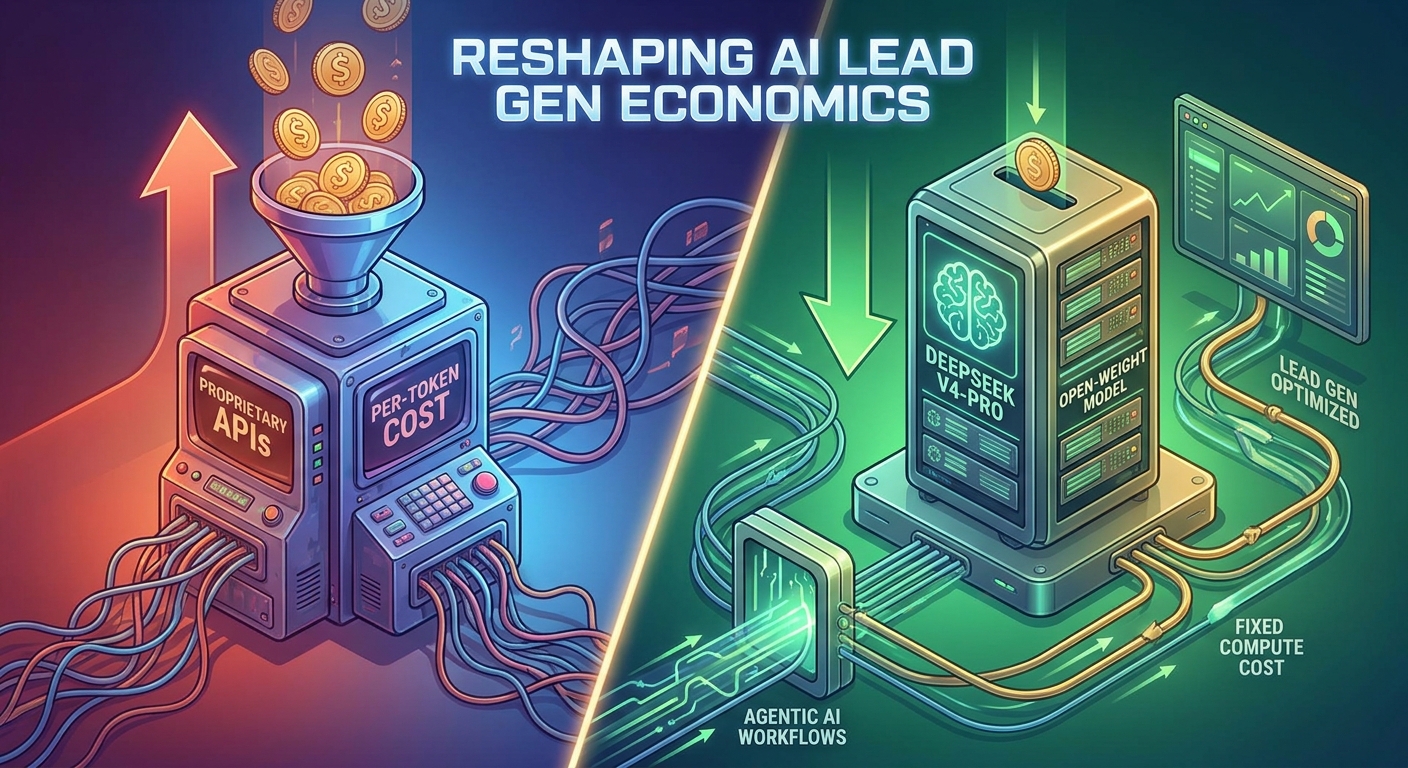
Open-weight AI models for lead generation are fundamentally changing the cost structure of B2B marketing automation. DeepSeek V4-Pro and similar models now deliver near-proprietary performance at a fraction of the inference cost, enabling marketers to deploy agentic AI systems that execute multi-step workflows without the per-token economics that made automation prohibitive. This post examines what open-weight models are, how DeepSeek V4-Pro compares to closed alternatives, and what B2B teams should consider when implementing these systems for lead generation.
What Are Open-Weight AI Models?
Open-weight AI models release their trained parameters publicly, allowing anyone to download, run, and modify them without licensing fees or API rate limits. Unlike open-source software, the training code and data often remain proprietary—only the final weights are shared.
This distinction matters for marketers. You can host DeepSeek V4-Pro on your own infrastructure or use third-party providers who compete on price. You’re not locked into a single vendor’s API pricing or usage policies.
The term “open-weight” replaced “open-source” in AI circles because most models don’t meet the Open Source Initiative’s definition. The weights are open; the full training stack usually isn’t.
Why This Matters for Lead Generation
Most B2B lead gen workflows involve repetitive tasks: enriching contact data, drafting personalized outreach, scoring leads based on intent signals, summarizing call transcripts. These tasks rack up API costs quickly when you’re processing thousands of records monthly.
Open-weight models let you run inference locally or on cheaper cloud instances. You pay for compute time, not per token. For high-volume automation, this shifts economics dramatically.
DeepSeek V4-Pro vs. Proprietary Models
DeepSeek V4-Pro is a mixture-of-experts model trained by the Chinese AI lab DeepSeek. It activates only a subset of parameters per inference call, reducing compute costs while maintaining competitive accuracy on reasoning and coding benchmarks.
Performance Comparison
Independent benchmarks show DeepSeek V4-Pro performs comparably to GPT-4 and Claude 3.5 Sonnet on tasks like structured data extraction, multi-step reasoning, and function calling—all core capabilities for agentic AI systems.
The model handles tool use natively. It can call APIs, parse responses, and decide next actions without brittle prompt engineering. This makes it suitable for lead gen workflows that require chaining together CRM lookups, web scraping, and email drafting.
Cost Structure Differences
Proprietary APIs charge per million tokens. At scale, a lead enrichment pipeline processing 10,000 contacts weekly can cost $500–$2,000 monthly depending on prompt length and model tier.
With open-weight models, you pay for GPU time. Running DeepSeek V4-Pro on a rented A100 instance costs roughly $1–$3 per hour. Most lead gen batches finish in minutes, dropping monthly costs to double-digit figures for equivalent throughput.
This cost gap widens as usage scales. For demand gen teams running 24/7 monitoring or real-time lead scoring, the savings compound.
The Shift to Agentic AI Systems
Chat-based AI answered questions. Agentic AI executes tasks. This distinction defines the current market shift.
Agentic systems use models as reasoning engines that decide which tools to invoke, interpret results, and chain actions autonomously. For marketers, this means moving from “ask AI to write an email” to “AI monitors inbound leads, scores them, enriches contact data, drafts personalized outreach, and queues it for review.”
What Enables Agentic Workflows
Two technical advances made agentic systems viable: reliable function calling and improved context retention across multi-turn interactions.
DeepSeek V4-Pro and similar models ship with native function-calling support. They output structured JSON that directly invokes APIs without parsing hacks. Context windows now exceed 128,000 tokens, letting agents maintain state across dozens of steps.
These capabilities weren’t reliable 18 months ago. Now they’re table stakes.
Implications for Lead Generation
Agentic AI collapses multi-tool workflows into single automated sequences. A typical B2B lead gen process involves CRM queries, intent data lookups, news monitoring, contact enrichment, and outreach drafting—each previously requiring manual handoffs or fragile Zapier chains.
An agent built on open-weight models can handle this end-to-end, triggering on inbound form fills or intent spikes, executing the full workflow, and surfacing results in Slack or your CRM. Setup takes days, not months. Costs stay fixed as volume grows.
Cost Impact on B2B Lead Generation
The economics shift from variable to fixed. Instead of paying per lead processed, you pay for infrastructure and initial setup.
Breaking Even on Self-Hosted Models
A mid-market B2B team processing 2,000 leads monthly hits breakeven on self-hosted DeepSeek V4-Pro within weeks. After that, incremental cost per lead approaches zero—just compute amortization.
Proprietary APIs make sense for low-volume experimentation or unpredictable workloads. For repeatable, high-throughput processes like lead scoring or enrichment, open-weight models deliver 10x–50x cost efficiency.
Labor Cost Considerations
Running your own models requires infrastructure expertise. You need someone who understands GPU provisioning, model serving, and observability. For teams without ML engineers, managed open-weight providers like Together AI or Replicate offer middle-ground pricing—still far cheaper than OpenAI or Anthropic APIs.
The real savings come from automation density. Agentic systems eliminate tasks that previously required human handoffs, reducing operational overhead beyond just model costs.
Implementation Best Practices
Start narrow. Pick one repeatable workflow where you process hundreds of similar records monthly: lead enrichment, outreach personalization, or call summarization.
Build vs. Buy Decision Framework
Use managed APIs (OpenAI, Anthropic) for prototyping and low-volume workflows under 500 operations monthly. Switch to managed open-weight providers (Together AI, Replicate) once volume crosses 1,000 operations. Consider self-hosting only if you exceed 10,000 monthly operations and have ML infrastructure expertise.
Most teams overestimate their volume initially. Start with the simplest deployment path, then optimize for cost as usage proves durable.
Observability and Quality Control
Agentic systems fail silently. A lead scoring agent might misinterpret intent data or an enrichment workflow might hallucinate contact details. Implement logging at every tool call, track success rates per workflow step, and sample outputs weekly.
Use structured outputs (JSON schemas) to constrain model responses. Open-weight models support this natively, reducing hallucination risk in high-stakes workflows like CRM updates.
Data Privacy and Compliance
Self-hosted models keep data on your infrastructure. This simplifies GDPR and SOC 2 compliance compared to third-party APIs. For industries with strict data residency requirements—healthcare, finance, government—open-weight models may be the only viable path for AI automation.
Document your data flows and retention policies. Even self-hosted models log inputs for debugging; ensure logs exclude PII or get purged on schedule.
FAQ
What is the main advantage of open-weight AI models for lead generation?
Cost efficiency at scale. Once you process thousands of leads monthly, hosting your own model costs 10x–50x less than proprietary APIs. You also control data privacy and aren’t subject to usage limits or pricing changes.
How does DeepSeek V4-Pro compare to GPT-4 for B2B marketing tasks?
DeepSeek V4-Pro matches GPT-4 on structured data extraction, function calling, and multi-step reasoning—the core capabilities for lead gen automation. It lacks GPT-4’s creative writing polish but excels at repeatable, tool-driven workflows where consistency matters more than style.
What are agentic AI systems?
Agentic AI systems autonomously execute multi-step tasks by deciding which tools to use, interpreting results, and chaining actions without human intervention. For marketers, this means AI that enriches leads, drafts outreach, and updates CRMs end-to-end rather than just answering questions.
When should a marketing team self-host an AI model?
Self-hosting makes sense above 10,000 monthly operations if you have ML infrastructure expertise. Below that threshold, managed open-weight providers like Together AI offer better cost-performance tradeoffs without operational overhead. Start with APIs, optimize for cost as volume scales.
Are open-weight models safe for sensitive B2B data?
Yes, when self-hosted. Running DeepSeek V4-Pro on your infrastructure keeps data on-premise, simplifying compliance with GDPR and SOC 2. Ensure you log responsibly, exclude PII from debugging outputs, and document data flows for audits.
—
Want practical AI automation insights for B2B teams? Subscribe to Alington Media’s newsletter for implementation guides and market analysis without the hype.