
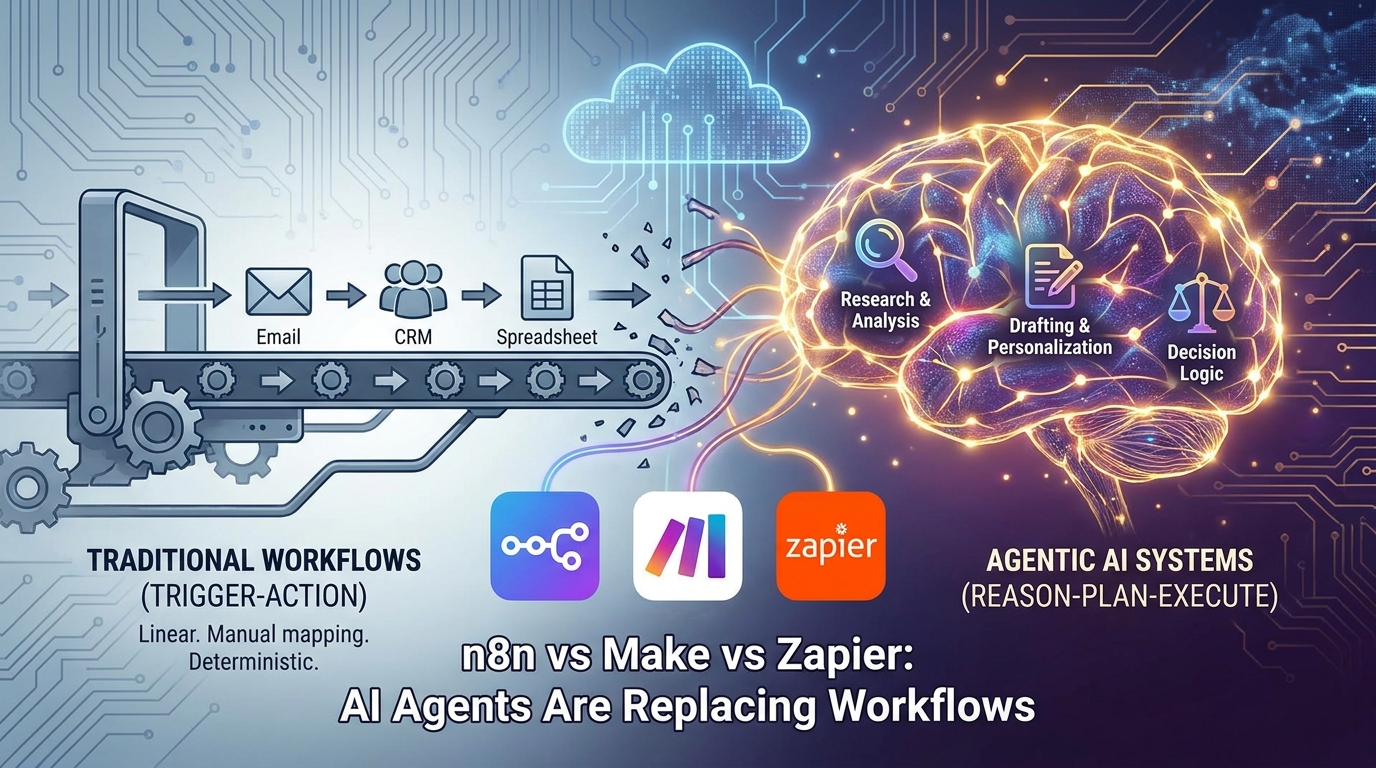
The three leading AI marketing automation tools—n8n, Make, and Zapier—are pivoting from simple trigger-action workflows to agentic systems that reason, plan, and execute multi-step tasks autonomously. This post evaluates their current AI capabilities, what agentic features actually deliver for B2B marketing operations, and how to restructure your automation stack before the next budget cycle.
The Shift From Workflows to AI Agents
Traditional automation platforms execute pre-defined sequences: when X happens, do Y. Agentic AI workflows flip that model. Instead of mapping every conditional branch yourself, you define a goal and constraints—then the agent decides which tools to use, in what order, adapting based on intermediate results.
For marketing ops, this means you can replace a 47-step Zapier workflow with a prompt like “research this lead, score fit, draft a personalized email, and add to the nurture sequence if they match our ICP.” The system handles API calls, data parsing, and decision logic without manual flow design.
The shift is already underway. Zapier launched Central AI agents in late 2024. Make introduced autonomous scenario execution in early 2025. n8n rolled out its AI execution layer in Q1 2025, letting users build no-code AI automation that writes its own workflow steps at runtime.
n8n’s New AI Execution Layer
n8n’s approach emphasizes transparency and control. Its AI execution mode exposes the reasoning chain—you see which nodes the agent selected, why it chose them, and the data passed between steps. This matters for compliance-conscious teams who need audit trails.
n8n AI features include tool-use orchestration (the agent can call any API you’ve configured), memory persistence across executions, and the ability to fall back to human approval for high-stakes actions. The platform remains self-hostable, which appeals to enterprises with data residency requirements.
The trade-off: n8n’s interface assumes technical literacy. Non-technical marketers often need developer support to configure custom nodes or debug agent behavior. It’s the choice for teams already running backend automation or those who want full infrastructure control.
Make and Zapier’s Agentic Features Compared
Make automation AI leans into visual workflow design, letting you mix deterministic steps with agentic blocks. You might hard-code data enrichment but delegate lead scoring to an AI module that adapts its criteria based on recent win/loss patterns. Make’s strength is granular control—you decide where agents intervene and where logic stays fixed.
Zapier AI agents prioritize speed and accessibility. Central allows non-technical users to describe goals in plain language, then auto-generates workflows combining Zapier’s 6,000+ app integrations with LLM reasoning. The platform handles error recovery and retries automatically.
Zapier’s limitation: less transparency into agent decision-making. You get results, but the intermediate reasoning is often opaque. For high-volume, low-risk tasks—social scheduling, list cleanup, CRM data entry—that’s fine. For strategic ops like budget allocation or campaign personalization, many teams want more visibility.
Make sits between n8n’s control and Zapier’s simplicity, offering modular agent blocks within a familiar interface. Teams migrating from traditional automation often find Make’s hybrid model easiest to adopt incrementally.
What This Means for B2B Marketing Operations
Agentic systems collapse role boundaries. Tasks that required a marketing ops specialist, a data analyst, and a copywriter can now run end-to-end autonomously—prospect research, competitive intelligence gathering, draft generation, sequence enrollment, and performance tracking.
This creates two immediate challenges. First, governance: who approves agent actions that touch customer data or brand voice? Second, skill shift: marketing ops roles move from building workflows to prompt engineering, QA, and exception handling.
The upside is velocity. Teams report cutting campaign launch timelines from weeks to days by delegating repetitive research and setup tasks to agents. Content operations become continuous rather than batched—agents monitor triggers, generate drafts, route for approval, and publish without manual handoffs.
The strategic shift: as agents handle execution, human focus moves to strategy, edge cases, and quality control. Budget and headcount allocations need to reflect that rebalancing.
How to Adapt Your Automation Stack Now
Start with inventory. Which existing workflows involve multi-step research, content generation, or decision logic? Those are agentic candidates. Which require perfect accuracy or regulatory compliance? Keep those deterministic or add human-in-the-loop checkpoints.
Run parallel pilots. Choose one low-risk use case per platform—n8n for a self-hosted lead enrichment agent, Make for a hybrid campaign builder, Zapier for social automation—and measure speed, error rate, and setup time against your current approach.
Plan for observability. Agentic systems fail differently than traditional workflows. Build logging, output review queues, and feedback loops so you catch hallucinations or logic errors before they reach customers.
Budget for iteration. First-generation agent implementations rarely work at scale without tuning. Reserve 20-30% of your automation budget for refinement cycles and edge case handling.
—
FAQ
Are AI agents really replacing traditional marketing automation workflows?
Not entirely—yet. Agentic systems handle unstructured, multi-step tasks better, but deterministic workflows still win for high-volume, predictable processes like email sends or CRM syncs. Most teams will run hybrid stacks for the next 12-18 months.
Which platform is best for non-technical marketing teams?
Zapier’s Central AI offers the lowest technical barrier, with natural language setup and broad app coverage. Make works well for teams comfortable with visual workflow builders who want more control than Zapier provides.
Can I self-host any of these AI agent platforms?
Only n8n offers full self-hosting, which matters for data residency and compliance. Make and Zapier are cloud-only, though both offer enterprise SOC 2 and GDPR compliance.
What’s the biggest risk when adopting agentic automation?
Output variability. Unlike deterministic workflows, agents can produce different results for similar inputs. Teams need QA processes and guardrails, especially for customer-facing or brand-sensitive tasks.
How much can I realistically automate with AI agents today?
Expect to automate 40-60% of repetitive research, draft generation, and data routing tasks. High-judgment work—strategic positioning, creative direction, stakeholder negotiation—still requires human leadership.
—
Ready to rebuild your automation stack around AI agents? [Subscribe to Alington’s weekly brief](https://alingtonmedia.com/newsletter) for platform comparisons, implementation guides, and real-world pilot results from B2B marketing teams.