Category: AI Automation

  • Automate In This Order: The Founder Stack That Works

    Automate In This Order: The Founder Stack That Works

    Most founders automate their business in the exact wrong order. They wire up a fancy Claude content pipeline, generate 40 hooks a week, feel like a genius — and meanwhile invoices go out four days late, three refunds are sitting in Slack, and a support ticket from Tuesday is rotting in a shared inbox.

    Every new automation on top of a broken money layer makes the business more fragile, not more free. You’ve added surface area without fixing the leaks.

    Here’s the order I actually use when I set up automation for a founder, and the specific tools at each layer. The test at every step: if this automation stopped tomorrow, would I lose money or just lose posts?

    Layer 1: Money In

    This is where every founder should start, and almost no one does. Content is loud. Cash flow is quiet until it isn’t.

    What to automate first:

    • Invoicing on contract signature. Trigger from your CRM or DocuSign/PandaDoc webhook into Stripe or QuickBooks. No human clicks “send invoice.”
    • Payment reminders on a schedule. Day 3 friendly, day 7 firm, day 14 with a Loom from the founder. Stripe has this natively via automatic reminders — turn it on today.
    • Failed-card retries. Stripe Smart Retries plus a Slack alert to a #revenue channel when a card fails twice. A recovered subscription is worth more than any thread you’ll write this month.
    • Dunning emails with a personal tone. Not the default Stripe template. Write three versions in your voice and route them through n8n based on customer LTV.

    If you do only this layer, you’ll usually recover [X]% of MRR that was quietly walking out the door. That’s the ROI ceiling on your content automation, by the way — you can’t out-post a leaking checkout.

    Layer 2: Money Out

    Money out is less sexy than money in but eats just as many hours and creates real legal risk when it’s manual.

    • Contractor payouts. Deel, Wise, or a simple n8n workflow that reads a Google Sheet of approved invoices and pushes to your bank API. Approval in Slack with a ✅ emoji reaction as the trigger.
    • Subscription audits. Once a month, a workflow that pulls every recurring charge from your business card, dumps it into Notion, and tags anything you haven’t logged into in 60 days. I’ve killed [$X]/mo doing this.
    • Receipt capture. Forward all receipts to an email that runs through a Claude parser and drops structured data into your bookkeeping tool. Your accountant will stop hating you.
    • Refund workflows. One-click refund from a Slack modal, logged to the customer record, with an automatic apology email drafted for human review.

    Layer 3: Support Triage

    Only now do you touch anything that talks to a customer with AI — and even here, the rule is auto-sort and auto-draft, human sends.

    The stack I use:

    • Auto-sort: Every inbound email or ticket goes through a classifier (Claude via API is fine, or a Front/Help Scout rule) that tags it: billing, bug, refund request, feature ask, sales.
    • Auto-draft: For the top 5 ticket types, Claude drafts a reply using your last 200 resolved tickets as context. It sits in draft — never sends.
    • Human sends: A team member (or you) reads, edits, sends. You cut response time from days to minutes without ever letting a hallucinated refund policy hit a customer.

    If you want to see how these pipelines fail when you skip the human-in-the-loop step, I wrote a full postmortem in The 4 n8n + Claude Workflows That Died in Production. Two of the four failures were support automations that sent before a human reviewed.

    Layer 4: Then, And Only Then, Content

    Content automation is dessert. Most founders eat it first and wonder why they feel sick.

    Once your money and support layers are stable, a content pipeline is genuinely leverage. Mine looks like this:

    • Voice notes → Whisper → Claude for structuring → draft in Notion
    • A persistent context stack so Claude actually sounds like me (I broke this down in The 91-Hour Context Tax)
    • Scheduled via a lightweight n8n workflow, not a $200/mo tool

    The reason this works fourth and not first: content is the compounding layer. If the business underneath is leaking, compounding attention just accelerates the leak. If the business is tight, content pours fuel on something that actually converts. This is also why founder-led accounts dominate organic reach — they’re built on top of an operation that can actually deliver.

    The Test, Every Time

    Before you build the next workflow, ask two questions:

    1. If this stopped tomorrow, would I lose money or just lose posts?
    2. Is there a manual money process upstream of this that’s still bleeding hours?

    Start where the money bleeds. Not where the dopamine is. Money in, money out, support triage, then content — in that order, every time.

  • The 4 n8n + Claude Workflows That Died in Production

    The 4 n8n + Claude Workflows That Died in Production

    I built 6 n8n + Claude workflows this quarter. Two are still running. Four died in production — quietly, at 3am, while I was posting screenshots of the canvas.

    Nobody talks about the graveyard. So here it is: the exact failure modes that killed each workflow, and the guardrails I’d build if I were starting over today.

    Failure 1: OAuth tokens silently expired

    The workflow: a Gmail → Claude → CRM pipeline that summarized inbound sales replies and updated HubSpot deal notes. Ran clean for [X] weeks. Then the Google OAuth refresh token expired because I’d hit Google’s 7-day expiry window for apps in Testing mode. No alert. Just a flatline.

    I found it when a prospect asked why we hadn’t followed up.

    What actually kills you: most n8n credential errors surface as an execution error on the failing node — which does nothing if you’re not watching executions. Google’s own docs confirm test-mode refresh tokens expire in 7 days (see OAuth 2.0 docs). Move the OAuth app to In Production status before you trust anything to it.

    Fix:

    • Publish your Google Cloud OAuth consent screen out of Testing.
    • Add an Error Trigger workflow in n8n that pings Slack on any failed execution. Takes 4 minutes to build. Would have saved me a week.
    • Add a daily heartbeat: a scheduled workflow that runs a trivial authenticated call (e.g. list 1 email) and posts “✅ auth alive” to Slack. If it goes silent, you know.

    Failure 2: Claude returned malformed JSON, one time in fifty

    The workflow: scrape LinkedIn signals → Claude formats them into a structured JSON object → n8n routes into Airtable columns.

    Worked beautifully. Until Claude, roughly 2% of the time, wrapped its JSON in a stray markdown fence or added a trailing sentence like “Let me know if you’d like me to adjust the format.” The JSON Parse node choked. Downstream nodes ran on the previous item’s data. Airtable filled with duplicate rows.

    Fix:

    • Use Anthropic’s tool use feature instead of asking for JSON in the prompt. When you define a tool schema, Claude returns structured input that matches the schema — no parsing gymnastics. Details in the Anthropic tool use docs.
    • If you’re stuck with plain text output, wrap the parse step in a Try/Catch using n8n’s error branches. On failure: retry with a stricter reprompt (“Return ONLY the JSON object, no markdown, no prose”).
    • Log every raw model response for 30 days. When something breaks, you need the actual output, not a guess.

    Failure 3: Rate limits hit mid-batch, no retry logic

    The workflow: a warm outbound sequence — [Y] leads pulled from a spreadsheet, enriched, personalized with Claude, sent through Instantly.

    Halfway through a batch, I hit Anthropic’s tier-1 tokens-per-minute limit. n8n threw a 429. The workflow stopped. Half the leads got a personalized message. The other half got nothing — and because my “sent” flag was set before the API call, the retry logic (that I built later, in a panic) skipped them entirely.

    Fix:

    • Set the sent flag after the send confirms, not before. Idempotency matters.
    • Use n8n’s built-in retry on the HTTP/Claude node — 3 retries, exponential backoff (2s, 8s, 30s).
    • Batch through a Split In Batches node with a 1–2 second wait node between iterations. Slower, but it doesn’t detonate.
    • Read the actual rate limits before you build. Anthropic publishes them per tier.

    Failure 4: The task didn’t need automating

    This one hurts. I built an elaborate workflow to auto-draft LinkedIn comment replies using my past voice as context. It worked. It was clever. I killed it after [Z] weeks because the replies read like a slightly-off version of me and the whole point of showing up in comments is showing up.

    I automated it because I could, not because it mattered. Related: I wrote about this exact trap in why AI-ghostwritten LinkedIn content quietly tanks reach. The algorithm and your audience both notice.

    Fix: before you build, answer three questions:

    • Does this task happen at least 10 times a week?
    • Is the output quality tolerant to ~90% accuracy?
    • Would a human noticing the automation break trust?

    If you can’t say yes/yes/no, don’t automate it. Same logic applies to founder-led content in general — I unpack that in why founder-led accounts dominate organic reach in 2026.

    The two workflows that survived

    Both are boring:

    • Inbound lead router: form fill → Claude classifies intent → Slack DM to me with a one-line summary and a suggested reply. Runs 20+ times a day. Zero downstream writes, so nothing catastrophic can break.
    • Content repurposing: new blog post → Claude drafts 3 social hooks → dumped into a Notion queue for me to edit. Human in the loop by design.

    Notice the pattern: low blast radius, human review, small outputs. The workflows that died all had one thing in common — they wrote to production systems without a human checkpoint.

    The actual playbook

    • Every workflow gets an Error Trigger → Slack from day one.
    • Every workflow gets a daily heartbeat if it touches OAuth.
    • Structured outputs use Claude tool use, not “please return JSON”.
    • Idempotency flags update after success, never before.
    • Retry with exponential backoff on every external API call.
    • If a human wouldn’t miss it, don’t build it.

    The flex isn’t the stack. The flex is the one workflow you haven’t touched in 90 days and it’s still quietly working. If you’re thinking about what to automate next, this piece on building a persistent AI context stack is where I’d start — because context, not workflows, is usually the real bottleneck.

    Show me your graveyard.

  • TikTok’s AI Voice Ban: What Fashion Brands Must Do Now

    TikTok’s AI Voice Ban: What Fashion Brands Must Do Now

    TikTok has banned AI-generated voices in livestream advertisements, forcing fashion and beauty brands to rebuild their creative strategies mid-campaign. This post explains why the TikTok AI voice ban happened, what it means for paid ad performance in an interest-graph world, and the specific creative adjustments your team needs to make this quarter.

    Why TikTok Banned AI Voices in Livestreams

    TikTok quietly updated its advertising policies in late June 2024 to prohibit synthetic voices in livestream commerce ads. The platform’s Advertising Policies page now explicitly states that advertisers cannot use “AI-generated voices, deepfakes, or synthetic audio that mimics human speech” in any livestream ad format.

    The timing isn’t accidental. TikTok Shop launched aggressive expansion into fashion and beauty verticals throughout 2024, and the platform saw a flood of low-quality livestream ads using cheap AI voice tools. These ads featured static product shots with robotic voiceovers cycling through feature lists—think dropshipping aesthetics at premium brand scale.

    The ban targets livestream formats specifically because that’s where TikTok’s commerce future lives. Standard in-feed video ads can still use AI voices, but livestream shopping ads—the format TikTok is pushing hardest for conversion—cannot. This creates a split testing environment where your creative strategy now differs by placement.

    The Real Reason This Matters for Paid Ads

    The TikTok AI voice ban isn’t about audio quality. It’s about watch time, and watch time dictates everything in interest-graph marketing.

    TikTok’s algorithm doesn’t care about your follower count. It cares whether viewers watch your ad past the three-second mark, whether they rewatch it, and whether they send it to friends. AI voices consistently underperform on these metrics because they sound like ads, and ads get skipped.

    Here’s the operational reality: TikTok’s interest-graph ranking means your ad creative competes directly with organic content for attention. When a user opens TikTok, the algorithm serves a mix of paid and organic posts based purely on predicted engagement. If your ad uses an AI voice that signals “skip this,” you’re paying for impressions that generate no watch time—and the algorithm learns to stop showing your ads.

    This applies across platforms now. Meta shifted to interest-graph ranking in 2023. YouTube Shorts prioritizes watch time over subscriber status. LinkedIn’s feed algorithm weights dwell time more heavily than connection graph. The common thread: content that holds attention gets distributed, regardless of who posted it.

    Fashion brand paid ads face a specific challenge here. Your product shots are beautiful, but beauty doesn’t equal engagement. A well-lit flat lay of a handbag won’t hold attention unless the first two seconds create pattern interruption. AI voices remove the one remaining tool for that interruption—human vocal personality.

    How Fashion and Beauty Brands Used AI Voices

    Before the TikTok AI voice ban, fashion and beauty marketers relied on AI voices for three specific use cases, all of which now need replacement.

    Product launch announcements used AI voices to localize the same visual creative across markets. A single video asset could run with English, Spanish, French, and Mandarin voiceovers without hiring talent or managing studio time. Brands launching seasonal collections across regions built entire media plans around this efficiency.

    Testimonial-style ads deployed AI voices to narrate user-generated content compilations. A brand would license customer photos, sequence them in a slideshow, and overlay an AI voice reading five-star reviews. This format converted well because it mimicked organic testimonial content, but the voice quality never quite matched the authenticity of the visuals.

    Rapid testing frameworks used AI voices as placeholder audio. Performance creative teams would test ten product hooks in a week, all using the same AI voice template to isolate which hook drove click-through rates. Once a winner emerged, they’d re-shoot with human talent. This testing velocity is now impossible in TikTok livestream formats.

    The beauty brand TikTok strategy adapted faster because beauty creators already dominated the platform. Fashion brands, selling higher-consideration products with longer purchase cycles, leaned harder on controlled brand creative—which meant more AI voice usage.

    The Interest-Graph Implications No One’s Talking About

    The TikTok AI voice ban exposes a deeper tension in interest-graph marketing: brands optimized for scale can’t move fast enough to win attention.

    Interest-graph algorithms reward recency and relevance. A fashion brand’s Spring 2025 campaign launched in February becomes stale by March, not because the product changed but because the algorithm has seen that creative pattern thousands of times. Repetition kills distribution.

    AI voices promised a solution—swap the audio, refresh the creative signal, maintain algorithm novelty without reshooting. That hack is now dead for TikTok livestream advertising, which forces brands back to the fundamental problem: you need more creative, faster, and it needs to feel native.

    Native feeling matters because interest-graph feeds blur the line between ads and content. Users don’t consciously switch modes between “scrolling entertainment” and “viewing ads.” Your paid creative gets the same three-second audition as a dance trend or recipe video. AI voices fail that audition because they sound categorically different from how creators talk.

    This creates asymmetric advantage for brands with creator networks. If you can deploy twenty micro-influencers to film product hooks in their own voices on their own accounts, you’ve built a creative engine that matches algorithm demand. If you’re still routing everything through an agency that delivers quarterly campaign assets, you’re structurally mismatched to how these platforms distribute reach.

    The interest-graph shift also means your creative testing budget needs to 10x while your media budget stays flat. You’re not buying reach anymore—you’re earning it through creative performance. That inverts traditional media planning, where 80% of budget went to placement and 20% to production.

    What Winning Creative Looks Like Now

    Post-ban TikTok livestream ads require human voices, but not professional ones. In fact, overly polished voiceovers hurt performance for the same reason AI voices did—they signal “ad” instead of “content.”

    Founder-led creative outperforms branded creative by every engagement metric that matters. The founder of a sustainable fashion brand talking directly to camera about supply chain challenges will hold attention longer than a model walking through a studio. This isn’t about production value. It’s about perceived authenticity and the interest-graph’s preference for human-to-human communication patterns.

    Record these on iPhone. Use natural light. Let the founder stumble over words. The imperfection is the strategy because it matches how organic content looks.

    Customer voice takeovers solve the testimonial problem without AI. Instead of narrating user photos with synthetic voices, give customers your product and ask them to film their own 15-second reaction. String together ten of these with minimal editing. The varied voices, backgrounds, and energy levels create pattern interruption every few seconds—exactly what watch time optimization requires.

    License these clips properly and compensate customers fairly, but the production cost is still lower than studio shoots and the performance delta is measurable.

    Employee perspectives work especially well for fashion brand paid ads because they bypass the founder personality dependency. Have your patternmaker explain why a seam is constructed a certain way. Let your stylist show three ways to wear a piece. These voices carry subject matter authority without requiring C-suite charisma, and they generate endless creative variations from your existing team.

    The strategic shift here is treating paid ads like content franchises rather than campaigns. Instead of one hero video per product launch, you need twenty micro-pieces of content per product, each featuring a different voice and angle. The algorithm will tell you which three of those twenty earn distribution, and you scale budget to those winners.

    FAQ

    Can I still use AI voices in regular TikTok video ads?
    Yes. The TikTok AI voice ban only applies to livestream advertising formats. Standard in-feed video ads can still use synthetic voices, though they’ll likely underperform human voices on watch time metrics regardless of policy.

    What counts as an AI voice under TikTok’s policy?
    TikTok defines AI voices as any synthetically generated audio designed to mimic human speech, including text-to-speech tools, voice cloning software, and deepfake audio. Heavily processed human voices with effects applied are still permitted as long as the original voice is human.

    Do other platforms plan to ban AI voices in ads?
    Meta and YouTube haven’t announced similar policies as of July 2024, but both platforms have introduced AI labeling requirements for synthetic media. The trend points toward disclosure rather than prohibition, but watch time performance will likely drive creative decisions more than policy will.

    How does this affect localization for global campaigns?
    You’ll need human voice talent for each market instead of running one video with AI-translated audio. The budget impact is significant, but consider testing English-only ads in non-English markets first—interest-graph algorithms often prioritize engaging content over language match.

    Should fashion brands stop using AI voices entirely?
    Not necessarily. AI voices still work for non-ad contexts like product description videos on your website or internal training materials. The issue is performance in interest-graph feeds where they can’t compete with human vocal patterns for attention.

    —

    Need help rebuilding your creative strategy around interest-graph dynamics? [Subscribe to Alington Media’s weekly breakdown](https://alingtonmedia.com) of platform changes that actually affect your paid performance.

  • TikTok AI Watermarks Will Kill Generic Ad Creative in 2026

    TikTok AI Watermarks Will Kill Generic Ad Creative in 2026

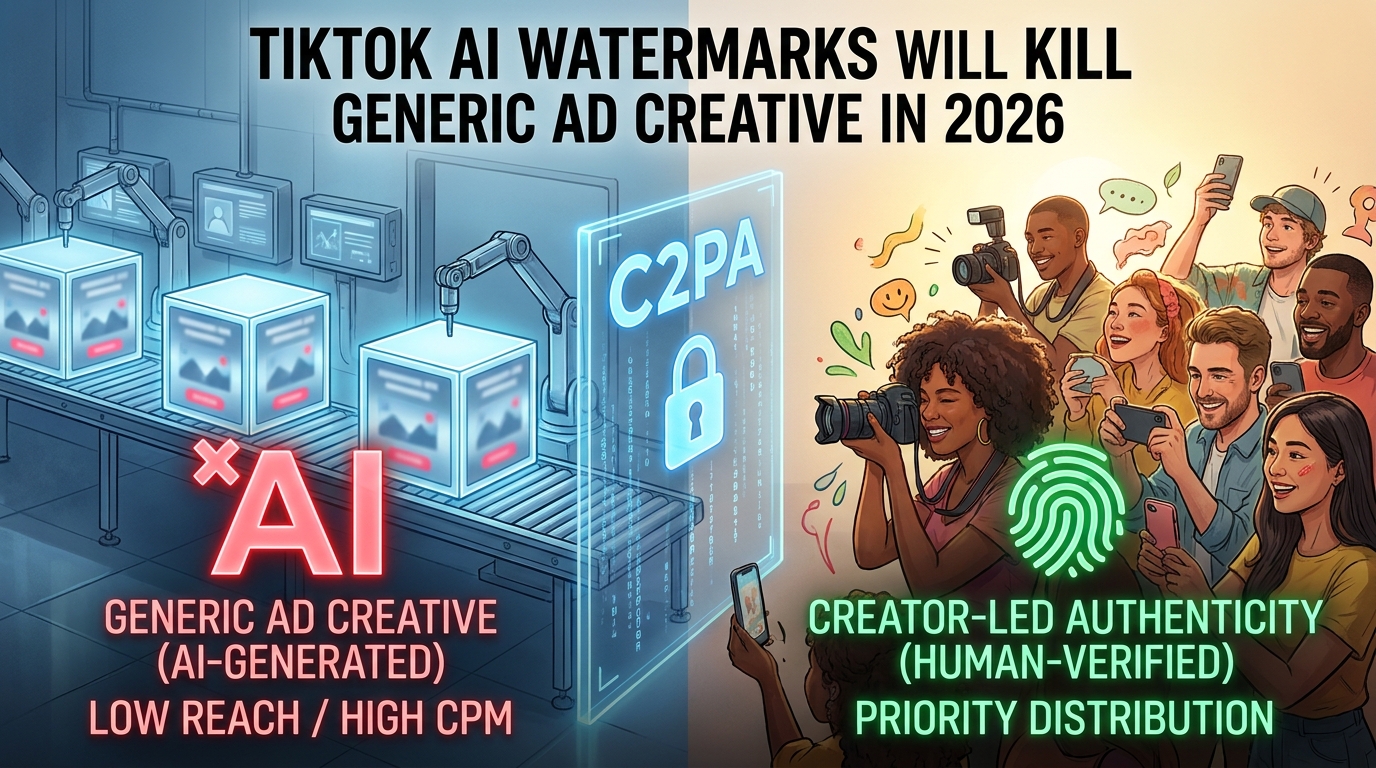
    TikTok’s integration of C2PA credentials—invisible AI watermarks that authenticate content provenance—will fundamentally change how paid ads perform on the platform. Brands relying on scaled, AI-generated creative will face targeting penalties and reduced reach, while creator-led advertising with verified human authorship will gain preferential distribution and audience trust.

    Why TikTok’s C2PA Integration Changes Everything

    TikTok began rolling out C2PA credentials in late 2024, initially labeling AI-generated content with visible tags. By early 2026, the system evolved into a backend authentication layer that feeds directly into the algorithm.

    Every video uploaded now carries embedded metadata: who created it, what tools were used, whether generative AI played a role in production. The Content Authenticity Initiative’s open standard makes this data cryptographically verifiable and tamper-resistant.

    This isn’t just transparency theater. TikTok’s ad delivery system now reads these credentials and adjusts bidding, reach, and targeting based on content authentication signals. TikTok AI watermarks have become a de facto ranking factor.

    The shift mirrors what’s already happened to organic reach. Generic brand-page content has collapsed across all major platforms. Audiences ignore polished, committee-approved posts. They engage with founder-led or creator-led accounts that feel unfiltered and real.

    C2PA credentials formalize that preference into the paid ads infrastructure.

    How Invisible AI Watermarks Expose Generic Creative

    Most brands don’t realize their creative is already flagged. If your agency uses Midjourney for static images, Runway for b-roll, or ChatGPT to draft scripts, those assets carry embedded provenance data.

    TikTok’s system doesn’t block AI content. It classifies it. And classification determines distribution.

    Here’s what happens: you upload an ad with AI-generated voiceover and synthetic b-roll. The C2PA metadata reveals the content chain. The algorithm sorts it into a lower-trust tier. Your CPM rises. Your feed placement drops. Your For You Page penetration shrinks.

    The inverse is also true. A creator shoots a selfie-style testimonial on an iPhone. No AI tools in the production chain. C2PA credentials confirm human authorship. The algorithm prioritizes it in auctions. Your cost per acquisition drops.

    This is AI content authentication as a competitive moat. Brands that invested in creator partnerships and authentic content marketing now have a structural advantage in TikTok paid ads targeting.

    The Death of Scaled Brand Content (And Why That’s Good)

    For years, performance marketers chased scale through templatization. One concept, fifty variations, algorithmic testing. AI tools like Synthesia and Captions accelerated this model by removing production bottlenecks.

    That playbook is now underwater. When TikTok’s algorithm can detect that your fifty ad variants came from the same generative pipeline, it penalizes the entire batch for lack of genuine diversity.

    Scaled brand content worked when platforms couldn’t distinguish between authentic variance and cosmetic iteration. C2PA credentials eliminate that ambiguity.

    The upside: this forces brands back toward quality and specificity. Instead of fifty generic hooks, you need five genuinely differentiated perspectives. That means working with real creators who bring their own audiences, voices, and proof points.

    This isn’t a return to influencer marketing circa 2019. It’s a recognition that dwell time and private sharing—Sends, specifically—drive algorithmic distribution more than likes or comments. And Sends only happen when content feels personally relevant, not mass-produced.

    Creator-Led Ads vs AI-Generated: The Targeting Split

    TikTok’s ad manager now segments inventory based on content provenance. You can bid exclusively on authenticated human-created content slots, or you can accept mixed inventory that includes AI-flagged placements.

    The pricing gap is significant. Authenticated inventory commands a 30-40% premium in competitive verticals. But conversion rates justify the markup. Users trust creator-led advertising more, especially in categories like finance, health, and B2B software where credibility determines purchase intent.

    Brands now face a strategic fork. Option one: continue producing scaled AI creative at lower cost, accept lower performance, and compete in the bargain bin. Option two: restructure budgets toward fewer, higher-quality creator partnerships that qualify for authenticated targeting.

    Most brands still operate on the first path because their internal workflows assume volume is the variable to optimize. Creative testing frameworks, agency retainers, and approval processes all assume you need dozens of assets per campaign.

    That assumption breaks when the platform itself rewards singular, verifiable authorship over iterative testing.

    How to Restructure Your Paid Strategy for Authenticated Content

    Start by auditing your current creative pipeline. Which assets carry AI provenance? Which are fully human-authored? Use TikTok’s Creator Marketplace to identify partners whose content already earns authenticated distribution.

    Shift budget from pre-produced creative to Spark Ads—paid promotion of organic creator posts. These inherit the creator’s C2PA credentials and audience trust. You’re amplifying content that already works rather than fabricating something new.

    Negotiate usage rights differently. Instead of buying one-off deliverables, establish ongoing partnerships where creators test concepts organically, then you amplify what resonates. This turns creators into de facto R&D for your paid strategy.

    Build a hybrid model. Reserve 60-70% of spend for authenticated creator content. Use the remaining 30-40% for rapid testing with AI tools, knowing you’ll pay a performance penalty. This lets you explore hooks quickly while maintaining a foundation of high-trust creative.

    Track performance by provenance tier. Your analytics should separate AI-flagged ads from authenticated ones. Most brands still aggregate all creative into one reporting bucket, which masks the gap.

    Finally, educate internal stakeholders. The CMO who greenlit a scaled AI content strategy in 2024 needs to understand why that approach no longer delivers ROI. TikTok AI watermarks have changed the economics of creative production, not just the optics.

    —

    FAQ

    What are TikTok AI watermarks and how do they work?
    TikTok AI watermarks are invisible C2PA credentials embedded in video files that verify whether content was created by humans or AI tools. The platform’s algorithm uses this metadata to classify ads and adjust their distribution and pricing in the auction system.

    Do AI watermarks completely block AI-generated content on TikTok?
    No, AI-generated content isn’t blocked, but it’s deprioritized in ad auctions and organic reach. Brands can still run AI-created ads, but they’ll pay higher CPMs and see lower engagement compared to authenticated human-created content.

    How does C2PA authentication affect organic reach?
    Organic posts with verified human authorship receive preferential algorithmic treatment, especially when they drive high dwell time and Sends. Generic brand content with AI provenance sees reduced For You Page placement and lower engagement rates.

    What’s the cost difference between authenticated and AI-flagged ad inventory?
    Authenticated creator content commands a 30-40% premium in competitive categories, but typically delivers higher conversion rates. The effective cost per acquisition often favors authenticated content despite the higher CPM.

    Should brands stop using AI tools for content creation entirely?
    Not entirely, but the use case shifts. AI tools work for rapid testing and exploration, but performance-critical campaigns should prioritize creator-led advertising with verified human authorship to maximize TikTok paid ads targeting effectiveness.

    —

    Want to restructure your paid strategy for the C2PA era? [Subscribe to Alington Media’s weekly insights](https://alingtonmedia.com/newsletter) on AI, automation, and authentic content marketing.

  • Signal-Based Outbound: The 2026 Cold Email Teardown

    Signal-Based Outbound: The 2026 Cold Email Teardown

    Platform average reply rate right now is around 3.43%. Most founders see that number and blame the channel. Wrong tell. The channel is fine. The trigger is broken.

    Old outbound was volume: 3,000 sends a day, 10 warmed domains, one hook, hope. New outbound is signal: wait for a real reason to reach out, then move fast with one specific line. This article is the full teardown — the signals to watch, the tools to catch them, the prompt to write the line, and the sequence that turns it into a reply.

    Why fake personalization stopped working

    Everyone got the same Clay + GPT stack in 2024. The result: inboxes flooded with "I loved your post about [topic]" openers that reference nothing the prospect actually cares about today. Prospects can smell the merge tag. The mechanical tell isn’t the wording — it’s that nothing changed in the prospect’s world that would make your email make sense right now.

    Real personalization has two parts: (1) a real trigger, and (2) a line that could only have been written this week. If either half is missing, you’re doing volume with extra steps.

    The signal stack: what to actually trigger off

    These are the signals worth building a pipeline around. Pick 2-3 to start — don’t try to catch all of them.

    • Job changes. New VP of Marketing at a Series B has a 90-day window to make a decision. Source: LinkedIn Sales Navigator saved searches, Champify, UserGems.
    • Funding rounds. Fresh capital = fresh budget. Source: Crunchbase, Harmonic, or a simple RSS pull from TechCrunch funding tag.
    • Tech stack changes. They just added Segment or ripped out HubSpot. Source: BuiltWith, Wappalyzer, TheirStack.
    • Hiring signals. A job req is a public admission of a problem. Source: LinkedIn Jobs API, Ashby public boards.
    • Content engagement. They commented on a founder’s post in your space this week. Source: Phantombuster, or a simple n8n LinkedIn scrape.
    • Podcast appearances. They said the thing you sell out loud, on tape. Source: Listen Notes API.

    The pipeline (n8n + Claude, roughly)

    Here’s the shape of the automation I run. You can build it in n8n, Make, or plain Python — the logic matters more than the tool.

    • Step 1 — Watch. Cron job every 6 hours hits your signal sources (Crunchbase RSS, LinkedIn saved search export, BuiltWith webhook). New rows drop into a Postgres or Airtable base.
    • Step 2 — Enrich. For each new signal, pull the person’s LinkedIn, company site, and last [3] posts using Apollo + a scraping node.
    • Step 3 — Draft. Send the enriched context to Claude with the prompt below. Output: one opener line + one relevance line, max 25 words combined.
    • Step 4 — Queue. Draft lands in a review tab (I use Airtable). You approve or edit in under 30 seconds each. No auto-sending. Ever.
    • Step 5 — Send. Approved rows push to Instantly or Smartlead. One domain, one mailbox per [40] sends a day. No warmup theatre.
    • Step 6 — Touch. 48 hours later, an n8n branch sends the same lead to a LinkedIn queue: view profile, like one recent post, send a connection request with no note.

    The Claude prompt that actually works

    Bad prompt: "Write a personalized cold email opener." You’ll get slop.

    Good prompt structure:

    • Role: "You are writing one line of a cold email. Not the whole email. One line."
    • Context block: Paste the raw signal (funding announcement text, job change post, podcast transcript excerpt).
    • Constraint: "Reference the signal specifically. Do not compliment. Do not use the words ‘noticed’, ‘saw’, ‘congrats’, or ‘reaching out’. Max 20 words. If you cannot write a line that a human insider would write, output NO_ANGLE."
    • Output format: Just the line. No preamble.

    The NO_ANGLE escape hatch is the trick. It gives Claude permission to skip weak leads instead of forcing generic output. Roughly [30-40%] of my signals come back NO_ANGLE. Those get dropped, not sent.

    The 80-word email template

    Structure, in order:

    • Line 1 (Claude output): The signal-specific line.
    • Line 2: Why it made you think of what you do — in one sentence, no pitch.
    • Line 3: A specific, low-commitment ask. Not "15 minutes." Something like "worth a two-line reply on how you’re handling X?"

    That’s it. No signature block with six links. No P.S. No calendar link on the first send.

    What to measure

    Stop tracking sends. Track these instead:

    • Signals-to-sends ratio. If you’re sending on 90%+ of signals, your filter is too loose.
    • Reply rate per signal type. Funding rounds vs. job changes vs. tech swaps perform differently in every niche. Kill the losers monthly.
    • Positive reply rate. Total replies is a vanity number. Only "yes, tell me more" and "not now but keep me posted" count.

    The honest take

    Signal-based outbound sends fewer emails. A lot fewer. You will feel unproductive for the first [2-3] weeks. The dashboard will look empty. Push through it. One reply from a VP who just raised beats 400 sends into a void.

    Volume is the tell. Precision is the moat. Pick two signals this week, wire up the pipeline, and delete your other sequences.

  • TikTok’s AI Watermark Policy Reshapes Ad Creative Trust

    TikTok’s AI Watermark Policy Reshapes Ad Creative Trust

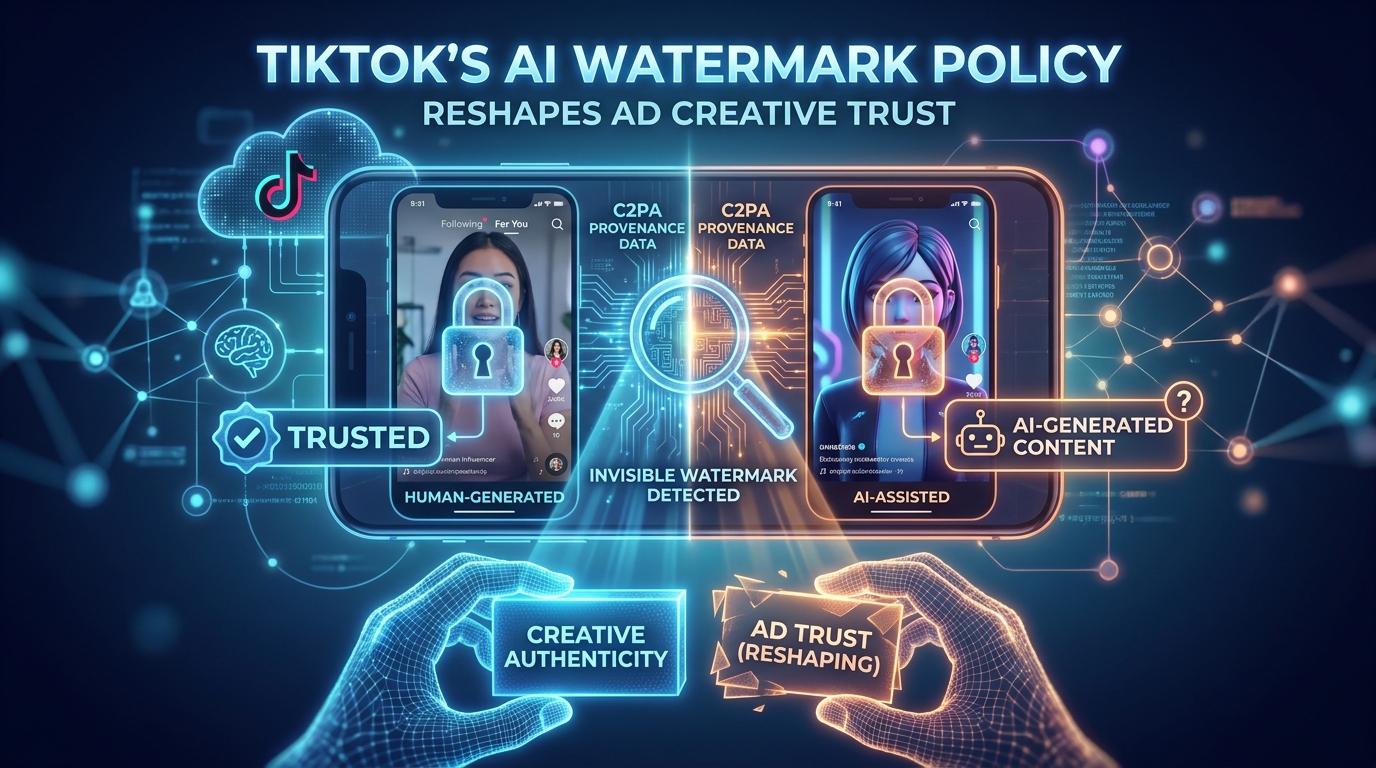
    TikTok’s mandatory AI watermark policy, rolling out globally in June 2026, introduces invisible Content Credentials to all AI-generated video and image assets on the platform. This policy affects both organic and paid content, fundamentally altering how the platform’s interest-graph algorithm evaluates creative authenticity and how users respond to disclosed AI content. For brands and agencies, the shift demands immediate creative strategy adjustments and new performance benchmarks.

    The Context: TikTok’s June 2026 AI Watermark Rollout

    TikTok implemented its AI watermark policy on June 1, 2026, making it the first major social platform to mandate invisible watermark technology for all AI-generated content. The policy leverages Content Credentials standards developed by the Coalition for Content Provenance and Authenticity (C2PA), embedding metadata directly into media files that documents creation tools, modification history, and AI involvement.

    The rollout applies to all content uploaded after the implementation date. Any video or image generated wholly or partially by AI tools—including generative backgrounds, AI avatars, synthetic voiceovers, or algorithmically enhanced visuals—now carries embedded watermarks visible through platform inspection tools. Users can tap a disclosure badge to view the full provenance chain.

    For advertisers, this creates a binary classification system. Creative assets fall into either human-generated or AI-assisted categories, with no middle ground. The TikTok AI watermark policy treats any AI involvement, however minimal, as trigger for mandatory disclosure. This includes popular workflows like AI background removal, upscaling tools, or text-to-image generation for static elements within otherwise filmed content.

    The timing coincides with broader platform shifts away from follower-based distribution. TikTok’s algorithm now prioritizes content that drives completion rates, saves, and shares over passive engagement metrics. AI content disclosure signals factor directly into these algorithmic calculations.

    How Invisible Watermarks Change User Trust Dynamics

    The invisible watermark technology operates at the file level, surviving downloads, re-uploads, and most editing processes. Unlike visible labels that creators could ignore or remove, Content Credentials persist through the content lifecycle. This creates permanent trust signals social media platforms can surface to users.

    Early user research from [Stanford’s Internet Observatory](https://cyber.fsi.stanford.edu/) indicates disclosure impacts vary dramatically by content category. Entertainment-focused AI content sees minimal trust degradation when properly disclosed. Users report expecting creative enhancement in comedy sketches, dance videos, and artistic productions. The disclosure meets expectations rather than violating them.

    Educational and informational content shows steeper trust penalties. When tutorials, product reviews, or news-adjacent content carries AI disclosure, users express skepticism about accuracy and authenticity. The watermark triggers questions about whether information was verified or merely synthesized.

    For paid advertising, the dynamic splits along creative approach lines. Ads that lean into obvious creative fantasia—impossible scenarios, stylized aesthetics, surreal environments—see negligible performance impact from AI content disclosure. The watermark simply confirms what users already assumed.

    Ads attempting photorealistic authenticity face measurable trust friction. When a TikTok ad shows what appears to be genuine user testimonials, behind-the-scenes footage, or documentary-style product demonstrations, AI disclosure creates cognitive dissonance. Users reconcile the visual realism with the AI label by downgrading credibility assessments.

    This trust dynamic compounds with TikTok’s interest-graph algorithm, which surfaces content based on behavioral signals rather than social connections. Users encountering ads from unfamiliar brands lack the relationship context that might offset disclosure concerns. The watermark becomes the primary trust signal in the absence of established credibility.

    Ad Creative Performance: Early Data and Signals

    Three weeks into the TikTok AI watermark policy implementation, ad creative performance patterns are emerging across agency client portfolios. While comprehensive platform data remains proprietary, directional trends show clear segmentation by creative strategy.

    Fully AI-generated ads using obvious synthetic aesthetics—animated characters, illustrated environments, stylized transitions—maintain baseline performance metrics. Click-through rates, conversion rates, and cost-per-acquisition figures track closely with pre-policy benchmarks for equivalent creative quality. The disclosure confirms user expectations rather than contradicting them.

    Hybrid creative using AI for specific production elements shows mixed results. Background replacement, object removal, and color grading tools trigger watermarks but minimally impact performance when the core content remains authentic. A filmed product demonstration with an AI-generated background performs comparably to studio-shot equivalents.

    The performance gap widens for AI-generated spokesperson content and synthetic testimonials. Ads featuring AI avatars delivering brand messages show elevated skip rates and reduced completion metrics compared to human-delivered scripts. The disclosure badge appears to trigger immediate skepticism about message authenticity, even when the script content itself is factual.

    Direct response campaigns face the steepest challenges. When ad creative must drive immediate conversion decisions, AI disclosure introduces friction in the trust-building sequence. Users demonstrate lower intent signals—reduced add-to-cart rates, higher bounce rates from landing pages—when the initial ad carried AI watermarks.

    These performance variations force strategic decisions about production investment. Brands must weigh AI production efficiency against potential performance degradation in trust-sensitive contexts.

    The Algorithmic Shift: Why Watermarks Matter Beyond Transparency

    TikTok’s algorithm treats AI disclosure as a content quality signal, not merely a transparency mechanism. The interest-graph algorithm evaluates how users respond to watermarked content, then adjusts distribution accordingly. This creates feedback loops that amplify performance differences.

    Content that maintains strong completion rates and save metrics despite AI disclosure receives favorable algorithmic treatment. The platform interprets sustained engagement as signal that users value the content regardless of production method. This rewards creative approaches where AI enhancement aligns with user expectations.

    Conversely, content showing elevated skip rates or reduced sharing after disclosure faces algorithmic suppression. The platform reads negative behavioral responses as quality signals, regardless of production quality or budget. An expensive AI-generated ad that fails to hold attention gets treated identically to low-effort spam.

    This algorithmic layer means the TikTok AI watermark policy extends beyond individual ad performance to broader account quality scores. Accounts consistently posting AI content that underperforms risk reduced organic reach and higher paid media costs as the algorithm downgrades overall content quality assessments.

    The relationship-first algorithm shift across platforms compounds these effects. As follower counts lose relevance, every piece of content must earn distribution through immediate engagement metrics. AI watermarks that trigger negative responses create steeper hurdles in earning algorithmic favor.

    Brands cannot simply accept moderately degraded performance on AI content. The algorithmic consequences of consistent underperformance affect entire account ecosystems, including non-AI content posted from the same profile.

    Strategic Implications for Brands and Agencies

    The TikTok AI watermark policy forces immediate creative strategy reassessment. Agencies must audit client content libraries to classify production methods and predict disclosure impacts. This requires new content classification systems distinguishing between enhancement tools and generative creation.

    Production workflows need explicit disclosure planning. Creative briefs should specify whether AI tools are acceptable for each project, based on content category and trust requirements. An entertainment-focused brand campaign might lean fully into AI generation, while thought leadership content demands purely human production.

    Testing protocols must incorporate disclosure variables. Standard creative testing should now include AI versus human production comparisons within identical strategic approaches. This isolates disclosure impact from other creative variables, building evidence-based guidelines for tool selection.

    Budget allocation shifts toward human production for high-stakes conversion content. While AI tools deliver production efficiency, the performance degradation in trust-sensitive contexts often exceeds the cost savings. Brands should reserve AI generation for awareness-stage content where disclosure carries minimal performance penalty.

    Agency roles expand to include AI disclosure strategy. Media buyers need fluency in how watermarks affect auction dynamics and cost efficiency. Creative strategists must understand which content categories tolerate AI involvement and which demand authentic production. Account leadership should guide clients through production method tradeoffs rather than defaulting to efficiency optimization.

    Platform diversification becomes risk management. Over-reliance on TikTok exposes brands to concentrated disclosure policy risk. Maintaining creative optionality across platforms with varying AI policies preserves strategic flexibility as the regulatory landscape evolves.

    Long-term content library planning must account for persistent watermarks. Content created today carries disclosure metadata indefinitely. Brands building evergreen creative libraries should consider whether current production methods align with how disclosure policies might evolve over multi-year timeframes.

    FAQ

    Does TikTok’s AI watermark policy affect all advertisers equally?
    No, performance impact varies significantly by content category and creative approach. Entertainment-focused content and obviously stylized creative see minimal impact, while photorealistic ads attempting authenticity face measurable trust friction. Direct response campaigns driving immediate conversions show the steepest performance degradation under disclosure.

    Can brands remove or disable the AI watermark on their content?
    No, the watermark is embedded at the file level using Content Credentials standards and cannot be removed by uploaders. The metadata persists through downloads, edits, and re-uploads. Attempting to strip or falsify watermark data violates platform policies and risks account penalties.

    How does the algorithm treat AI-disclosed content differently?
    TikTok’s interest-graph algorithm uses behavioral responses to watermarked content as quality signals. Content maintaining strong engagement despite disclosure receives favorable distribution, while content showing elevated skip rates faces algorithmic suppression. These effects compound across account-level quality scores affecting all content from that profile.

    Should brands stop using AI tools for TikTok content creation?
    Not necessarily, but tool selection should align with content category and trust requirements. AI tools remain viable for entertainment content, stylized creative, and obvious enhancement applications. High-stakes conversion content and authenticity-dependent messaging should prioritize human production to avoid disclosure-related trust penalties.

    What other platforms are implementing similar AI watermark policies?
    As of June 2026, TikTok is the first major platform with mandatory disclosure using invisible watermark technology. Meta has announced plans for similar implementation in Q4 2026, while YouTube is piloting voluntary disclosure tools. Industry momentum suggests invisible watermarking will become standard across major social platforms within 12-18 months.

    —

    Word count: 1,497

    —

    Need help navigating AI disclosure strategy across your paid social campaigns? [Subscribe to Alington Media’s weekly newsletter](https://alingtonmedia.com/newsletter) for agency insights on emerging platform policies and performance optimization.

  • Which AI Tools Actually Help Social Marketers in 2026

    Which AI Tools Actually Help Social Marketers in 2026

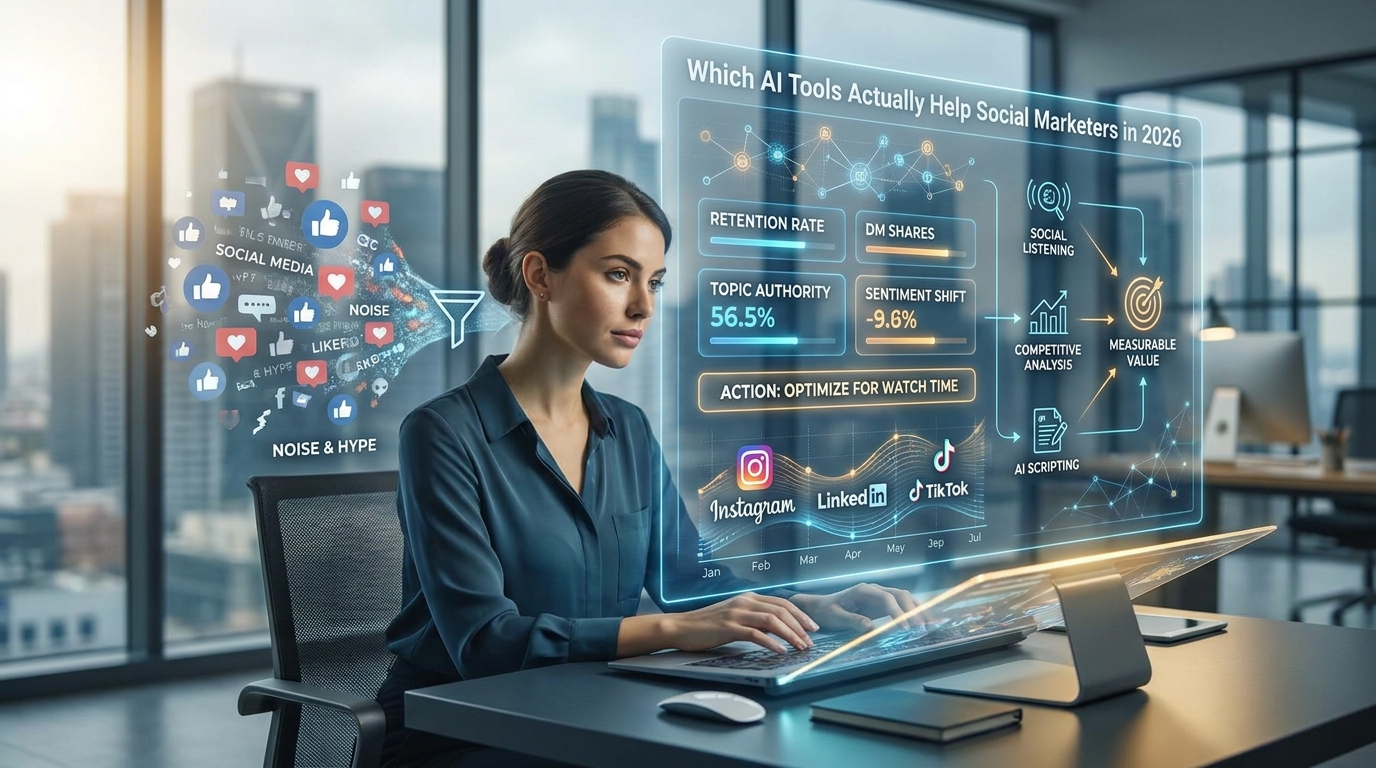
    AI tools for social media have moved past hype cycles into practical deployment, but most marketing teams still struggle to separate signal from noise. This guide examines which social media AI tools deliver measurable value in 2026 — from social listening platforms to AI content scheduling systems — and where automation breaks down. The focus is on tools that adapt to platform algorithm shifts rewarding watch time, shares, and topic relevance over vanity metrics.

    The Current State of AI in Social Media Marketing

    The landscape has consolidated significantly. Early-stage AI content scheduling tools either evolved into full-stack platforms or disappeared entirely. What remains are purpose-built systems designed for specific workflow pain points rather than all-in-one promises.

    The defining shift is platform behavior. Instagram, LinkedIn, and TikTok now prioritize retention metrics — how long viewers watch, whether they share to DMs, and how closely content matches declared user interests. Broad reach plays matter less than topical authority and genuine interaction depth.

    This changes what social media automation tools need to accomplish. Generic posting calendars don’t cut it anymore. Tools must help teams identify micro-communities, optimize for watch completion rates, and track sentiment shifts in real time. The winners are those that surface strategic insights, not just scheduling convenience.

    AI Tools for Social Listening and Research

    Real-Time Audience Intelligence

    Modern AI for social research analyzes conversations at scale to identify emergent topics before they peak. Tools like Brandwatch and Sprinklr use natural language processing to detect sentiment shifts, competitor positioning changes, and customer pain points surfacing in comments and Reddit threads.

    The practical value shows up in positioning decisions. When a SaaS marketing team notices recurring questions about a specific integration, that insight feeds directly into content briefs and paid creative angles. When sentiment around a product category shifts negative, teams can pivot messaging before launching campaigns.

    These platforms work best when tied to action. Running monthly reports doesn’t move the needle. Setting up alerts for specific keyword clusters, competitor mentions, or category trends creates a feedback loop that informs daily creative decisions.

    Competitive Content Analysis

    Some social media AI tools now benchmark content performance across competitors without requiring login access. They analyze public engagement patterns, posting cadence, creative formats, and audience response to identify what’s working in a specific niche.

    This matters for B2B teams entering crowded categories. Instead of guessing which content formats drive results, you can analyze what already resonates with your target buyer profiles. The output isn’t “make videos like this” — it’s “this hook structure drives 40% higher completion rates in fintech decision-maker feeds.”

    AI-Powered Scripting and Content Creation Tools

    From Prompts to Publication-Ready Copy

    AI scripting tools have matured past generic templates. Platforms like Jasper, Copy.ai, and Writesonic now integrate with brand voice documentation, previous high-performing posts, and platform-specific formatting requirements.

    The workflow improvement is tangible. A content manager can feed three bullet points into a tool trained on their company’s tone and get back five LinkedIn post variations optimized for different audience segments. The first draft quality has improved enough that editing time often drops by 60-70%, not because AI writes perfectly, but because it handles structural grunt work.

    The limitation remains nuance. AI tools struggle with contrarian takes, industry-specific jargon used correctly in context, and the kind of vulnerable founder-led storytelling that drives B2B engagement in 2026. They excel at explanatory posts, listicles, and educational content frameworks.

    Video Script Generation and Hook Testing

    Short-form video scripting represents the fastest-growing use case. Tools analyze trending formats on TikTok and Instagram Reels, then generate script structures optimized for retention.

    The best implementations combine AI-generated hooks with human expertise on product positioning. A team might generate 20 opening hooks, test the top five in production, then feed performance data back into the system to refine future outputs. This isn’t autopilot — it’s accelerated iteration.

    Intelligent Scheduling Without Losing the Human Touch

    Timing Optimization vs. Strategic Presence

    AI content scheduling has shifted from “post when your audience is online” to “post when your content type performs best for this specific goal.” Tools like Buffer and Hootsuite now use machine learning to recommend timing based on content format, topic, and historical engagement patterns.

    The difference matters. A thought leadership LinkedIn post might perform best Tuesday morning when decision-makers browse during coffee, while a product demo video could peak Thursday afternoon when teams are researching solutions before end-of-week purchases.

    But automation creates risk. Over-reliance on AI scheduling removes the human judgment that catches tone-deaf timing — launching a celebratory campaign the same day negative industry news breaks, for example. The strongest approach uses AI recommendations as defaults with mandatory human review for anything high-stakes.

    Maintaining Authentic Engagement

    Social media automation tools now include “authentic engagement windows” — periods where AI won’t auto-post, reserved for real-time interaction. This acknowledges that algorithms reward fast, genuine responses to comments and DMs.

    The tactical implementation: schedule evergreen content via AI, but leave mornings open for founder-led posts and active comment participation. Platforms are sophisticated enough to detect which accounts behave like broadcast channels versus genuine participants. The latter get distribution advantages.

    Where AI Stops and Strategy Begins

    No AI tool builds a differentiated point of view. The platforms rewarding niche authority and topical relevance in 2026 require human strategic decisions AI can’t make: which market position to claim, which audience subset to serve intensely, which contrarian perspective to defend.

    Social media AI tools accelerate execution once strategy exists. They help teams produce more variations, identify performance patterns faster, and maintain consistency at scale. They don’t replace the creative director who knows why a specific angle will resonate, or the founder whose personal story builds trust.

    The teams seeing ROI from AI investment treat these tools as leverage, not replacement. They define clear brand positioning, then use AI to test 10 headlines instead of three. They set engagement goals, then use listening tools to find earlier signals. The strategy remains human; the amplification is automated.

    The risk is inverting this relationship. Teams that ask AI “what should our social strategy be” get generic recommendations indistinguishable from competitors. Those that ask “how do we test this specific positioning across 50 audience micro-segments” unlock compounding advantages.

    —

    FAQ

    What AI tools are best for small social media teams in 2026?
    Start with AI listening tools that surface audience insights and content opportunities, then add scripting assistance for high-volume platforms like LinkedIn or Twitter. Avoid all-in-one platforms until you’ve defined clear workflow bottlenecks — specialized tools outperform generic suites for lean teams.

    Can AI fully automate social media marketing?
    No. Platforms increasingly reward authentic engagement, fast response times, and differentiated perspectives that require human judgment. AI handles content variation, timing optimization, and research synthesis, but strategic positioning and genuine community building remain human responsibilities.

    How do AI scheduling tools adapt to 2026 algorithm changes?
    Modern tools continuously retrain on engagement data, adjusting recommendations as platforms shift metrics emphasis. The best systems let you set goals (maximize shares vs. comments vs. watch time) and optimize timing and format suggestions accordingly, rather than using static “best time to post” rules.

    What’s the ROI timeline for implementing social media AI tools?
    Most teams see workflow efficiency gains within 30 days — faster content production, better research synthesis. Strategic impact like improved engagement rates or audience growth typically emerges after 90 days once you’ve iterated based on AI-surfaced insights and optimized content testing cycles.

    Should B2B companies use AI for founder-led social content?
    Use AI for structure and variation testing, not voice or perspective. Founder-led content works because it’s authentic and opinionated — AI can suggest hooks or formats, but the core insights must remain human. The strongest approach: founder provides raw thoughts, AI helps format and test variations.

    —

    Want help implementing AI tools that actually move metrics? Alington Media works with B2B teams to build efficient, strategy-first social systems. [Get in touch](https://alingtonmedia.com/contact) to discuss your specific challenges.

  • Social Search & AI Citations: The New SEO Playbook for 2026

    Social Search & AI Citations: The New SEO Playbook for 2026

    Social platforms now function as primary search engines for discovery, while AI systems cite content based on structure and authority signals rather than traditional backlinks. This post examines how social search SEO, AI citations, and founder-led content are reshaping B2B content discoverability—and what marketing teams need to change in 2026 to maintain visibility and generate leads.

    The Social Search Revolution: Platform Data & Usage Trends

    TikTok and Instagram aren’t just content feeds anymore. They’re replacing Google for millions of users making purchase decisions. According to [Google’s own internal data shared in 2022](https://techcrunch.com/2022/07/12/google-exec-suggests-instagram-and-tiktok-are-eating-into-googles-core-products-search-and-maps/), nearly 40% of young adults prefer Instagram and TikTok for search over Google Maps or Search.

    That trend has accelerated. LinkedIn reports that video content now generates 5x more engagement than static posts, and the platform’s algorithm increasingly surfaces content based on search intent signals, not just network connections. X (formerly Twitter) rebuilt its search infrastructure in 2024 specifically to compete as a real-time information engine.

    For B2B marketers, this means content strategy can no longer assume Google is the default discovery layer. Social platforms are where prospects first encounter your brand, evaluate credibility, and decide whether to engage. Your content must be optimized for social search SEO—not as an afterthought, but as a primary distribution channel.

    Platform-Specific Search Behavior Patterns

    Each platform handles search differently. LinkedIn prioritizes recency and engagement velocity for searched terms. TikTok’s algorithm weighs watch-through rate and shares. Instagram surfaces Reels based on topic hashtags and audio trends.

    YouTube remains the second-largest search engine globally, but its recommendation engine now favors viewer satisfaction metrics over pure watch time. That shifts content strategy toward depth and value delivery rather than clickbait hooks.

    Marketing teams need platform-specific optimization tactics. That means understanding how each algorithm interprets search intent, which metadata fields drive discoverability, and how to structure content for both human readers and machine parsing.

    How AI Citations Are Changing Content Attribution

    ChatGPT, Perplexity, Google’s AI Overviews, and similar tools now cite sources when answering queries. But they don’t cite based on traditional SEO signals alone. AI citations prioritize content structure, clarity, recency, and topical authority.

    Content formatted as clear answers—with questions as headings, concise explanations, and structured data—gets cited more frequently. AI models prefer content that demonstrates expertise through specificity and that breaks complex topics into scannable components.

    This creates new incentive structures for content teams. The goal isn’t just ranking on page one anymore. It’s being cited as the authoritative source when AI answers questions in your domain.

    Optimizing Content for AI Citation

    Use question-based H2 and H3 headings that match natural language queries. AI models scan heading structures to identify relevant passages. Clear, direct answers immediately following question headings increase citation probability.

    Include structured data markup where relevant—FAQ schema, article schema, and organization schema help AI systems understand content context. These aren’t just technical implementations; they’re semantic signals that improve content discoverability across AI platforms.

    Publish updated content regularly. AI models weight recency heavily when determining which sources to cite. A 2024 article on a stable topic may get passed over for a 2026 refresh, even if the core information hasn’t changed.

    Why Human-Led Content Wins in the AI Era

    AI can generate content at scale, but it struggles to produce genuinely novel insights, personal experience, or trust signals. That makes founder-led content and human expertise more valuable, not less.

    LinkedIn’s algorithm explicitly rewards “People Also Know For” signals—the platform’s version of topical authority. Accounts that consistently post original insights in a specific domain get amplified to broader audiences searching those topics. B2B buyers increasingly filter content by author credibility before engaging.

    Founder visibility has become a competitive moat. When prospects search for solutions, they look for evidence that real humans with domain expertise stand behind the product. Anonymous corporate content gets ignored. Authentic founder voices build trust that AI-generated alternatives can’t replicate.

    Implementing Founder-Led Content Programs

    The most effective B2B content programs in 2026 treat founders and subject matter experts as creators, not just spokespeople. That means investing in content infrastructure—recording setups, editing support, distribution systems—to make consistent publishing sustainable.

    Short-form video performs especially well for founder-led content. Three-minute LinkedIn videos explaining strategic decisions, industry shifts, or product philosophy generate both immediate engagement and long-term search discoverability. These videos surface in platform search results months after publication.

    Written founder commentary still matters, particularly for AI citations. Detailed post-mortems, tactical breakdowns, and contrarian takes formatted as blog posts or LinkedIn articles get cited by AI systems answering industry-specific queries.

    Adapting SEO Strategy: Content Structure for Social Discovery

    Traditional SEO focused on keyword density, backlinks, and domain authority. Social search SEO requires different optimization priorities: engagement signals, creator authority, platform-specific metadata, and content formatting for both human and AI consumption.

    Titles and opening lines must work as standalone snippets. Social platforms surface content in search results with minimal context. If your first sentence doesn’t clearly communicate value, the content gets skipped regardless of quality deeper in the piece.

    Hashtags function as keyword tags on visual platforms. LinkedIn limits effective hashtag use to 3-5 relevant terms. Instagram and TikTok can support more, but only if they genuinely match user search behavior. Research platform autocomplete suggestions to identify which hashtags have active search volume.

    Metadata Optimization for Social Platforms

    LinkedIn article features, YouTube descriptions, TikTok captions, and Instagram alt text all function as metadata that platform search algorithms parse. Treat these fields as seriously as you would meta descriptions for traditional SEO.

    Include your primary keyword and LSI keywords naturally within the first 100 characters of captions and descriptions. Social algorithms weight opening text more heavily when matching content to search queries.

    Tag relevant accounts and locations when appropriate. These function as structured data signals that help platforms categorize content and surface it to users searching related topics or exploring tagged entities.

    Implementing a Search-Aware Social Strategy for B2B

    B2B content discoverability now requires integrated execution across social platforms, not siloed campaigns. Marketing teams need workflows that create search-optimized content efficiently and distribute it across multiple platforms with platform-specific formatting.

    Start with pillar content designed for AI citations—comprehensive guides, frameworks, and methodologies formatted with clear question-based headings. Publish these as blog posts with full schema markup, then atomize them into social content.

    Each section of a pillar post becomes a LinkedIn post, a short video script, or a carousel. This approach maintains topical consistency across platforms while optimizing each asset for its native search environment.

    Measurement Frameworks for Social Search Performance

    Track search-driven metrics, not just engagement vanity metrics. Monitor how much traffic comes from platform search versus feed distribution. LinkedIn analytics shows this breakdown. YouTube Studio provides search versus suggested view sources.

    For AI citations, set up Google Alerts and use tools like Perplexity’s cited sources feature to track when your content gets referenced. Manual monitoring works for now—proper attribution tracking tools will mature throughout 2026.

    Measure founder visibility separately from brand metrics. Track follower growth, engagement rate, and search appearance for founder accounts. These metrics predict future brand discoverability as AI systems increasingly weight human credibility signals.

    FAQ

    What is social search SEO?
    Social search SEO is the practice of optimizing content for discoverability within social platform search functions rather than traditional search engines. It requires platform-specific strategies for metadata, content formatting, and engagement signals that drive algorithmic visibility.

    How do AI citations differ from traditional backlinks?
    AI citations reference your content when answering user queries, making it visible even if users never click through to your site. Unlike backlinks that pass domain authority, AI citations demonstrate topical authority and increase brand credibility when AI tools position you as a trusted source.

    Why does founder-led content perform better than corporate content?
    Both AI systems and human audiences weight credibility signals heavily when evaluating content. Founder-led content carries implicit expertise and authenticity that anonymous corporate publishing lacks, making it more likely to be cited by AI and trusted by prospects.

    Which social platforms matter most for B2B search discoverability?
    LinkedIn dominates for B2B professional search, but YouTube provides long-term evergreen discoverability. X offers real-time industry conversation search, while TikTok increasingly captures younger B2B buyers researching solutions. Most effective strategies maintain presence across multiple platforms.

    How should B2B marketing teams structure content for AI citation?
    Use question-based headings that match natural language queries, provide direct answers in opening sentences, implement structured data markup, and publish updates regularly. Content should be scannable by both humans and AI systems parsing for authoritative sources.

    —

    Ready to build a search-aware social strategy? [Subscribe to Alington Media’s newsletter](https://alingtonmedia.com) for tactical breakdowns on AI-era marketing execution.

  • AI Workflows vs Human Authenticity in Social Creative

    AI Workflows vs Human Authenticity in Social Creative

    AI social creative testing now enables marketing teams to iterate concepts, hooks, and variants in hours rather than weeks, but the ads and posts that convert still rely on human authenticity—especially founder voice and creator-led execution. This post covers how to integrate AI-native workflows into social content production without sacrificing the trust signals that drive B2B conversions, and how to build repeatable systems that balance speed with credibility.

    Social platforms have evolved into search-and-discovery layers where short-form video and series content replace one-off posts. For B2B teams, this shift demands new production models that combine performance creative optimization with the community trust that only humans deliver.

    How AI Is Transforming Social Creative Testing

    AI social creative testing compresses feedback loops. Tools like generative image platforms, script generators, and hook variant engines let teams produce dozens of creative concepts before a single dollar moves to production or media spend.

    The core workflow change is pre-flight iteration. Instead of briefing an agency, waiting two weeks, reviewing three static concepts, and choosing one to test in-market, teams now generate 20 thumbnail variations, 15 hook scripts, and 10 visual styles in a single morning session. The best ideas surface before any creator touches a camera.

    This doesn’t replace creative judgment. It front-loads it. Creative directors and strategists spend less time waiting for assets and more time deciding which concepts align with brand strategy and audience insights.

    Testing Variants Before Production

    Performance creative optimization used to mean running five ads, letting the algorithm pick a winner, and killing the losers after spending budget. AI-native workflows reverse that. You test concepts as text prompts, static mockups, or storyboard frames—then produce only the statistically promising variants.

    This matters for B2B social strategy because production budgets are finite. Founder time is finite. If your CEO records ten LinkedIn videos and only two perform, you’ve burned eight takes. If you validate hooks and formats with AI mockups first, that same CEO records three winning scripts and ships all three.

    The trade-off is that AI-generated previews don’t capture delivery, timing, or the micro-expressions that make short-form video work. You’re testing concept and framing, not performance. That’s still a massive efficiency gain for teams managing multi-channel content calendars.

    The Speed Advantage of AI-Native Workflows

    Speed is the structural advantage. Marketing teams adopting AI-native workflows for social content report concept-to-publish cycles measured in days, not weeks. The bottleneck shifts from asset creation to strategic decision-making.

    This acceleration changes planning cadences. Instead of quarterly creative refreshes, teams iterate monthly or even weekly. Social content becomes responsive to product launches, competitor moves, and platform algorithm shifts in near real-time.

    For paid social, this velocity compounds. Advertisers running creator-led content or founder-voice campaigns can now test new angles every week, retire underperformers faster, and allocate budget to proven formats without waiting for agency cycles or long production timelines.

    Where Automation Unlocks Capacity

    AI tools handle the high-volume, low-judgment tasks: resizing assets for platform specs, generating caption variants, pulling performance data into dashboards, and recommending optimal posting times based on engagement history.

    This frees strategists and creators to focus on the work machines can’t do—identifying emerging narratives, shaping brand positioning, and building relationships with audience communities. The most effective B2B social teams treat AI as a production assistant, not a replacement for strategic thinking.

    Repeatability is the second-order benefit. Once a workflow is established—prompt templates, approval gates, asset libraries—it becomes a system. Junior team members can execute it. Agencies can plug into it. Founders can contribute without becoming bottlenecks.

    Why Human Authenticity Still Drives Conversions

    Social media authenticity is not a stylistic preference. It’s a conversion driver. Audiences on LinkedIn, Twitter, Instagram, and TikTok have developed sophisticated filters for synthetic content. They scroll past polished, generic brand messaging and stop for voices that sound like real people solving real problems.

    This is especially true in B2B. Decision-makers follow founders, practitioners, and subject-matter experts—not corporate accounts. They trust individuals who share lessons from building products, managing teams, or navigating industry challenges. That trust transfers to purchasing decisions.

    The Founder Voice Advantage

    Founder-led content consistently outperforms brand account content in reach and engagement. The mechanism is simple: platforms reward authentic voices because users engage with them. Algorithms surface content that people watch, comment on, and share. Polished brand videos don’t earn those signals.

    Creator-led content leverages the same dynamic. B2B brands partnering with niche creators—industry analysts, former operators, technical educators—gain access to established trust networks. The creator’s credibility becomes the distribution channel.

    AI-generated scripts, captions, and visuals can support this model, but they can’t replace the human delivering the message. A founder reading an AI-drafted script still brings their face, voice, and reputation. An AI avatar does not.

    Community Trust and Parasocial Relationships

    Audiences form parasocial relationships with consistent voices. They follow a founder’s journey, recognize recurring themes, and feel invested in their success. This dynamic builds brand equity that no ad spend can replicate.

    For B2B social strategy, this means the most valuable asset isn’t a viral post—it’s a sustained presence. Series content, recurring formats, and regular publishing schedules compound over time. Followers become leads. Leads become customers. Customers become advocates.

    AI workflows support this by making consistency achievable. Founders can batch-record video, use AI tools to edit and repurpose clips, and maintain weekly publishing cadences without hiring full production teams.

    Building Repeatable Content Systems for B2B

    Repeatable content systems treat social creative as a production line, not a series of one-off projects. The goal is sustainable output at consistent quality, driven by strategic frameworks rather than heroic individual effort.

    Start with content pillars—three to five themes that align with business goals and audience needs. Every piece of content maps to a pillar. This creates thematic consistency and makes planning sessions faster.

    Structuring Workflows for Scale

    A scalable workflow separates ideation, production, and distribution into distinct phases with clear handoffs. Ideation sessions generate a backlog of concepts. Production teams (or AI tools) execute against that backlog. Distribution happens on a fixed calendar.

    AI-native workflows slot into this structure. Use generative tools during ideation to brainstorm hooks and angles. Use editing assistants during production to cut footage and generate captions. Use scheduling platforms during distribution to automate posting and track performance.

    The system should include feedback loops. Weekly performance reviews surface what’s working. Insights feed back into ideation. High-performing content gets repurposed into new formats or extended into series.

    Balancing Quality and Volume

    Volume matters on social platforms. Algorithms favor accounts that post frequently. But low-quality volume erodes trust. The balance point is consistent, repeatable formats that maintain quality while enabling higher output.

    Examples include weekly LinkedIn posts with a fixed structure, daily Twitter threads on rotating topics, or short-form video series with recurring segments. Templates and frameworks make these formats executable without reinventing the wheel each time.

    Performance creative optimization applies here too. Test different formats, measure engagement and conversion metrics, and double down on what works. Retire underperformers quickly.

    Balancing Automation and Founder Voice for Maximum Impact

    The ideal B2B social strategy layers AI efficiency underneath human authenticity. Automation handles logistics, asset creation, and distribution. Humans handle strategy, voice, and community engagement.

    Founder voice remains the differentiator. No AI tool replicates the strategic insights, lived experience, or personal credibility that a founder brings. The role of AI is to make that voice more scalable and consistent.

    Practical Integration Points

    Use AI to draft scripts, then have the founder edit for voice and emphasis. Use generative tools to create thumbnail options, then let the creative lead choose the one that aligns with brand guidelines. Use automation to schedule posts, but have team members monitor comments and reply personally.

    This hybrid model preserves authenticity while compressing timelines. The founder isn’t writing captions from scratch or learning video editing software. They’re focusing on the 20% of creative input that drives 80% of the results—concept, messaging, and delivery.

    For larger teams, this approach extends across multiple creators. Subject-matter experts contribute video snippets. AI tools edit them into polished clips. Social managers distribute them across channels. Everyone stays in their zone of genius.

    Measuring What Matters

    Track both efficiency and effectiveness. Measure how much content your team ships per week (efficiency) and how that content performs in engagement and conversions (effectiveness). AI workflows should improve both.

    Avoid vanity metrics. Follower counts and impressions don’t pay bills. Focus on metrics tied to business outcomes: inbound leads from social, pipeline influenced by content, and revenue from social-attributed deals.

    If automation increases output but tanks engagement, the system isn’t working. If founder-led posts convert but you can’t produce enough of them, you need better workflows. The goal is high-quality output at sustainable velocity.

    —

    FAQ

    What is AI social creative testing?
    AI social creative testing uses generative tools to rapidly produce and evaluate creative concepts—hooks, visuals, scripts—before committing to full production. This allows teams to validate ideas with low investment and produce only the variants most likely to perform, reducing waste and improving ROI.

    Can AI-generated content replace creator-led social media?
    No. AI tools can draft scripts, generate visuals, and optimize workflows, but audiences respond to human authenticity—especially in B2B contexts where trust and credibility drive conversions. AI should support creators by handling production logistics, not replace them.

    How do AI-native workflows improve B2B social strategy?
    AI-native workflows compress production timelines, enable rapid testing, and free strategists to focus on high-judgment decisions rather than repetitive tasks. This allows B2B teams to maintain consistent publishing schedules, respond quickly to market changes, and optimize performance without scaling headcount proportionally.

    What role does founder voice play in social content performance?
    Founder voice builds trust and differentiation that brand accounts cannot replicate. Platforms reward authentic individual voices with greater reach, and B2B buyers trust personal expertise over corporate messaging. Founder-led content consistently outperforms generic brand posts in both engagement and conversion metrics.

    How do you balance automation with authenticity in social creative?
    Layer AI efficiency beneath human creativity. Use automation for ideation support, asset production, and distribution logistics, but keep strategic decisions, messaging tone, and community engagement in human hands. Founders and creators should focus on the irreplaceable elements—perspective, delivery, and relationship-building—while AI handles scalability.

    —

    Want to build AI-powered content systems that scale without losing your voice? Alington Media helps B2B teams integrate automation into creative workflows. [Get in touch](https://alingtonmedia.com/contact) to explore what’s possible.

  • Meta’s Paid Subscription & AI Plans: A New Era for Marketers

    Meta’s Paid Subscription & AI Plans: A New Era for Marketers

    Meta’s rollout of paid verification subscriptions and deep AI agent integration across Facebook and Instagram fundamentally changes how B2B marketers should think about social distribution strategy. This isn’t just another algorithm tweak—it’s a structural shift toward platform-controlled feeds, AI-mediated discovery, and paid access models that make organic reach increasingly obsolete for business content.

    Meta’s Strategic Pivot: Subscriptions Meet AI

    Meta launched Meta Verified in 2023, initially as a simple verification badge program. By 2025, the company expanded it into a tiered subscription model offering algorithmic reach boosts, enhanced analytics, and priority customer support—essentially monetizing what organic reach used to provide for free.

    Simultaneously, Meta has embedded AI agents throughout its platform ecosystem. These aren’t passive recommendation algorithms. They’re autonomous systems that surface content, answer user queries, and increasingly mediate the relationship between brands and audiences.

    The combination is deliberate. Subscriptions fund the infrastructure. AI agents control the distribution. Together, they represent Meta’s bet that platform-controlled feeds—curated by machine intelligence and unlocked through payment—will replace the open social graph model that defined the 2010s.

    For marketers building a social distribution strategy in 2026, this means the playbook has changed at the infrastructure level.

    The Death of Organic Reach as We Know It

    Organic reach on Meta platforms has been declining since the 2018 News Feed algorithm changes prioritized “meaningful interactions.” What’s different now is the *mechanism* of that decline.

    Previously, algorithmic reach favored engagement metrics—comments, shares, saves. Marketers could engineer visibility through content formats and posting cadence. Now, AI agents determine relevance based on user intent signals that aren’t directly observable or gameable.

    Meta’s AI systems analyze behavioral patterns across apps, search queries, and even time spent hovering over content. They predict what a user *might* want before explicit engagement happens. This predictive layer makes traditional engagement optimization tactics less effective.

    Add paid subscriptions into the mix, and you have a two-tier system: brands that pay for distribution advantages and brands that compete in an increasingly constrained organic channel. The financial incentive for Meta is obvious—push more brands toward paid solutions.

    B2B marketers need to stop optimizing for yesterday’s engagement metrics and start thinking about how AI agents interpret content relevance.

    How AI Agents Are Reshaping Social Distribution

    Meta’s AI agents don’t just recommend posts. They answer questions, aggregate information from multiple sources, and execute tasks across connected apps. This is the shift from chatbots to autonomous agents that’s defining 2026.

    When a user asks Meta AI about a business problem, the agent might surface a LinkedIn article, a YouTube tutorial, and a product page—without the user ever scrolling a feed. The traditional content discovery path gets bypassed entirely.

    For social distribution strategy, this creates a new challenge: your content needs to be *agent-legible*. That means clear topic signals, structured information, and formats that AI systems can parse and cite.

    Meta is also testing “subagents”—specialized AI assistants for tasks like event planning, product research, or learning. Each subagent has its own retrieval logic and content preferences. Getting visibility now means understanding how multiple AI systems evaluate and surface your content across different user intents.

    The B2B implication is stark: distribution is no longer about reaching people directly. It’s about reaching the AI systems that mediate access to people.

    What This Means for B2B Content Strategy

    Most B2B brands treat social media as a top-of-funnel awareness channel. Post thought leadership, drive traffic to the website, nurture through email. That linear model breaks when AI agents control discovery.

    Your content now competes in two environments simultaneously: human feeds and AI retrieval systems. The optimization targets are different.

    For human feeds (increasingly paywalled or subscription-boosted), you need personality, perspective, and formats that signal “worth reading” to both algorithms and people. Short-form video, carousel posts, and conversational threads perform better than link drops.

    For AI agent retrieval, you need semantic clarity and structured information. Think FAQ-style content, clear problem-solution framing, and embedded metadata that helps AI systems understand context. The content that gets cited by Meta AI isn’t necessarily the content that gets likes.

    This dual optimization requirement means B2B content teams need to produce for *distribution contexts*, not just audiences. A single asset might need multiple format variations—one for feed visibility, one for AI legibility.

    Resource allocation also shifts. If organic reach is structurally declining, investing in paid distribution (whether Meta Verified, ads, or other paid channels) becomes table stakes. The question isn’t whether to pay for reach, but how to make that spend efficient.

    How to Adapt Your Social Marketing Now

    First, audit your current social distribution strategy against the new platform dynamics. Are you still optimizing purely for engagement metrics? Are you assuming organic reach will recover? Both are outdated frameworks.

    Build content formats that serve AI retrieval. Create explainer posts, how-to threads, and structured Q&A content that AI agents can parse and cite. Make your expertise machine-readable.

    Test Meta’s paid subscription tools if you’re running business Pages at scale. Track whether the algorithmic boost and analytics access improve content performance enough to justify the cost. Treat it as a distribution channel investment, not a vanity feature.

    Diversify platform dependency. Meta’s AI integration and subscription model are part of a broader industry trend. LinkedIn, X, and emerging platforms are all implementing similar dynamics. Your social distribution strategy should hedge against any single platform’s policy shifts.

    Finally, invest in owned distribution channels—email lists, communities, content hubs—that don’t rely on algorithmic intermediation. Platform-controlled feeds will only become more controlled. Building direct audience relationships is the long-term hedge.

    —

    FAQ

    What is Meta’s paid subscription model for businesses?
    Meta Verified offers verification badges, algorithmic reach boosts, enhanced analytics, and priority support for a monthly fee. It’s Meta’s way of monetizing distribution advantages that used to be earned through organic reach. For B2B brands, it’s essentially a pay-to-play visibility tier.

    How do AI agents change social media marketing?
    AI agents mediate content discovery by predicting user intent and surfacing relevant information before users scroll feeds. This means marketers must optimize for AI retrieval logic—making content semantically clear and structured—not just human engagement. Distribution now requires agent legibility.

    Should B2B companies pay for Meta Verified?
    If social media is a core distribution channel and you’re seeing declining organic reach, test it. Track whether the analytics and algorithmic boost improve content performance enough to justify the cost. Treat it as a channel investment, not a branding expense.

    What is agent-legible content?
    Content formatted so AI systems can easily parse, understand, and cite it. This includes clear topic signals, structured information (FAQs, how-tos), and semantic clarity. Agent-legible content gets surfaced when users ask AI assistants questions, bypassing traditional feed discovery.

    How should B2B marketers diversify social distribution strategy?
    Build owned channels (email, communities, content hubs) that bypass algorithmic intermediation. Test multiple platforms to reduce single-platform dependency. Invest in both feed-optimized content (for human visibility) and structured content (for AI retrieval). Treat platform access as rented, not owned.

    —

    Want help building an AI-ready social distribution strategy? [Subscribe to our newsletter](#) for weekly insights on platform shifts and marketing automation.