
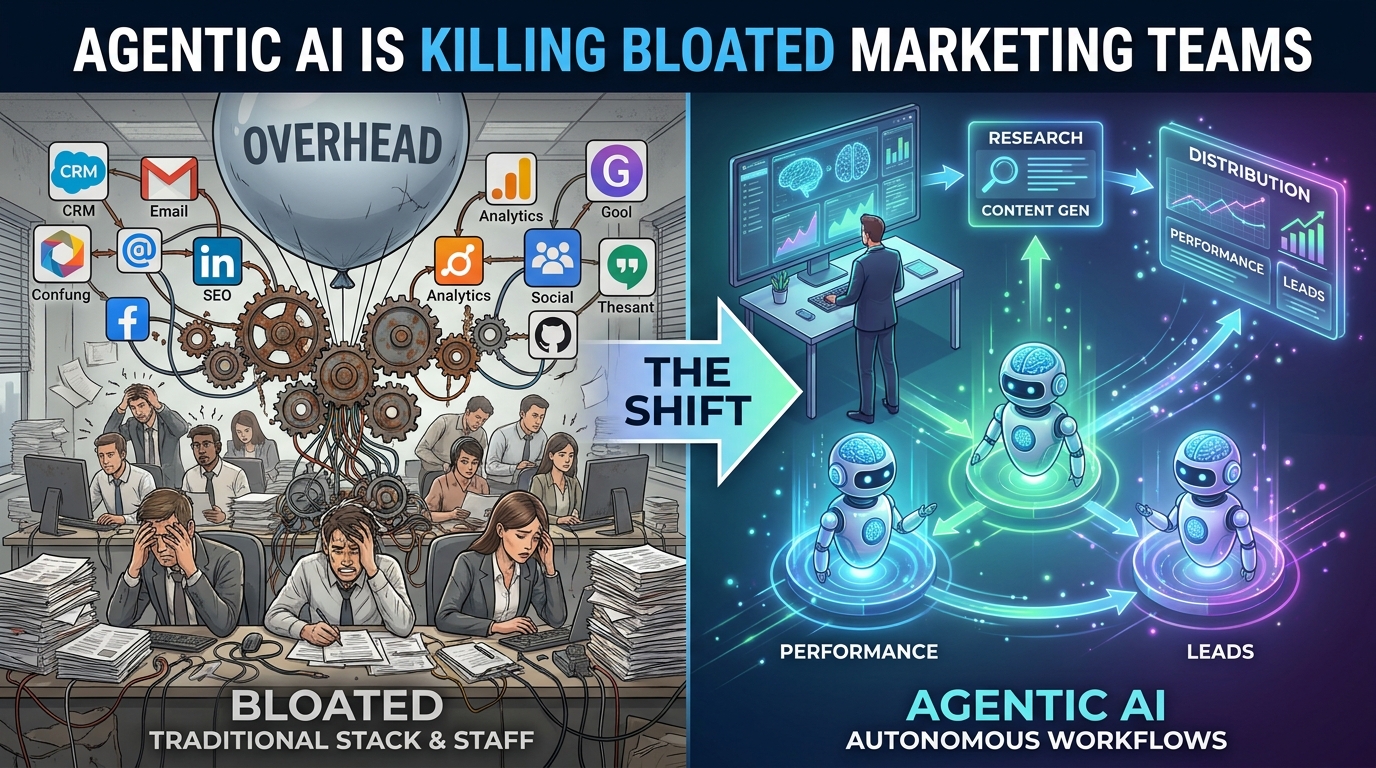
Agentic AI marketing is replacing the traditional stack-and-staff model that defined B2B marketing for the last decade. This post explains how agentic AI systems differ from standalone tools, why they’re collapsing marketing tech stacks from 15 platforms to 3 autonomous agents, and what that means for content production, team structure, and adapting SEO and lead-gen to AI-native discovery.
What Agentic AI Actually Means for Marketing Operations
Agentic AI systems don’t just respond to prompts. They execute multi-step workflows autonomously: researching competitors, drafting content, publishing to CMS platforms, analyzing performance, and iterating without human intervention at each decision point.
The difference matters for marketing ops. A standard AI tool like ChatGPT waits for your next instruction. An agentic system pulls data from your CRM, identifies accounts showing buying signals, drafts personalized outreach sequences, schedules sends, monitors replies, and routes qualified responses to sales—all from a single triggering event.
This shift from assistant to operator changes team design. Marketing leaders no longer need specialists to manage each stage of a workflow. They need strategists who can architect agent behavior and QA outputs at scale.
The Core Capabilities That Define Agentic AI
Agentic AI marketing platforms integrate three capabilities that standalone tools can’t: autonomous decision-making, tool use, and memory across sessions.
Autonomous decision-making means the system chooses next steps based on goals, not prompts. If organic traffic drops for a target keyword, the agent decides whether to refresh existing content, create net-new assets, or adjust internal linking—without waiting for a human to diagnose and delegate.
Tool use means agents can operate your existing stack. They log into analytics platforms, pull performance data, write SQL queries, update spreadsheets, push content to WordPress, send Slack notifications, and trigger Zapier workflows. You’re not copying and pasting between systems.
Memory across sessions means context persists. An agent tracking a campaign remembers what it tested last week, which variants underperformed, and why it chose the current approach. That continuity replaces the institutional knowledge that used to live in a marketing manager’s head.
Why Standalone AI Tools Are Already Obsolete
The 2023–2024 wave of AI adoption centered on point solutions: an AI writing tool here, an image generator there, a chatbot for customer support. That model is collapsing because integration overhead kills the efficiency gains.
Every standalone tool requires onboarding, login management, data export/import, and manual handoffs between systems. A content marketer using separate tools for ideation, drafting, SEO optimization, image creation, and publishing spends more time managing tools than creating value.
Agentic systems collapse those handoffs. One agent handles the entire content pipeline because it can access all necessary tools and make decisions about when to use each one. The ROI equation shifts from “does this tool save time on Task X?” to “does this agent eliminate Job Function Y?”
The Integration Tax Is Higher Than You Think
Most marketing teams underestimate how much time disappears into tool-switching and context-loading. A demand gen manager might touch 12 platforms in a single campaign: CRM for account lists, enrichment tools for firmographics, ad platforms for targeting, landing page builders, email sequencers, analytics dashboards, and reporting tools.
Each switch costs cognitive load and manual data transfer. Agentic AI systems don’t eliminate all those platforms overnight, but they drastically reduce how often humans need to touch them. Agents handle the repetitive data movement and status-checking that fills 60–70% of a marketing coordinator’s day.
That’s why standalone tools feel obsolete once you’ve worked with a functional agent. Going back to manual workflow orchestration feels like returning to fax machines after using email.
The New Marketing Stack: From 15 Tools to 3 Agents
The modern B2B marketing stack averages 10–15 platforms: marketing automation, CRM, ad platforms, content management, analytics, SEO tools, social schedulers, design software, and more. Agentic AI marketing doesn’t replace all of these, but it collapses roles and reduces the number of platforms humans actively manage.
A realistic near-term stack looks like this: one agent for content production (research through publishing), one for demand generation (ad creative, targeting, lead scoring, and nurture), and one for performance monitoring (analytics, attribution, reporting). Each agent uses existing platforms as tools but handles all coordination autonomously.
This isn’t theoretical. AI workflow automation tools like Relevance AI, Zapier Central, and n8n already let teams build agents that span multiple platforms. The constraint isn’t technology—it’s willingness to redesign processes around agent capabilities instead of retrofitting agents into old workflows.
What This Means for Hiring and Team Structure
Smaller teams running agentic systems outperform larger teams running traditional stacks. That’s not a productivity platitude—it’s a structural consequence of removing coordination overhead.
A five-person team managing three agents can produce more content, run more experiments, and analyze more data than a 15-person team coordinating across specialists. The bottleneck shifts from execution capacity to strategic judgment: what to build, which segments to target, how to position against competitors.
This creates a hiring inversion. Instead of adding junior coordinators to scale execution, teams hire senior strategists and give them agents that execute at coordinator speed. Compensation concentrates in fewer, more experienced roles.
How Content Production Scales Without Hiring
Content has always been a linear scaling problem: double your output, double your headcount. Agentic AI systems break that relationship by automating research, drafting, optimization, and distribution as a continuous workflow.
An agent assigned to maintain a content cluster can monitor keyword rankings, identify declining posts, analyze top-ranking competitors, draft refreshed content, optimize on-page SEO, update internal links, and republish—completing in hours what used to take a writer and SEO specialist days.
The quality bar matters here. Early AI content was obvious and low-value. Current agentic systems produce usable first drafts when trained on your brand voice, fed proprietary research, and constrained by detailed briefs. The human role shifts from writing to editing, fact-checking, and injecting perspective that only comes from customer conversations.
The New Content Workflow
A functional agentic content workflow starts with strategic direction: which topics, which audience segments, which stage of awareness. The agent handles everything downstream.
It researches search intent and competitor positioning. It drafts long-form content following your style guide. It generates or sources visuals. It optimizes for target keywords. It formats for your CMS. It schedules publication. It monitors performance and proposes updates based on ranking changes.
Human intervention happens at two points: approving strategic direction and QA-ing outputs before publication. Everything else runs autonomously. One strategist can oversee content production that previously required a team of four.
Adapting SEO and Lead-Gen for AI-Native Discovery
The shift to agentic AI marketing changes how prospects discover and evaluate vendors. AI-powered search and research tools don’t click through ten blue links—they synthesize information and present direct answers.
That breaks traditional SEO. Ranking #1 for a keyword matters less if ChatGPT Search or Perplexity never surfaces your content in its synthesized answer. The new game is being cited as a source in AI-generated summaries.
This requires different content signals: structured data markup, clear authorship and expertise indicators, citation-friendly formatting (definitions, comparisons, step-by-step guides), and authoritative backlink profiles that AI systems trust.
Lead-Gen in an AI-Mediated Buying Process
B2B marketing AI tools are also changing how prospects engage before contacting sales. Buyers use AI assistants to research vendors, compare features, and draft shortlists—often without visiting your website directly.
This shifts lead-gen strategy toward being present in the datasets and sources those AI systems query. That means appearing in authoritative directories, earning citations in industry reports, getting mentioned in analyst content, and maintaining detailed, structured product information that AI can parse.
Gated content and form-fill lead capture lose effectiveness when prospects can get answers from AI without surrendering contact information. The new lead-gen model emphasizes signal-based identification: tracking which accounts show research behavior, even if individuals don’t convert through traditional forms.
FAQ
What is agentic AI marketing?
Agentic AI marketing refers to autonomous AI systems that execute multi-step marketing workflows end-to-end without human intervention at each decision point. Unlike standalone AI tools that respond to individual prompts, agentic systems research, decide, act, and iterate across entire campaigns.
How does agentic AI differ from marketing automation platforms?
Traditional marketing automation executes predefined rules you configure (if/then logic). Agentic AI systems make contextual decisions based on goals, adapting their approach as conditions change. They operate existing tools rather than replacing them, functioning as the orchestration layer above your stack.
Can small marketing teams realistically use agentic AI systems?
Yes—agentic AI systems are particularly valuable for small teams because they eliminate the coordination overhead that typically requires additional headcount. A three-person team with well-configured agents can match the output of much larger traditional teams, provided they focus on strategy and QA rather than execution.
What skills do marketers need to work with agentic AI?
Marketers need strategic thinking (setting goals and success criteria), process design (mapping workflows for agents to execute), and critical evaluation (QA-ing outputs and iterating on agent instructions). Technical implementation often requires some familiarity with API connections and workflow automation platforms, though no-code tools are reducing this barrier.
How should marketing teams start adopting agentic AI?
Start with one repetitive, multi-step workflow that currently consumes significant coordinator time—content refresh processes, lead enrichment and scoring, or performance reporting. Build an agent for that single workflow, measure impact, and expand from there rather than attempting to transform your entire operation simultaneously.
—
Alington Media helps B2B marketing teams design and implement agentic AI workflows. [Get our weekly breakdown of what’s working in AI marketing automation](https://alingtonmedia.com/newsletter).