
—
Claude Opus 4.8 introduces agentic AI capabilities that enable marketers to orchestrate complex workflows through natural language rather than visual builders, fundamentally shifting how B2B teams approach marketing automation. This post examines what changed in Opus 4.8’s architecture, why traditional no-code tools now face existential pressure, and what marketing teams should prioritize this quarter to capitalize on AI workflow automation before competitors do.
What Claude Opus 4.8 Actually Changed (And Why It Matters)
Anthropic’s Claude Opus 4.8 release centers on three architectural improvements: extended context windows to 500K tokens, native function calling with state persistence, and multi-step reasoning that doesn’t require human checkpoints between actions.
The extended context window means Claude Opus 4.8 marketing automation can ingest your entire customer data platform schema, campaign taxonomy, and brand guidelines in a single prompt. Previous models required chunking or summarization, which introduced errors and limited workflow complexity.
Native function calling with state persistence allows the model to execute API calls, store intermediate results, and make conditional decisions across multiple tools without returning to the user. This is what transforms Claude from a chatbot into an agent—it can complete a 12-step campaign workflow autonomously.
Multi-step reasoning removes the bottleneck that plagued earlier AI marketing tools: the need for human approval at each decision point. Opus 4.8 can evaluate outcomes, adjust parameters, and proceed through branching logic based on real-time data. That’s the difference between a task assistant and a workflow orchestrator.
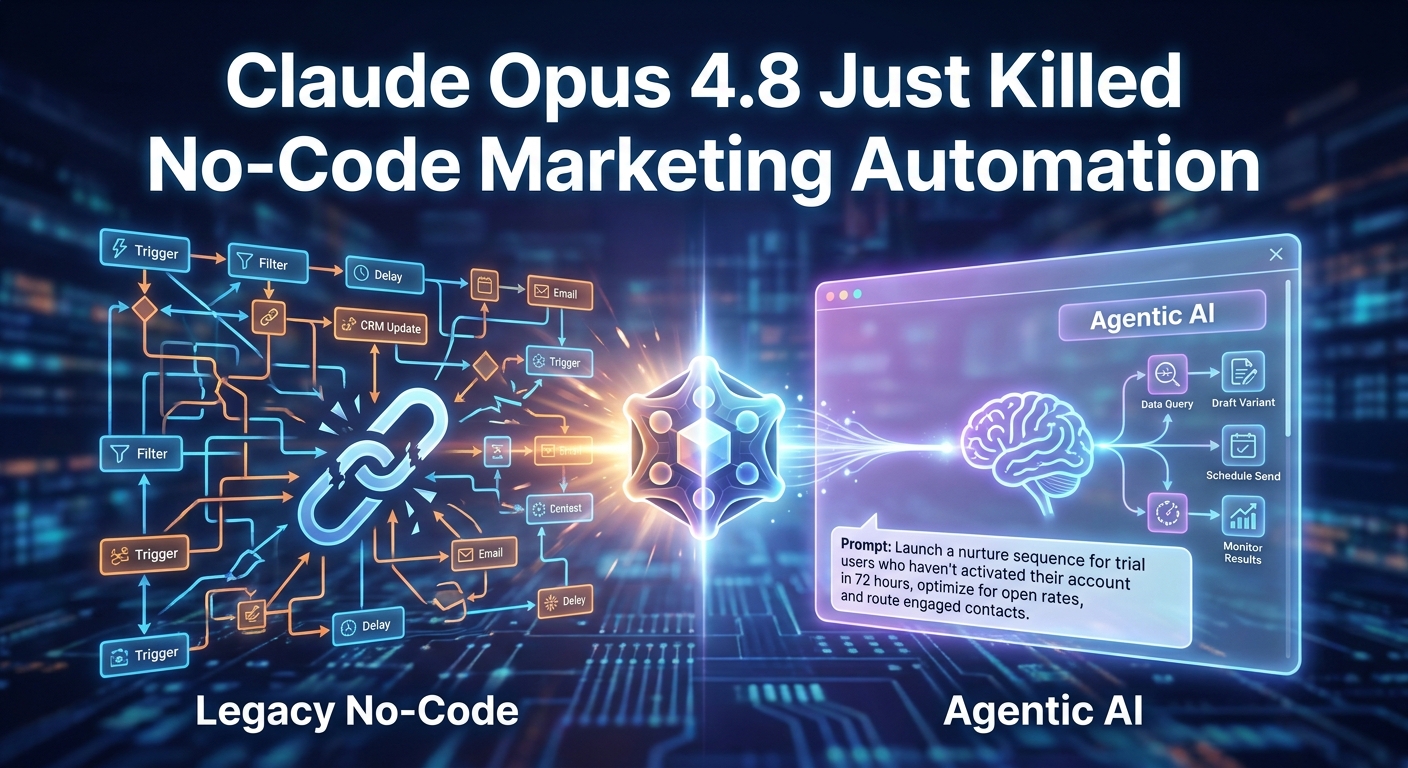
For B2B marketers, this means you can describe a desired outcome in natural language—”launch a nurture sequence for trial users who haven’t activated their account in 72 hours”—and the agent constructs the workflow, pulls the segment, writes the emails, sets the triggers, and monitors performance.
Why Traditional No-Code Tools Are Now Legacy Infrastructure
No-code automation platforms like Zapier, Make, and HubSpot Workflows were built on a drag-and-drop paradigm: users connect pre-built modules to create linear or branching sequences. This model thrived when the alternative was hiring developers to write custom integrations.
Agentic AI for marketers eliminates the visual builder entirely. Instead of spending 45 minutes configuring triggers, filters, delays, and actions in a UI, you describe the workflow once and the agent generates the execution path. The time-to-value collapses from hours to minutes.
Traditional no-code tools also struggle with context switching. Each workflow exists in isolation. If you need to modify ten related automations because your lead scoring model changed, you’re clicking through ten separate builders. AI agents operate across your entire workflow ecosystem simultaneously, applying changes consistently.
The economic model shifts too. No-code platforms charge per task or per seat, creating predictable but scaling costs. Embedded AI marketing tools charge per API call or token consumption, which initially feels opaque but trends toward commodity pricing as model costs decline. More importantly, agentic systems reduce total workflow volume by consolidating redundant tasks.
The real obsolescence isn’t technical—it’s cognitive. No-code tools require users to translate business logic into the platform’s visual syntax. AI workflow automation accepts business logic in its native form: plain language descriptions of desired outcomes. The cognitive overhead vanishes.
The Agentic Performance Leap: From Task Execution to Workflow Orchestration
Earlier AI marketing tools performed isolated tasks: write an email, generate a subject line, summarize a report. They required humans to connect the outputs into coherent workflows. Claude Opus 4.8’s architecture enables true orchestration—chaining dependent tasks, making conditional decisions, and adjusting based on intermediate results.
Here’s what orchestration looks like in practice. A B2B demand gen team wants to re-engage cold leads from last quarter’s webinar. Traditional workflow: segment the audience in your MAP, export to CSV, upload to email tool, write three variants, set up A/B test, configure send schedule, monitor open rates, trigger follow-up sequences based on engagement.
With agentic AI, the prompt is: “Re-engage 2024 Q1 webinar attendees who didn’t convert, using three email variants tested for open rates, sending follow-ups based on engagement tier.” The agent queries your data warehouse, drafts variants aligned to your brand voice (already in context), configures the test, schedules sends optimized for recipient time zones, monitors results, and routes engaged contacts into appropriate nurture tracks.
The performance leap isn’t speed alone—it’s decision quality. AI agents can evaluate hundreds of conditional paths and select optimal routing in real time. A human builder might configure three or four branches before complexity becomes unmanageable. An agent can manage dozens.
This matters most for account-based campaigns where workflow complexity grows exponentially with personalization depth. Customizing outreach across account tier, industry vertical, buying committee role, and engagement history creates thousands of potential paths. Agents handle this natively; visual builders collapse under combinatorial explosion.
What B2B Marketing Teams Should Do This Quarter
First, audit your current automation stack for redundant workflows that exist only because visual builders make consolidation too painful. Identify clusters of similar automations—welcome sequences, re-engagement campaigns, event follow-ups—that could collapse into a single agent-orchestrated workflow with natural language parameters.
Second, invest in structured data infrastructure. B2B marketing AI agents are only as effective as the data they can access. If your lead scoring exists as tribal knowledge or your campaign taxonomy lives in scattered spreadsheets, agentic tools can’t leverage them. Document your data schema, standardize naming conventions, and expose clean API endpoints.
Third, establish governance for agent-generated workflows. Decide which actions require human approval (budget commitments, external communications) versus which can run autonomously (internal reporting, data enrichment). Build approval checkpoints into your prompts where judgment calls matter.
Fourth, train your team on prompt engineering for workflow orchestration, not content generation. The skill isn’t “write a better blog post”—it’s “describe a multi-step campaign workflow with sufficient context, constraints, and success criteria that an agent can execute it reliably.” This is closer to writing technical specs than creative briefs.
Fifth, prototype in production. Don’t sandbox agentic AI projects indefinitely. Run one live campaign this quarter where Claude Opus 4.8 marketing automation handles the entire execution from segmentation through analysis. Learn from real performance data, not hypothetical use cases.
The Real Competitive Advantage: Structured Data + AI Agents
The competitive moat for B2B marketing teams isn’t access to AI models—those are commodity infrastructure now. The moat is proprietary structured data combined with agents that can act on it.
Companies with clean customer data models, documented campaign taxonomies, and API-first martech stacks can deploy agentic workflows in days. Companies with messy CRMs, siloed tools, and manual processes will spend months on data cleanup before agents deliver value.
This creates a compounding advantage. Teams that operationalize AI workflow automation faster generate more structured data from automated workflows (activity logs, decision trees, performance metrics), which makes subsequent agent deployments more effective. The feedback loop accelerates.
The shift also rewards integrated platforms over best-of-breed tools. Agents perform best when data and actions live in connected systems with consistent schemas. The decade-long trend toward specialized point solutions reverses as embedded AI marketing tools favor consolidation.
Strategic investments shift from buying more tools to instrumenting existing ones for agent access. That means prioritizing APIs, webhooks, and structured outputs over UI-based features. Marketing technology selection criteria now include “can an AI agent use this autonomously?” as a first-order question.
For marketing leaders, this is the quarter to audit data quality, document workflows, and prototype agentic automation in one high-value use case. The teams that move now build structural advantages before agentic AI for marketers becomes table stakes.
FAQ
What makes Claude Opus 4.8 different from previous AI marketing tools?
Opus 4.8 introduces state persistence and multi-step reasoning, allowing it to complete complex workflows autonomously rather than requiring human intervention between tasks. Previous models could assist with individual steps but couldn’t orchestrate end-to-end campaigns.
Do we need to replace our existing marketing automation platform?
Not immediately. Agentic AI layers on top of existing tools through API connections, automating workflow creation and management rather than replacing the execution infrastructure. However, platforms that don’t expose robust APIs will become limiting factors.
How do we measure ROI on agentic AI implementations?
Track time saved on workflow configuration, reduction in manual task volume, and improvement in campaign complexity (number of personalization variables or conditional paths). Early adopters report 60-80% reduction in setup time for multi-touch campaigns.
What are the biggest risks with AI-orchestrated marketing workflows?
Data quality issues compound quickly when agents make autonomous decisions based on flawed inputs. Poor segmentation or incorrect attribution models will propagate errors across connected workflows. Start with high-confidence data sets and expand gradually.
Can smaller marketing teams benefit or is this enterprise-only?
Smaller teams often benefit more because they lack dedicated marketing ops resources. Agentic AI eliminates the need for specialized automation expertise, letting generalists orchestrate sophisticated workflows. The barrier is data cleanliness, not team size.
—
Want practical guidance on implementing AI workflow automation in your marketing stack? Subscribe to Alington Media’s weekly newsletter for hands-on frameworks and deployment playbooks.