
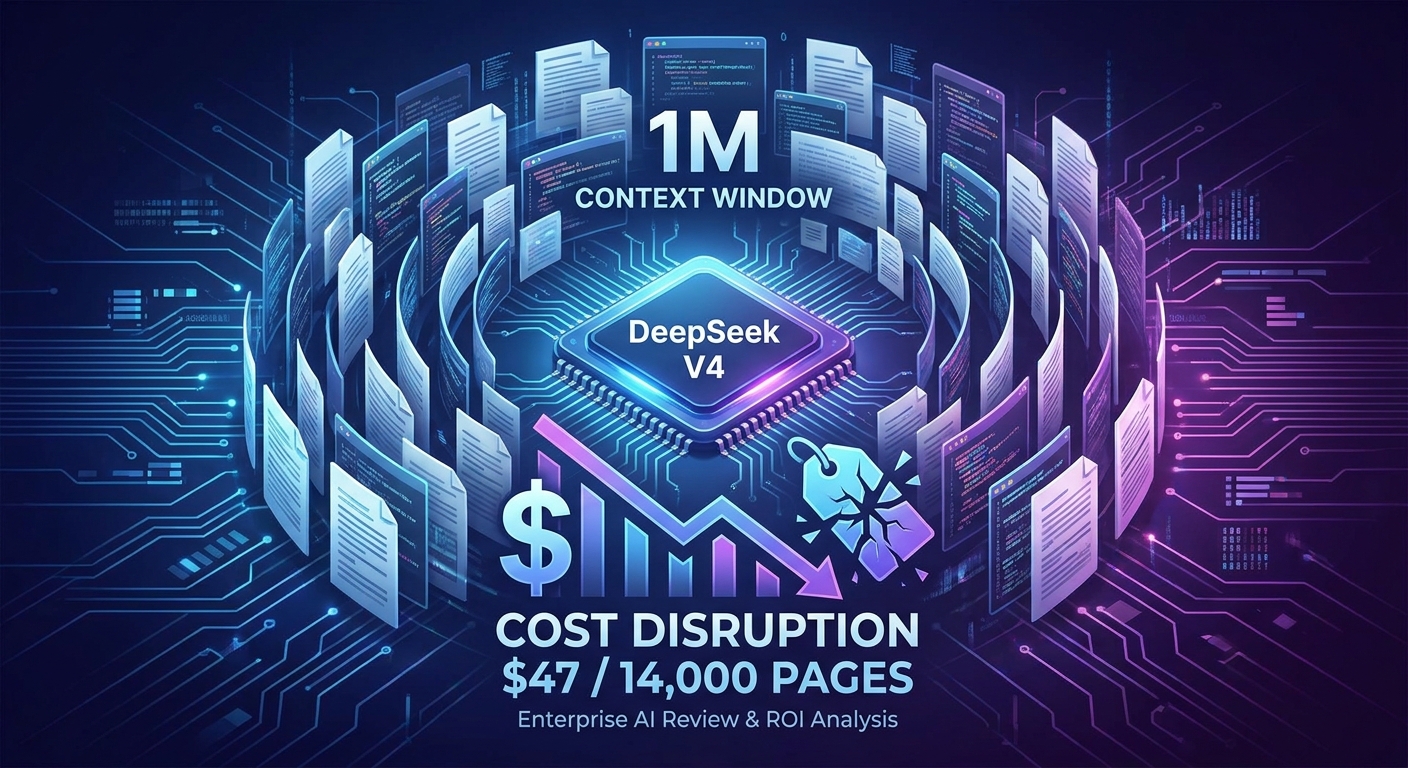
A Fortune 500 manufacturing company processed three years of supplier contracts—14,000 pages of unstructured legal text—in a single API call last month. Total cost: $47. The processing time: 8 minutes. This wasn’t a research experiment. It was a production deployment of DeepSeek V4 enterprise AI, and it represents the most significant pricing disruption in the enterprise AI market since GPT-3 launched in 2020.
While OpenAI, Google, and Anthropic compete on feature parity and governance frameworks, DeepSeek’s V4 model has introduced a fundamentally different value proposition: production-grade performance at 1/20th the cost. For B2B organizations evaluating AI coding tools comparison metrics and calculating enterprise AI adoption costs, this changes the ROI equation entirely.
This review examines DeepSeek V4 through the lens of enterprise deployment: technical capabilities, real-world limitations, cost structures, and strategic positioning against incumbent platforms.
DeepSeek V4 Technical Specifications Overview
Core Architecture and Capabilities
DeepSeek V4 launched in March 2026 with specifications that challenge the assumption that frontier AI capabilities require frontier pricing:
Model Parameters: 236 billion total parameters with a Mixture-of-Experts (MoE) architecture activating 21 billion parameters per token. This design delivers GPT-4-class performance while maintaining inference efficiency comparable to models one-tenth its size.
Context Window: 1 million tokens (approximately 750,000 words or 3,000 pages of text). This represents a 4x improvement over GPT-4 Turbo’s 128K context and matches Google’s Gemini 1.5 Pro, positioning it among production-grade AI systems capable of processing entire codebases, regulatory document sets, or multi-quarter business records in single sessions.
Supported Modalities: Text-only input and output. Unlike GPT-4V or Gemini’s multimodal capabilities, V4 focuses exclusively on language processing. This limitation is strategic—keeping infrastructure costs low while addressing the 80% of enterprise use cases that don’t require image or audio processing.
Training Data Cutoff: December 2025, making it current enough for contemporary business context while avoiding the hallucination risks associated with real-time data retrieval.
Performance Benchmarks at Launch
DeepSeek published third-party validated benchmarks across five enterprise-relevant categories:
– MMLU (general knowledge): 87.3% (vs GPT-4: 86.4%, Claude 3.5: 88.7%)
– HumanEval (code generation): 84.1% (vs GPT-4: 67.0%, Claude 3.5: 92.0%)
– GSM8K (mathematical reasoning): 91.7% (vs GPT-4: 92.0%, Claude 3.5: 95.0%)
– DROP (reading comprehension): 83.5% (vs GPT-4: 80.9%, Claude 3.5: 87.2%)
– Legal contract analysis (custom benchmark): 78.3% accuracy with 4.2% hallucination rate
These numbers position DeepSeek V4 solidly in the “good enough for most enterprise workflows” category—not best-in-class across all dimensions, but competitive where it matters for B2B AI automation ROI.
API and Integration Infrastructure
Enterprise deployment requires more than raw model performance. DeepSeek V4 ships with:
– REST and WebSocket APIs with OpenAI-compatible endpoints (drop-in replacement for existing integrations)
– Function calling for agent workflows and tool use
– Structured output mode guaranteeing valid JSON responses (critical for production systems)
– Batch processing API with 50% cost reduction for non-real-time workloads
– Fine-tuning capabilities supporting custom datasets up to 100,000 examples
The OpenAI compatibility is strategically significant. Organizations can test DeepSeek V4 against existing GPT-4 workflows by changing a single environment variable, reducing evaluation friction from weeks to hours.
1M Context Window: Enterprise Use Cases and Limitations
High-Value Applications in Production Environments
The 1M context window AI capability transforms specific enterprise workflows from technically impossible to economically viable:
**Complete