
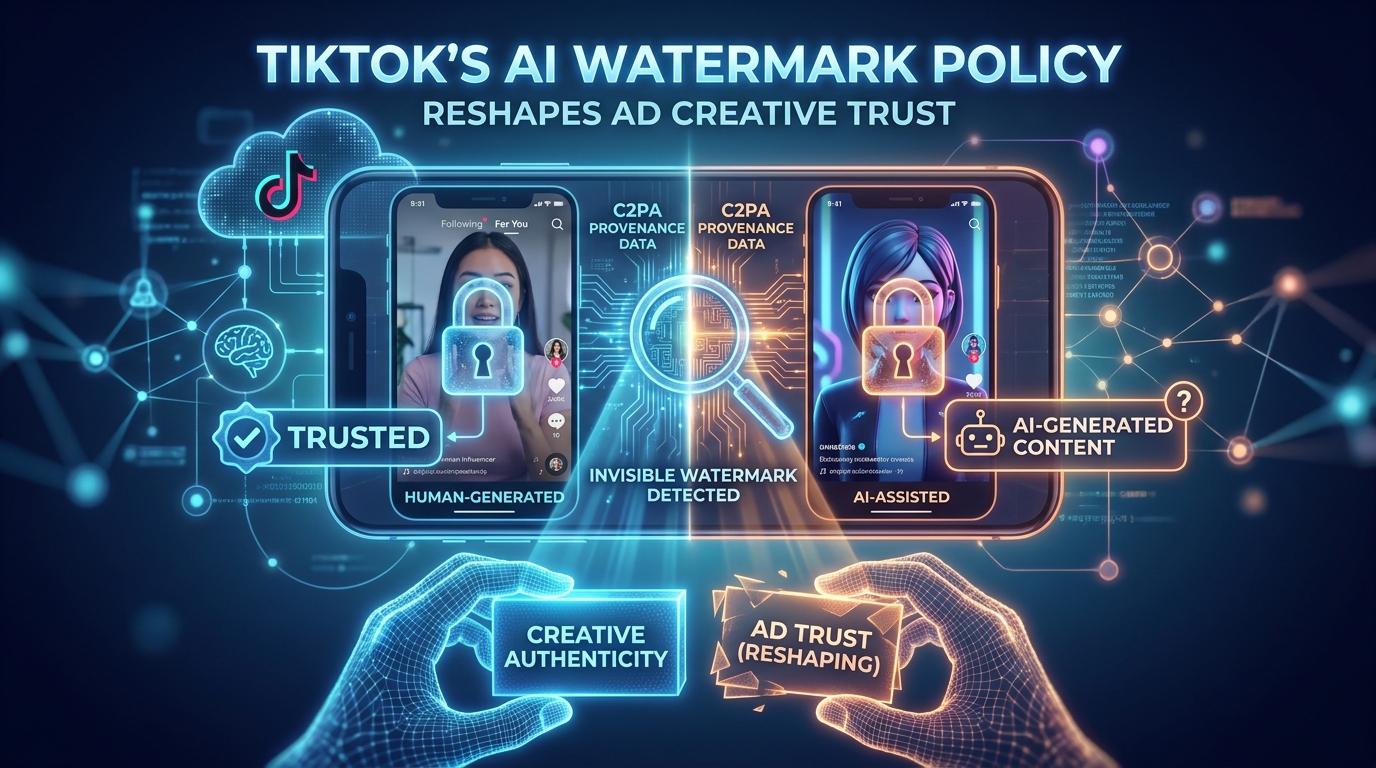
TikTok’s mandatory AI watermark policy, rolling out globally in June 2026, introduces invisible Content Credentials to all AI-generated video and image assets on the platform. This policy affects both organic and paid content, fundamentally altering how the platform’s interest-graph algorithm evaluates creative authenticity and how users respond to disclosed AI content. For brands and agencies, the shift demands immediate creative strategy adjustments and new performance benchmarks.
The Context: TikTok’s June 2026 AI Watermark Rollout
TikTok implemented its AI watermark policy on June 1, 2026, making it the first major social platform to mandate invisible watermark technology for all AI-generated content. The policy leverages Content Credentials standards developed by the Coalition for Content Provenance and Authenticity (C2PA), embedding metadata directly into media files that documents creation tools, modification history, and AI involvement.
The rollout applies to all content uploaded after the implementation date. Any video or image generated wholly or partially by AI tools—including generative backgrounds, AI avatars, synthetic voiceovers, or algorithmically enhanced visuals—now carries embedded watermarks visible through platform inspection tools. Users can tap a disclosure badge to view the full provenance chain.
For advertisers, this creates a binary classification system. Creative assets fall into either human-generated or AI-assisted categories, with no middle ground. The TikTok AI watermark policy treats any AI involvement, however minimal, as trigger for mandatory disclosure. This includes popular workflows like AI background removal, upscaling tools, or text-to-image generation for static elements within otherwise filmed content.
The timing coincides with broader platform shifts away from follower-based distribution. TikTok’s algorithm now prioritizes content that drives completion rates, saves, and shares over passive engagement metrics. AI content disclosure signals factor directly into these algorithmic calculations.
How Invisible Watermarks Change User Trust Dynamics
The invisible watermark technology operates at the file level, surviving downloads, re-uploads, and most editing processes. Unlike visible labels that creators could ignore or remove, Content Credentials persist through the content lifecycle. This creates permanent trust signals social media platforms can surface to users.
Early user research from [Stanford’s Internet Observatory](https://cyber.fsi.stanford.edu/) indicates disclosure impacts vary dramatically by content category. Entertainment-focused AI content sees minimal trust degradation when properly disclosed. Users report expecting creative enhancement in comedy sketches, dance videos, and artistic productions. The disclosure meets expectations rather than violating them.
Educational and informational content shows steeper trust penalties. When tutorials, product reviews, or news-adjacent content carries AI disclosure, users express skepticism about accuracy and authenticity. The watermark triggers questions about whether information was verified or merely synthesized.
For paid advertising, the dynamic splits along creative approach lines. Ads that lean into obvious creative fantasia—impossible scenarios, stylized aesthetics, surreal environments—see negligible performance impact from AI content disclosure. The watermark simply confirms what users already assumed.
Ads attempting photorealistic authenticity face measurable trust friction. When a TikTok ad shows what appears to be genuine user testimonials, behind-the-scenes footage, or documentary-style product demonstrations, AI disclosure creates cognitive dissonance. Users reconcile the visual realism with the AI label by downgrading credibility assessments.
This trust dynamic compounds with TikTok’s interest-graph algorithm, which surfaces content based on behavioral signals rather than social connections. Users encountering ads from unfamiliar brands lack the relationship context that might offset disclosure concerns. The watermark becomes the primary trust signal in the absence of established credibility.
Ad Creative Performance: Early Data and Signals
Three weeks into the TikTok AI watermark policy implementation, ad creative performance patterns are emerging across agency client portfolios. While comprehensive platform data remains proprietary, directional trends show clear segmentation by creative strategy.
Fully AI-generated ads using obvious synthetic aesthetics—animated characters, illustrated environments, stylized transitions—maintain baseline performance metrics. Click-through rates, conversion rates, and cost-per-acquisition figures track closely with pre-policy benchmarks for equivalent creative quality. The disclosure confirms user expectations rather than contradicting them.
Hybrid creative using AI for specific production elements shows mixed results. Background replacement, object removal, and color grading tools trigger watermarks but minimally impact performance when the core content remains authentic. A filmed product demonstration with an AI-generated background performs comparably to studio-shot equivalents.
The performance gap widens for AI-generated spokesperson content and synthetic testimonials. Ads featuring AI avatars delivering brand messages show elevated skip rates and reduced completion metrics compared to human-delivered scripts. The disclosure badge appears to trigger immediate skepticism about message authenticity, even when the script content itself is factual.
Direct response campaigns face the steepest challenges. When ad creative must drive immediate conversion decisions, AI disclosure introduces friction in the trust-building sequence. Users demonstrate lower intent signals—reduced add-to-cart rates, higher bounce rates from landing pages—when the initial ad carried AI watermarks.
These performance variations force strategic decisions about production investment. Brands must weigh AI production efficiency against potential performance degradation in trust-sensitive contexts.
The Algorithmic Shift: Why Watermarks Matter Beyond Transparency
TikTok’s algorithm treats AI disclosure as a content quality signal, not merely a transparency mechanism. The interest-graph algorithm evaluates how users respond to watermarked content, then adjusts distribution accordingly. This creates feedback loops that amplify performance differences.
Content that maintains strong completion rates and save metrics despite AI disclosure receives favorable algorithmic treatment. The platform interprets sustained engagement as signal that users value the content regardless of production method. This rewards creative approaches where AI enhancement aligns with user expectations.
Conversely, content showing elevated skip rates or reduced sharing after disclosure faces algorithmic suppression. The platform reads negative behavioral responses as quality signals, regardless of production quality or budget. An expensive AI-generated ad that fails to hold attention gets treated identically to low-effort spam.
This algorithmic layer means the TikTok AI watermark policy extends beyond individual ad performance to broader account quality scores. Accounts consistently posting AI content that underperforms risk reduced organic reach and higher paid media costs as the algorithm downgrades overall content quality assessments.
The relationship-first algorithm shift across platforms compounds these effects. As follower counts lose relevance, every piece of content must earn distribution through immediate engagement metrics. AI watermarks that trigger negative responses create steeper hurdles in earning algorithmic favor.
Brands cannot simply accept moderately degraded performance on AI content. The algorithmic consequences of consistent underperformance affect entire account ecosystems, including non-AI content posted from the same profile.
Strategic Implications for Brands and Agencies
The TikTok AI watermark policy forces immediate creative strategy reassessment. Agencies must audit client content libraries to classify production methods and predict disclosure impacts. This requires new content classification systems distinguishing between enhancement tools and generative creation.
Production workflows need explicit disclosure planning. Creative briefs should specify whether AI tools are acceptable for each project, based on content category and trust requirements. An entertainment-focused brand campaign might lean fully into AI generation, while thought leadership content demands purely human production.
Testing protocols must incorporate disclosure variables. Standard creative testing should now include AI versus human production comparisons within identical strategic approaches. This isolates disclosure impact from other creative variables, building evidence-based guidelines for tool selection.
Budget allocation shifts toward human production for high-stakes conversion content. While AI tools deliver production efficiency, the performance degradation in trust-sensitive contexts often exceeds the cost savings. Brands should reserve AI generation for awareness-stage content where disclosure carries minimal performance penalty.
Agency roles expand to include AI disclosure strategy. Media buyers need fluency in how watermarks affect auction dynamics and cost efficiency. Creative strategists must understand which content categories tolerate AI involvement and which demand authentic production. Account leadership should guide clients through production method tradeoffs rather than defaulting to efficiency optimization.
Platform diversification becomes risk management. Over-reliance on TikTok exposes brands to concentrated disclosure policy risk. Maintaining creative optionality across platforms with varying AI policies preserves strategic flexibility as the regulatory landscape evolves.
Long-term content library planning must account for persistent watermarks. Content created today carries disclosure metadata indefinitely. Brands building evergreen creative libraries should consider whether current production methods align with how disclosure policies might evolve over multi-year timeframes.
FAQ
Does TikTok’s AI watermark policy affect all advertisers equally?
No, performance impact varies significantly by content category and creative approach. Entertainment-focused content and obviously stylized creative see minimal impact, while photorealistic ads attempting authenticity face measurable trust friction. Direct response campaigns driving immediate conversions show the steepest performance degradation under disclosure.
Can brands remove or disable the AI watermark on their content?
No, the watermark is embedded at the file level using Content Credentials standards and cannot be removed by uploaders. The metadata persists through downloads, edits, and re-uploads. Attempting to strip or falsify watermark data violates platform policies and risks account penalties.
How does the algorithm treat AI-disclosed content differently?
TikTok’s interest-graph algorithm uses behavioral responses to watermarked content as quality signals. Content maintaining strong engagement despite disclosure receives favorable distribution, while content showing elevated skip rates faces algorithmic suppression. These effects compound across account-level quality scores affecting all content from that profile.
Should brands stop using AI tools for TikTok content creation?
Not necessarily, but tool selection should align with content category and trust requirements. AI tools remain viable for entertainment content, stylized creative, and obvious enhancement applications. High-stakes conversion content and authenticity-dependent messaging should prioritize human production to avoid disclosure-related trust penalties.
What other platforms are implementing similar AI watermark policies?
As of June 2026, TikTok is the first major platform with mandatory disclosure using invisible watermark technology. Meta has announced plans for similar implementation in Q4 2026, while YouTube is piloting voluntary disclosure tools. Industry momentum suggests invisible watermarking will become standard across major social platforms within 12-18 months.
—
Word count: 1,497
—
Need help navigating AI disclosure strategy across your paid social campaigns? [Subscribe to Alington Media’s weekly newsletter](https://alingtonmedia.com/newsletter) for agency insights on emerging platform policies and performance optimization.