
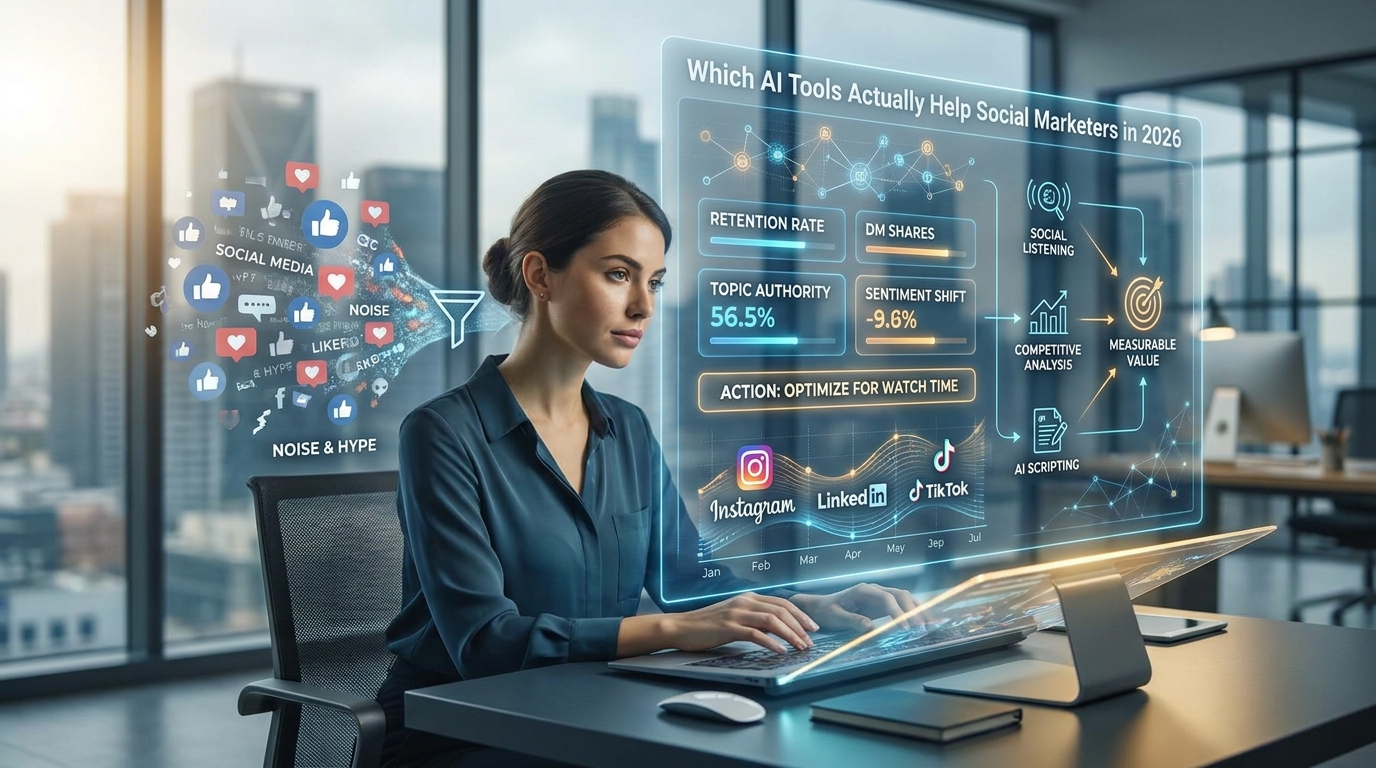
AI tools for social media have moved past hype cycles into practical deployment, but most marketing teams still struggle to separate signal from noise. This guide examines which social media AI tools deliver measurable value in 2026 — from social listening platforms to AI content scheduling systems — and where automation breaks down. The focus is on tools that adapt to platform algorithm shifts rewarding watch time, shares, and topic relevance over vanity metrics.
The Current State of AI in Social Media Marketing
The landscape has consolidated significantly. Early-stage AI content scheduling tools either evolved into full-stack platforms or disappeared entirely. What remains are purpose-built systems designed for specific workflow pain points rather than all-in-one promises.
The defining shift is platform behavior. Instagram, LinkedIn, and TikTok now prioritize retention metrics — how long viewers watch, whether they share to DMs, and how closely content matches declared user interests. Broad reach plays matter less than topical authority and genuine interaction depth.
This changes what social media automation tools need to accomplish. Generic posting calendars don’t cut it anymore. Tools must help teams identify micro-communities, optimize for watch completion rates, and track sentiment shifts in real time. The winners are those that surface strategic insights, not just scheduling convenience.
AI Tools for Social Listening and Research
Real-Time Audience Intelligence
Modern AI for social research analyzes conversations at scale to identify emergent topics before they peak. Tools like Brandwatch and Sprinklr use natural language processing to detect sentiment shifts, competitor positioning changes, and customer pain points surfacing in comments and Reddit threads.
The practical value shows up in positioning decisions. When a SaaS marketing team notices recurring questions about a specific integration, that insight feeds directly into content briefs and paid creative angles. When sentiment around a product category shifts negative, teams can pivot messaging before launching campaigns.
These platforms work best when tied to action. Running monthly reports doesn’t move the needle. Setting up alerts for specific keyword clusters, competitor mentions, or category trends creates a feedback loop that informs daily creative decisions.
Competitive Content Analysis
Some social media AI tools now benchmark content performance across competitors without requiring login access. They analyze public engagement patterns, posting cadence, creative formats, and audience response to identify what’s working in a specific niche.
This matters for B2B teams entering crowded categories. Instead of guessing which content formats drive results, you can analyze what already resonates with your target buyer profiles. The output isn’t “make videos like this” — it’s “this hook structure drives 40% higher completion rates in fintech decision-maker feeds.”
AI-Powered Scripting and Content Creation Tools
From Prompts to Publication-Ready Copy
AI scripting tools have matured past generic templates. Platforms like Jasper, Copy.ai, and Writesonic now integrate with brand voice documentation, previous high-performing posts, and platform-specific formatting requirements.
The workflow improvement is tangible. A content manager can feed three bullet points into a tool trained on their company’s tone and get back five LinkedIn post variations optimized for different audience segments. The first draft quality has improved enough that editing time often drops by 60-70%, not because AI writes perfectly, but because it handles structural grunt work.
The limitation remains nuance. AI tools struggle with contrarian takes, industry-specific jargon used correctly in context, and the kind of vulnerable founder-led storytelling that drives B2B engagement in 2026. They excel at explanatory posts, listicles, and educational content frameworks.
Video Script Generation and Hook Testing
Short-form video scripting represents the fastest-growing use case. Tools analyze trending formats on TikTok and Instagram Reels, then generate script structures optimized for retention.
The best implementations combine AI-generated hooks with human expertise on product positioning. A team might generate 20 opening hooks, test the top five in production, then feed performance data back into the system to refine future outputs. This isn’t autopilot — it’s accelerated iteration.
Intelligent Scheduling Without Losing the Human Touch
Timing Optimization vs. Strategic Presence
AI content scheduling has shifted from “post when your audience is online” to “post when your content type performs best for this specific goal.” Tools like Buffer and Hootsuite now use machine learning to recommend timing based on content format, topic, and historical engagement patterns.
The difference matters. A thought leadership LinkedIn post might perform best Tuesday morning when decision-makers browse during coffee, while a product demo video could peak Thursday afternoon when teams are researching solutions before end-of-week purchases.
But automation creates risk. Over-reliance on AI scheduling removes the human judgment that catches tone-deaf timing — launching a celebratory campaign the same day negative industry news breaks, for example. The strongest approach uses AI recommendations as defaults with mandatory human review for anything high-stakes.
Maintaining Authentic Engagement
Social media automation tools now include “authentic engagement windows” — periods where AI won’t auto-post, reserved for real-time interaction. This acknowledges that algorithms reward fast, genuine responses to comments and DMs.
The tactical implementation: schedule evergreen content via AI, but leave mornings open for founder-led posts and active comment participation. Platforms are sophisticated enough to detect which accounts behave like broadcast channels versus genuine participants. The latter get distribution advantages.
Where AI Stops and Strategy Begins
No AI tool builds a differentiated point of view. The platforms rewarding niche authority and topical relevance in 2026 require human strategic decisions AI can’t make: which market position to claim, which audience subset to serve intensely, which contrarian perspective to defend.
Social media AI tools accelerate execution once strategy exists. They help teams produce more variations, identify performance patterns faster, and maintain consistency at scale. They don’t replace the creative director who knows why a specific angle will resonate, or the founder whose personal story builds trust.
The teams seeing ROI from AI investment treat these tools as leverage, not replacement. They define clear brand positioning, then use AI to test 10 headlines instead of three. They set engagement goals, then use listening tools to find earlier signals. The strategy remains human; the amplification is automated.
The risk is inverting this relationship. Teams that ask AI “what should our social strategy be” get generic recommendations indistinguishable from competitors. Those that ask “how do we test this specific positioning across 50 audience micro-segments” unlock compounding advantages.
—
FAQ
What AI tools are best for small social media teams in 2026?
Start with AI listening tools that surface audience insights and content opportunities, then add scripting assistance for high-volume platforms like LinkedIn or Twitter. Avoid all-in-one platforms until you’ve defined clear workflow bottlenecks — specialized tools outperform generic suites for lean teams.
Can AI fully automate social media marketing?
No. Platforms increasingly reward authentic engagement, fast response times, and differentiated perspectives that require human judgment. AI handles content variation, timing optimization, and research synthesis, but strategic positioning and genuine community building remain human responsibilities.
How do AI scheduling tools adapt to 2026 algorithm changes?
Modern tools continuously retrain on engagement data, adjusting recommendations as platforms shift metrics emphasis. The best systems let you set goals (maximize shares vs. comments vs. watch time) and optimize timing and format suggestions accordingly, rather than using static “best time to post” rules.
What’s the ROI timeline for implementing social media AI tools?
Most teams see workflow efficiency gains within 30 days — faster content production, better research synthesis. Strategic impact like improved engagement rates or audience growth typically emerges after 90 days once you’ve iterated based on AI-surfaced insights and optimized content testing cycles.
Should B2B companies use AI for founder-led social content?
Use AI for structure and variation testing, not voice or perspective. Founder-led content works because it’s authentic and opinionated — AI can suggest hooks or formats, but the core insights must remain human. The strongest approach: founder provides raw thoughts, AI helps format and test variations.
—
Want help implementing AI tools that actually move metrics? Alington Media works with B2B teams to build efficient, strategy-first social systems. [Get in touch](https://alingtonmedia.com/contact) to discuss your specific challenges.