
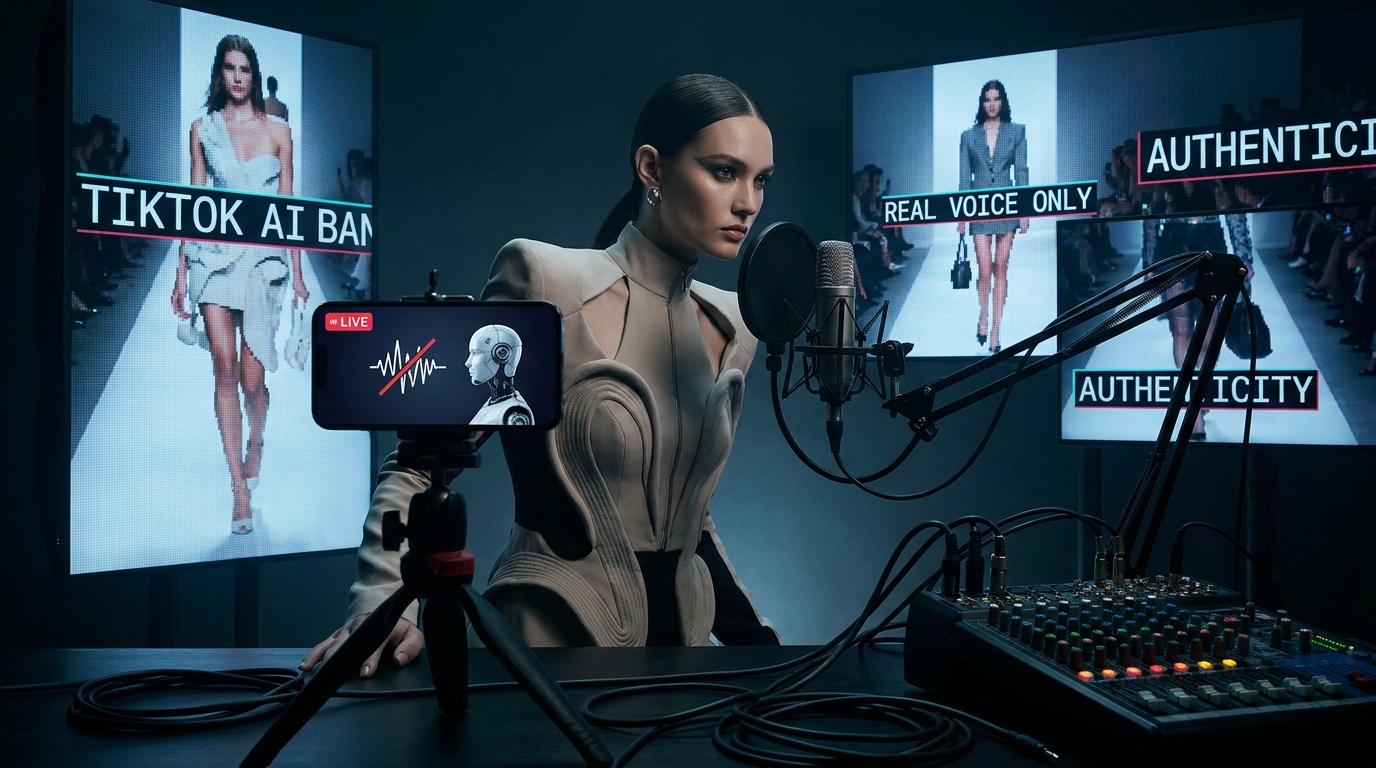
TikTok has banned AI-generated voices in livestream advertisements, forcing fashion and beauty brands to rebuild their creative strategies mid-campaign. This post explains why the TikTok AI voice ban happened, what it means for paid ad performance in an interest-graph world, and the specific creative adjustments your team needs to make this quarter.
Why TikTok Banned AI Voices in Livestreams
TikTok quietly updated its advertising policies in late June 2024 to prohibit synthetic voices in livestream commerce ads. The platform’s Advertising Policies page now explicitly states that advertisers cannot use “AI-generated voices, deepfakes, or synthetic audio that mimics human speech” in any livestream ad format.
The timing isn’t accidental. TikTok Shop launched aggressive expansion into fashion and beauty verticals throughout 2024, and the platform saw a flood of low-quality livestream ads using cheap AI voice tools. These ads featured static product shots with robotic voiceovers cycling through feature lists—think dropshipping aesthetics at premium brand scale.
The ban targets livestream formats specifically because that’s where TikTok’s commerce future lives. Standard in-feed video ads can still use AI voices, but livestream shopping ads—the format TikTok is pushing hardest for conversion—cannot. This creates a split testing environment where your creative strategy now differs by placement.
The Real Reason This Matters for Paid Ads
The TikTok AI voice ban isn’t about audio quality. It’s about watch time, and watch time dictates everything in interest-graph marketing.
TikTok’s algorithm doesn’t care about your follower count. It cares whether viewers watch your ad past the three-second mark, whether they rewatch it, and whether they send it to friends. AI voices consistently underperform on these metrics because they sound like ads, and ads get skipped.
Here’s the operational reality: TikTok’s interest-graph ranking means your ad creative competes directly with organic content for attention. When a user opens TikTok, the algorithm serves a mix of paid and organic posts based purely on predicted engagement. If your ad uses an AI voice that signals “skip this,” you’re paying for impressions that generate no watch time—and the algorithm learns to stop showing your ads.
This applies across platforms now. Meta shifted to interest-graph ranking in 2023. YouTube Shorts prioritizes watch time over subscriber status. LinkedIn’s feed algorithm weights dwell time more heavily than connection graph. The common thread: content that holds attention gets distributed, regardless of who posted it.
Fashion brand paid ads face a specific challenge here. Your product shots are beautiful, but beauty doesn’t equal engagement. A well-lit flat lay of a handbag won’t hold attention unless the first two seconds create pattern interruption. AI voices remove the one remaining tool for that interruption—human vocal personality.
How Fashion and Beauty Brands Used AI Voices
Before the TikTok AI voice ban, fashion and beauty marketers relied on AI voices for three specific use cases, all of which now need replacement.
Product launch announcements used AI voices to localize the same visual creative across markets. A single video asset could run with English, Spanish, French, and Mandarin voiceovers without hiring talent or managing studio time. Brands launching seasonal collections across regions built entire media plans around this efficiency.
Testimonial-style ads deployed AI voices to narrate user-generated content compilations. A brand would license customer photos, sequence them in a slideshow, and overlay an AI voice reading five-star reviews. This format converted well because it mimicked organic testimonial content, but the voice quality never quite matched the authenticity of the visuals.
Rapid testing frameworks used AI voices as placeholder audio. Performance creative teams would test ten product hooks in a week, all using the same AI voice template to isolate which hook drove click-through rates. Once a winner emerged, they’d re-shoot with human talent. This testing velocity is now impossible in TikTok livestream formats.
The beauty brand TikTok strategy adapted faster because beauty creators already dominated the platform. Fashion brands, selling higher-consideration products with longer purchase cycles, leaned harder on controlled brand creative—which meant more AI voice usage.
The Interest-Graph Implications No One’s Talking About
The TikTok AI voice ban exposes a deeper tension in interest-graph marketing: brands optimized for scale can’t move fast enough to win attention.
Interest-graph algorithms reward recency and relevance. A fashion brand’s Spring 2025 campaign launched in February becomes stale by March, not because the product changed but because the algorithm has seen that creative pattern thousands of times. Repetition kills distribution.
AI voices promised a solution—swap the audio, refresh the creative signal, maintain algorithm novelty without reshooting. That hack is now dead for TikTok livestream advertising, which forces brands back to the fundamental problem: you need more creative, faster, and it needs to feel native.
Native feeling matters because interest-graph feeds blur the line between ads and content. Users don’t consciously switch modes between “scrolling entertainment” and “viewing ads.” Your paid creative gets the same three-second audition as a dance trend or recipe video. AI voices fail that audition because they sound categorically different from how creators talk.
This creates asymmetric advantage for brands with creator networks. If you can deploy twenty micro-influencers to film product hooks in their own voices on their own accounts, you’ve built a creative engine that matches algorithm demand. If you’re still routing everything through an agency that delivers quarterly campaign assets, you’re structurally mismatched to how these platforms distribute reach.
The interest-graph shift also means your creative testing budget needs to 10x while your media budget stays flat. You’re not buying reach anymore—you’re earning it through creative performance. That inverts traditional media planning, where 80% of budget went to placement and 20% to production.
What Winning Creative Looks Like Now
Post-ban TikTok livestream ads require human voices, but not professional ones. In fact, overly polished voiceovers hurt performance for the same reason AI voices did—they signal “ad” instead of “content.”
Founder-led creative outperforms branded creative by every engagement metric that matters. The founder of a sustainable fashion brand talking directly to camera about supply chain challenges will hold attention longer than a model walking through a studio. This isn’t about production value. It’s about perceived authenticity and the interest-graph’s preference for human-to-human communication patterns.
Record these on iPhone. Use natural light. Let the founder stumble over words. The imperfection is the strategy because it matches how organic content looks.
Customer voice takeovers solve the testimonial problem without AI. Instead of narrating user photos with synthetic voices, give customers your product and ask them to film their own 15-second reaction. String together ten of these with minimal editing. The varied voices, backgrounds, and energy levels create pattern interruption every few seconds—exactly what watch time optimization requires.
License these clips properly and compensate customers fairly, but the production cost is still lower than studio shoots and the performance delta is measurable.
Employee perspectives work especially well for fashion brand paid ads because they bypass the founder personality dependency. Have your patternmaker explain why a seam is constructed a certain way. Let your stylist show three ways to wear a piece. These voices carry subject matter authority without requiring C-suite charisma, and they generate endless creative variations from your existing team.
The strategic shift here is treating paid ads like content franchises rather than campaigns. Instead of one hero video per product launch, you need twenty micro-pieces of content per product, each featuring a different voice and angle. The algorithm will tell you which three of those twenty earn distribution, and you scale budget to those winners.
FAQ
Can I still use AI voices in regular TikTok video ads?
Yes. The TikTok AI voice ban only applies to livestream advertising formats. Standard in-feed video ads can still use synthetic voices, though they’ll likely underperform human voices on watch time metrics regardless of policy.
What counts as an AI voice under TikTok’s policy?
TikTok defines AI voices as any synthetically generated audio designed to mimic human speech, including text-to-speech tools, voice cloning software, and deepfake audio. Heavily processed human voices with effects applied are still permitted as long as the original voice is human.
Do other platforms plan to ban AI voices in ads?
Meta and YouTube haven’t announced similar policies as of July 2024, but both platforms have introduced AI labeling requirements for synthetic media. The trend points toward disclosure rather than prohibition, but watch time performance will likely drive creative decisions more than policy will.
How does this affect localization for global campaigns?
You’ll need human voice talent for each market instead of running one video with AI-translated audio. The budget impact is significant, but consider testing English-only ads in non-English markets first—interest-graph algorithms often prioritize engaging content over language match.
Should fashion brands stop using AI voices entirely?
Not necessarily. AI voices still work for non-ad contexts like product description videos on your website or internal training materials. The issue is performance in interest-graph feeds where they can’t compete with human vocal patterns for attention.
—
Need help rebuilding your creative strategy around interest-graph dynamics? [Subscribe to Alington Media’s weekly breakdown](https://alingtonmedia.com) of platform changes that actually affect your paid performance.