
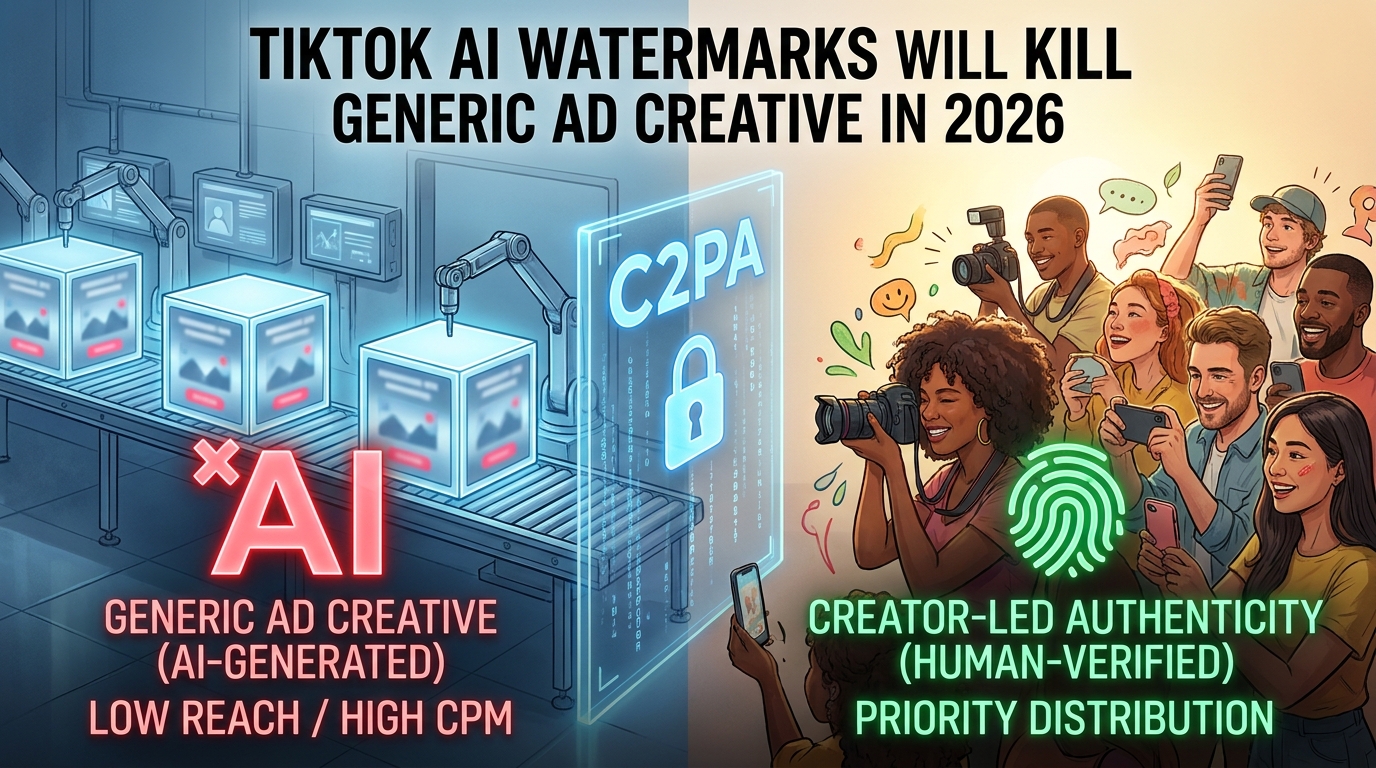
TikTok’s integration of C2PA credentials—invisible AI watermarks that authenticate content provenance—will fundamentally change how paid ads perform on the platform. Brands relying on scaled, AI-generated creative will face targeting penalties and reduced reach, while creator-led advertising with verified human authorship will gain preferential distribution and audience trust.
Why TikTok’s C2PA Integration Changes Everything
TikTok began rolling out C2PA credentials in late 2024, initially labeling AI-generated content with visible tags. By early 2026, the system evolved into a backend authentication layer that feeds directly into the algorithm.
Every video uploaded now carries embedded metadata: who created it, what tools were used, whether generative AI played a role in production. The Content Authenticity Initiative’s open standard makes this data cryptographically verifiable and tamper-resistant.
This isn’t just transparency theater. TikTok’s ad delivery system now reads these credentials and adjusts bidding, reach, and targeting based on content authentication signals. TikTok AI watermarks have become a de facto ranking factor.
The shift mirrors what’s already happened to organic reach. Generic brand-page content has collapsed across all major platforms. Audiences ignore polished, committee-approved posts. They engage with founder-led or creator-led accounts that feel unfiltered and real.
C2PA credentials formalize that preference into the paid ads infrastructure.
How Invisible AI Watermarks Expose Generic Creative
Most brands don’t realize their creative is already flagged. If your agency uses Midjourney for static images, Runway for b-roll, or ChatGPT to draft scripts, those assets carry embedded provenance data.
TikTok’s system doesn’t block AI content. It classifies it. And classification determines distribution.
Here’s what happens: you upload an ad with AI-generated voiceover and synthetic b-roll. The C2PA metadata reveals the content chain. The algorithm sorts it into a lower-trust tier. Your CPM rises. Your feed placement drops. Your For You Page penetration shrinks.
The inverse is also true. A creator shoots a selfie-style testimonial on an iPhone. No AI tools in the production chain. C2PA credentials confirm human authorship. The algorithm prioritizes it in auctions. Your cost per acquisition drops.
This is AI content authentication as a competitive moat. Brands that invested in creator partnerships and authentic content marketing now have a structural advantage in TikTok paid ads targeting.
The Death of Scaled Brand Content (And Why That’s Good)
For years, performance marketers chased scale through templatization. One concept, fifty variations, algorithmic testing. AI tools like Synthesia and Captions accelerated this model by removing production bottlenecks.
That playbook is now underwater. When TikTok’s algorithm can detect that your fifty ad variants came from the same generative pipeline, it penalizes the entire batch for lack of genuine diversity.
Scaled brand content worked when platforms couldn’t distinguish between authentic variance and cosmetic iteration. C2PA credentials eliminate that ambiguity.
The upside: this forces brands back toward quality and specificity. Instead of fifty generic hooks, you need five genuinely differentiated perspectives. That means working with real creators who bring their own audiences, voices, and proof points.
This isn’t a return to influencer marketing circa 2019. It’s a recognition that dwell time and private sharing—Sends, specifically—drive algorithmic distribution more than likes or comments. And Sends only happen when content feels personally relevant, not mass-produced.
Creator-Led Ads vs AI-Generated: The Targeting Split
TikTok’s ad manager now segments inventory based on content provenance. You can bid exclusively on authenticated human-created content slots, or you can accept mixed inventory that includes AI-flagged placements.
The pricing gap is significant. Authenticated inventory commands a 30-40% premium in competitive verticals. But conversion rates justify the markup. Users trust creator-led advertising more, especially in categories like finance, health, and B2B software where credibility determines purchase intent.
Brands now face a strategic fork. Option one: continue producing scaled AI creative at lower cost, accept lower performance, and compete in the bargain bin. Option two: restructure budgets toward fewer, higher-quality creator partnerships that qualify for authenticated targeting.
Most brands still operate on the first path because their internal workflows assume volume is the variable to optimize. Creative testing frameworks, agency retainers, and approval processes all assume you need dozens of assets per campaign.
That assumption breaks when the platform itself rewards singular, verifiable authorship over iterative testing.
How to Restructure Your Paid Strategy for Authenticated Content
Start by auditing your current creative pipeline. Which assets carry AI provenance? Which are fully human-authored? Use TikTok’s Creator Marketplace to identify partners whose content already earns authenticated distribution.
Shift budget from pre-produced creative to Spark Ads—paid promotion of organic creator posts. These inherit the creator’s C2PA credentials and audience trust. You’re amplifying content that already works rather than fabricating something new.
Negotiate usage rights differently. Instead of buying one-off deliverables, establish ongoing partnerships where creators test concepts organically, then you amplify what resonates. This turns creators into de facto R&D for your paid strategy.
Build a hybrid model. Reserve 60-70% of spend for authenticated creator content. Use the remaining 30-40% for rapid testing with AI tools, knowing you’ll pay a performance penalty. This lets you explore hooks quickly while maintaining a foundation of high-trust creative.
Track performance by provenance tier. Your analytics should separate AI-flagged ads from authenticated ones. Most brands still aggregate all creative into one reporting bucket, which masks the gap.
Finally, educate internal stakeholders. The CMO who greenlit a scaled AI content strategy in 2024 needs to understand why that approach no longer delivers ROI. TikTok AI watermarks have changed the economics of creative production, not just the optics.
—
FAQ
What are TikTok AI watermarks and how do they work?
TikTok AI watermarks are invisible C2PA credentials embedded in video files that verify whether content was created by humans or AI tools. The platform’s algorithm uses this metadata to classify ads and adjust their distribution and pricing in the auction system.
Do AI watermarks completely block AI-generated content on TikTok?
No, AI-generated content isn’t blocked, but it’s deprioritized in ad auctions and organic reach. Brands can still run AI-created ads, but they’ll pay higher CPMs and see lower engagement compared to authenticated human-created content.
How does C2PA authentication affect organic reach?
Organic posts with verified human authorship receive preferential algorithmic treatment, especially when they drive high dwell time and Sends. Generic brand content with AI provenance sees reduced For You Page placement and lower engagement rates.
What’s the cost difference between authenticated and AI-flagged ad inventory?
Authenticated creator content commands a 30-40% premium in competitive categories, but typically delivers higher conversion rates. The effective cost per acquisition often favors authenticated content despite the higher CPM.
Should brands stop using AI tools for content creation entirely?
Not entirely, but the use case shifts. AI tools work for rapid testing and exploration, but performance-critical campaigns should prioritize creator-led advertising with verified human authorship to maximize TikTok paid ads targeting effectiveness.
—
Want to restructure your paid strategy for the C2PA era? [Subscribe to Alington Media’s weekly insights](https://alingtonmedia.com/newsletter) on AI, automation, and authentic content marketing.