Category: Digital Marketing Strategy

Broader marketing advice, planning, and ROI topics.

  • The LinkedIn Algorithm Audit: What Actually Moves Reach

    The LinkedIn Algorithm Audit: What Actually Moves Reach

    Every time LinkedIn tweaks its feed ranking, the same cycle happens. Someone posts a screenshot of a reach drop, a dozen “gurus” publish theories with zero data behind them, and everyone changes their posting habits based on a guess. I did that for about a week after my reach started sliding. Then I stopped guessing and built a pipeline to actually check.

    Here’s the exact system, so you can run it on your own account instead of trusting someone else’s screenshot.

    The Pipeline: n8n + Claude

    The goal was simple: pull every post from the last 60-90 days, grab the metrics LinkedIn actually shows me (impressions, reactions, comments, reposts, and rough dwell/scroll signals from the analytics export), and have Claude score each post against the others instead of me eyeballing a spreadsheet.

    Step 1: Pull the raw data

    LinkedIn doesn’t give you a clean API for personal profile analytics, so the workaround is the manual export (Analytics > Post analytics on each post, or the aggregated export from your Creator dashboard) dropped into a Google Sheet. An n8n workflow watches that sheet via the Google Sheets trigger node and pulls new rows on a schedule.

    Step 2: Normalize the metrics

    Raw impressions are useless without context. A Function node in n8n normalizes each post’s numbers against the account’s rolling 30-post average, so you’re comparing relative performance, not absolute numbers that get skewed by follower growth. This step matters more than people think – without it you’ll think your “algorithm changed” when really your audience just grew 20%.

    Step 3: Feed it to Claude for pattern scoring

    Once the data is normalized, an HTTP Request node sends batches of posts (text + normalized metrics) to Claude with a structured prompt: score each post’s opening line for scroll-stop strength, flag comment length and depth, flag any engagement-bait phrasing (“comment YES”), and rank posts by a composite score weighting saves/shares highest, comments second, reactions last. Claude returns structured JSON, which n8n writes back into the sheet. If you haven’t built error handling into a workflow like this yet, do it before you trust the output – a silently failed node will quietly corrupt your data and you won’t notice until the conclusions are wrong. I wrote the exact fix for this in The Silent Failure: Fix n8n’s Green Checkmark Lie, and the follow-up build is here: n8n Failed Silently? Build This Error Handler Today.

    What The Data Actually Showed

    Across 30 posts, four patterns held consistently enough to act on:

    • Sub-130-word posts got buried unless the first line stopped the scroll cold. Short posts with a weak hook underperformed long posts with a strong one, every time.
    • A comment over three words counted roughly 4x a like in terms of downstream reach. LinkedIn is visibly weighting conversation over approval.
    • Saves and shares outweighed reactions and comments combined on the top-performing posts. That’s the strongest signal in the dataset.
    • “Comment YES” bait tanked reach on every single post that used it, no exceptions in this batch.

    The pattern underneath all of it: LinkedIn stopped rewarding volume of engagement and started rewarding depth of engagement. A post that gets 12 real comments and 4 saves is outperforming a post with 200 one-word reactions. That’s a meaningful shift if you’ve been optimizing for reaction counts.

    How To Run This On Your Own Account

    You don’t need the full n8n build to get value from this. Start manually:

    • Pull your last 20-30 posts into a spreadsheet with impressions, comments, reactions, reposts, and word count of the opening line.
    • Tag each post: did it use engagement bait? Did the first line make a claim or ask a generic question?
    • Sort by saves/shares first, comments second, reactions last – not by impressions. Impressions without action is a hollow number, which is the same math I broke down in The 200-Person Math: Why Reach Isn’t Revenue.
    • Once you see the pattern manually, automate the pull with n8n and let Claude do the scoring at scale so you’re not doing this by hand every month.

    If you’re deciding between formats while you rebuild your posting habits, the format question isn’t a guess either – I ran the same kind of breakdown on carousels vs. text posts, and the results surprised me. Worth reading before you pick your next format: Carousel vs Text Post: The Full 51-Post Breakdown.

    The Actual Takeaway

    LinkedIn’s public guidance on feed ranking has always been vague by design – they’ve said openly that relevance and “meaningful engagement” drive distribution, without publishing the weights (LinkedIn’s own feed content guidelines confirm the emphasis on genuine interaction over passive consumption). That vagueness is exactly why guessing doesn’t work and measuring does. You don’t need LinkedIn to publish the algorithm. You need your own data, run through a pipeline you control, telling you what’s actually happening on your account – not someone else’s.

    Build the pipeline once with tools like n8n and Claude, and you stop reacting to every algorithm rumor and start posting based on what your own numbers say.
  • Carousel vs Text Post: The Full 51-Post Breakdown

    Carousel vs Text Post: The Full 51-Post Breakdown

    Everyone has an opinion on carousels vs text posts. Almost nobody has tested it on their own audience. I did, on my own page, same idea, same day, one carousel version and one text version. Then I went back and pulled the numbers on my last 51 posts to see if the pattern held. It did, but not for the reason I expected.

    The Test: Same Idea, Two Formats

    I took one insight I wanted to share and built two versions:

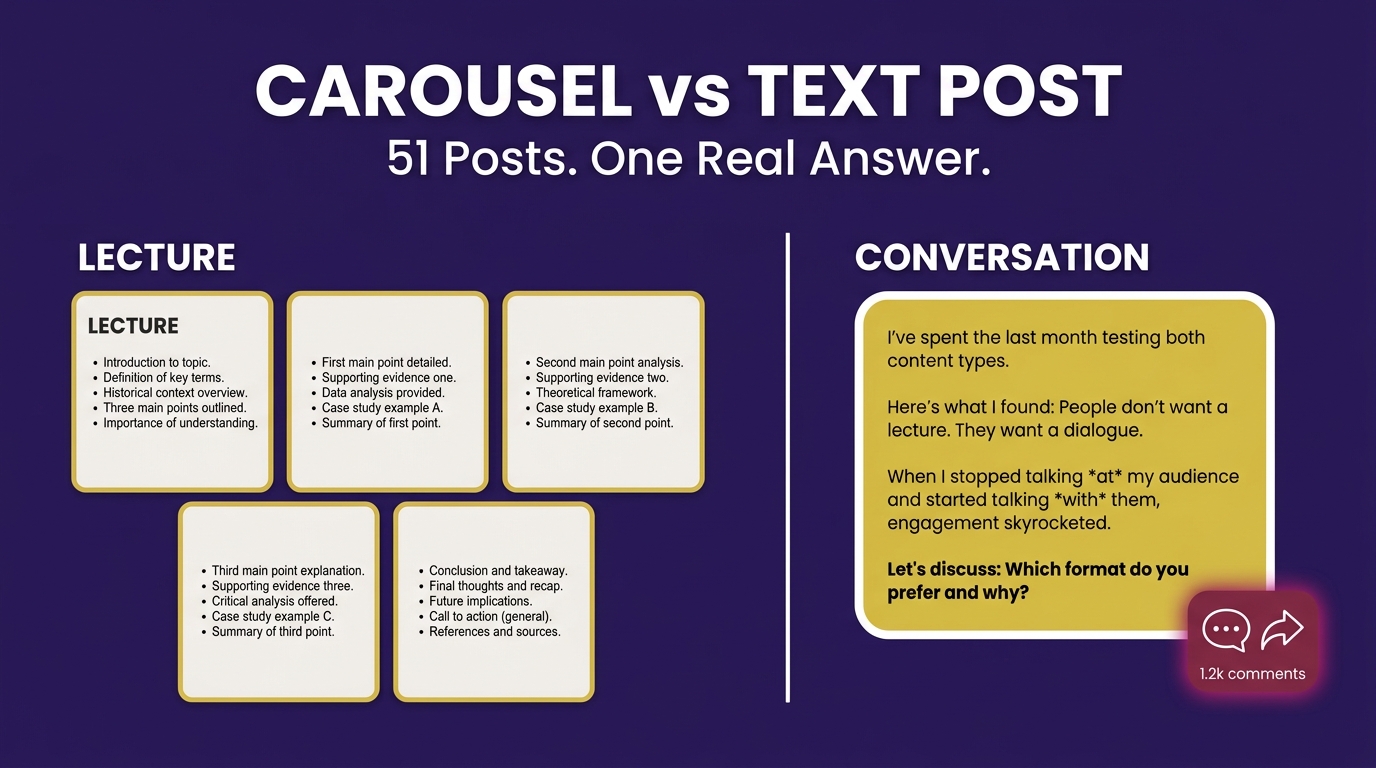
    • A 5-slide carousel breaking the idea into steps, one point per slide, clean design.
    • A plain text post, same idea, written the way I’d say it to one person over coffee.

    Posted the same day, similar time window, no paid boost, no engagement pod nonsense. The text post won by a landslide — more reach, more comments, more saves.

    My first instinct was “carousels are dead.” That’s the lazy conclusion, and it’s wrong. The real problem was how I wrote the carousel. I wrote it like a lecture: numbered points, no voice, no stakes, nothing that sounded like a person talking. The text post read like I was talking to one specific reader. That’s the actual variable. Format didn’t lose. Tone did.

    Going Back Through 51 Posts

    One test isn’t a pattern, so I pulled the last 51 posts on my personal page and ran the real numbers:

    • 51 posts total, mixing text, carousels, and a few video clips.
    • 56,487 people reached across all 51.
    • My personal content — the posts written in first person, about something I was actually building or messing up — got shared 9.7x more than anything I posted for the business page in the same window.
    • 20 of those posts reached over 22,000 people combined and got exactly zero comments.

    That last stat is the one that made me stop and rewrite my whole approach. Reach with zero comments means the post got shown to a lot of people and none of them felt like responding. That’s not a small-sample fluke at 20 posts. That’s a pattern in how I was writing.

    Why Reach Without Comments Is a Warning Sign

    It’s easy to screenshot a big reach number and call it a win. But reach is a vanity checkpoint, not the goal — I’ve written about this before in The 200-Person Math: Why Reach Isn’t Revenue, and this test proved it again from a different angle. A post that reaches 22,000 people and gets zero comments isn’t failing at distribution. It’s failing at connection. LinkedIn’s own ranking signals lean heavily on early engagement velocity — comments and shares in the first hour matter more than raw impressions, which platforms like Hootsuite have documented in their LinkedIn algorithm breakdowns. If nobody comments, the algorithm reads that as “nobody cared,” and your next post gets throttled before it even starts.

    The 4 Rules I Run Now

    1. Write to one person, not a room

    Every high-performing post in my 51 used “you” or told a story about one specific moment. The zero-comment posts used “we” or talked in general truths. Specificity forces a reaction. Generality invites scrolling past.

    2. Personal beats branded, every time, in the feed

    The 9.7x gap between personal and business content wasn’t close. If you’re building a company page and a personal page side by side, the personal one carries the business page’s reach. This is also why I’ve argued you don’t need to show your face to build a real personal brand — voice and specificity do the work, which I get into in Build a Personal Brand Without Showing Your Face.

    3. End every post with a real question, not a fake one

    “Thoughts?” gets ignored. A specific question tied to the post’s story gets answered. The comment prompt in my original post — “what’s the last post you argued about instead of testing” — is the same mechanic: give people something concrete to respond to, not an open floor.

    4. Audit format only after you’ve audited voice

    Before you run another carousel-vs-text debate, check if your last 10 posts sound like a press release or a person. If your writing sounds AI-generated or corporate, no format will save it — I broke down exactly how to fix that drift in The AI Voice Fingerprint Fix. Format is the last variable to test, not the first.

    What to Do With Your Own Numbers

    Pull your last 30-50 posts. Sort by reach, then sort by comments. Look for the posts that got both. Read them side by side with the posts that got reach and nothing else. You’ll find your own version of the lecture-vs-conversation gap within ten minutes. Stop arguing about carousels. Go run the test on your own page — the answer’s already sitting in your analytics tab.

  • The 200-Person Math: Why Reach Isn’t Revenue

    The 200-Person Math: Why Reach Isn’t Revenue

    Everyone gives you the same order of operations: build the audience, then the offer. Get to 10,000 followers, then figure out what to sell them. I ran my own numbers against that advice because it never sat right, and the data backed up what I suspected — reach was never the bottleneck. Trust was.

    The Actual Numbers

    Over 51 posts, I reached 56,487 people. On paper that looks like a healthy audience. But when I broke it down by post type and engagement, the picture changed fast:

    • Personal posts (behind-the-scenes, opinions, things I built and broke) got shared 9.7 times more than anything I posted for the business.
    • 20 of those 51 posts, reaching a combined 22,000+ people, got zero comments. Not one.
    • The posts that actually drove replies, saves, and DMs came from a much smaller slice of that 56,487 — closer to a few hundred people, repeatedly.

    That’s the part nobody tells you: reach and relationship are two different metrics, and only one of them pays you.

    Why 10,000 Followers Is the Wrong Number

    Kevin Kelly’s original argument still holds up over a decade later — you don’t need millions of fans, you need enough true fans who will buy whatever you produce. His essay 1,000 True Fans was written before the algorithm era, and it’s more accurate now than when he wrote it, because algorithmic reach is rented, not owned. You can hit 56,000 impressions and still have zero people who’d notice if you disappeared tomorrow.

    Trust doesn’t scale linearly with reach. It compounds through repeated, specific contact — someone seeing you show your actual thinking, not your polished output, enough times that they start treating you as a known quantity. That’s also why founder-led content consistently outperforms brand content for the same account: people don’t trust logos, they trust the person behind them. If you’re trying to build that without putting your face on camera, I broke down exactly how in Build a Personal Brand Without Showing Your Face.

    The Real Customer List Is Hiding in Your Comments

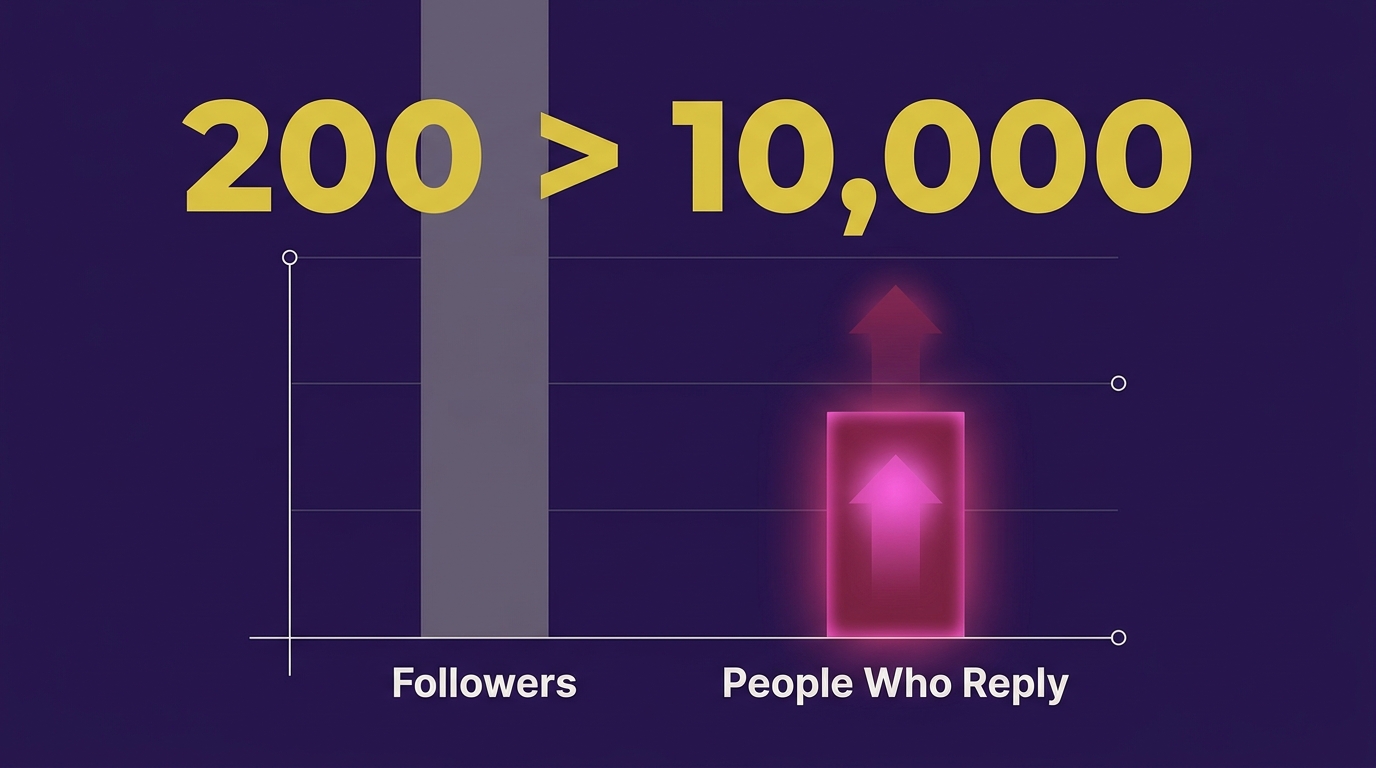
    Here’s the reframe: your real customer list isn’t your follower count. It’s the 200 to 2,000 people who reply, save, or DM you back — regardless of whether you’ve priced anything yet. That group is small enough to know by name and large enough to build a business on. Trust research backs this up too; Edelman’s Trust Barometer has shown for years that people trust individuals they recognize as consistent and transparent far more than institutions, which is exactly what a small, engaged following gives you that a big passive one doesn’t.

    The 20 zero-comment posts weren’t failures of reach — they were failures of specificity. Generic value posts get seen and scrolled past. Specific, opinionated, slightly risky posts get replies. That’s the difference between content that performs for the algorithm and content that performs for you.

    The 4 Rules I Run By Now

    1. Track replies, saves, and DMs — not likes

    Likes are the cheapest signal on the platform. A reply means someone stopped, thought about it, and typed something. Weight your own scorecard accordingly. If a post gets 3,000 views and 40 likes and zero replies, that’s a worse post than one that gets 400 views and 6 replies.

    2. Post personal before business, at roughly a 3:1 ratio

    The 9.7x share difference wasn’t a fluke. Personal, opinionated, behind-the-scenes content earns distribution because people share things that make them look interesting, not things that sound like an ad. Save the offer-forward posts for after you’ve earned the share.

    3. Keep a manual list of everyone who replies

    Every DM, comment, and save is a data point. I keep a running list — not a CRM, just a note — of who engages and what they said. That list becomes your actual pipeline. When you do have something to sell, you’re not cold-pitching strangers, you’re following up with people who already raised their hand. This is the same logic behind why cold outreach converts so much better when it’s warmed up first — see Inbound-Led Outbound: Kill Cold Email in 2026 for the full mechanics.

    4. Follow up within 24 hours of a real reply

    A comment or DM is a small window of attention. If you let it sit for three days, it’s cold again. The move isn’t to pitch immediately — it’s to continue the conversation like a person would. That single habit converts more of your 200 into paying customers than any amount of additional reach ever will.

    What This Changes

    If you’re a solo founder or agency operator waiting to hit some follower threshold before you charge for anything, stop. Pull up your last 20-50 posts, sort by replies and saves instead of impressions, and look at who shows up repeatedly. That list — even if it’s 60 people right now — is closer to revenue than 56,000 passive impressions will ever be.

    Reach tells you how many people saw you. Replies tell you how many people would miss you. Build for the second number.

  • Build a Personal Brand Without Showing Your Face

    Build a Personal Brand Without Showing Your Face

    47 unfinished takes. Every one deleted before it hit post. Not because the audio was bad — because you hated how you looked on screen.

    Every growth guide says the same thing: just get on camera. As if confidence is a switch you flip. It isn’t, and treating it like one is why so many founders sit on months of unposted content.

    Here’s the actual fix: a personal brand is a distribution system, not a face. Below is the system — formats ranked by how much of you they require, the tools that make each one work, and the order to actually attempt them in.

    The Format Ladder: Start Where the Fear Is Lowest

    Don’t start with ‘no camera ever.’ Start with the format that scares you least, prove it works, then decide if you ever need to move up the ladder.

    Level 1: Text Posts With One Brutal, Specific Line

    No editing, no recording, no face. Just a specific, honest sentence about something you actually did — a number, a mistake, a decision. The trap here is sounding like every other LinkedIn post. If your drafts read generic, that’s a voice problem, not a content problem — fix the AI voice fingerprint issue before you scale volume, or you’re just publishing more of the same slop faster.

    Level 2: Document Carousels That Read Like a Story

    Carousels work because they’re read, not watched — no vocal delivery to second-guess. The mistake most people make: they build a slide deck, not a story. Structure every carousel the same way: slide 1 is the hook (a claim or a number), slides 2-7 are the build (the mistake, the fix, the mechanism), the last slide is the takeaway or a question. Build these in Canva with a locked template so you’re not redesigning from scratch every time.

    Level 3: Voiceover Over Screen Recordings

    This is the unlock most camera-shy founders skip past too fast. You record your screen — your dashboard, your workflow, your product, your notes app — and narrate over it. Nobody sees you. They see your work and hear your thinking. Tools: Descript for recording + editing in one pass, or Loom for the raw capture. If your speaking voice is the actual blocker (not just your face), record audio-only first, then layer screen footage over it after — separating the two removes half the pressure.

    Level 4: B-Roll First, Script Second

    This is the format that gets mistaken for ‘faceless is limiting.’ It isn’t. Shoot loose, unscripted b-roll of your actual day — typing, whiteboard, walking to a meeting, your setup — before you write a word. Then write the script to match footage you already have, instead of trying to perform a script live. This flips the anxiety order: you’re never on camera reciting anything, you’re narrating footage after the fact, calm, in as many takes as you want.

    Why This Actually Builds Trust (Not Just Views)

    None of these formats require you to like your reflection. All of them build trust the same way face-first content does — through specificity and consistency, not through eye contact. Content researchers have found repeatedly that format diversity, not personality performance, is what sustains audience growth over time; see Ahrefs’ content marketing research on how varied formats outperform single-format strategies long term.

    The trust comes from the pattern being real and repeated — the same brutal honesty in the text post, the same specific mistake in the carousel, the same actual dashboard in the screen recording. That’s the system. The face is optional.

    The Pipeline: How to Actually Ship This Weekly

    • Monday: Write 3 text posts from things that happened last week — a decision, a number, a mistake.
    • Wednesday: Turn your best text post into a 6-8 slide carousel using a locked Canva template.
    • Friday: Record one screen-recording voiceover walking through something you built or fixed that week.

    If you’re automating any part of this — repurposing one piece into three formats, scheduling, drafting first passes — treat the automation the same way you’d treat any other workflow: know what’s safe to hand off and what still needs your judgment. That distinction is covered in depth in this teardown of what to automate vs. rewrite, and once the system is producing consistent reach, the real leverage is turning that attention into pipeline — which is exactly what inbound-led outbound is built for.

    The Face Can Come Later, If It Ever Needs To

    Most founders who start with formats 1-4 never feel pressure to add their face — the system already works. If you do eventually go on camera, you’ll do it because the content proved itself, not because a growth guide told you confidence is a switch. It isn’t. Distribution is the switch. Flip that one first.

  • Inbound-Led Outbound: Kill Cold Email in 2026

    Inbound-Led Outbound: Kill Cold Email in 2026

    Cold email is a skill issue in 2026. I stopped sending them eight months ago and pipeline went up, not down. This is the writeup I promised — the actual loop, the post structure, the DM handling, and what to do when it stalls.

    If you are still running Instantly with 12 domains and a 47-step sequence, read this before you renew.

    The math that made me quit cold outbound

    Here is what I was seeing across my own sends and what other operators I trade notes with are seeing:

    • Cold email reply rate: under 4% (and most of that is "unsubscribe" or "wrong person").
    • Cold LinkedIn DM: worse — under 3% for anything that reads like a pitch.
    • Inbound DM after a stranger reads one post of yours: closer to 15%, and the intent is already qualified.

    Google's own guidance on spam and unsolicited bulk mail has tightened every year — see the Gmail sender guidelines — and inboxes are only getting more hostile to unknown senders. Volume is not the fix. The fix is making the post do the qualifying before anyone talks to you.

    That is inbound-led outbound. The post is the outbound. The DM is just the paperwork.

    The 5-step loop I actually run

    1. Post a specific pain your ICP is living through this week

    Not "marketing is hard." Not "AI is changing everything." A specific, dated, this-week pain. If you sell to agency owners, it is "your best client just asked why their retainer went up when ChatGPT is free." If you sell to ecom founders, it is "Meta CPMs jumped 30% since Thursday and your team is blaming creative."

    Specificity is the qualifier. Vague posts attract vague DMs.

    2. Name the exact wrong fix everyone is selling them

    This is the part most people skip because it feels rude. Do it anyway. Name the bad advice by name. "Stop buying $2k prompt packs." "Stop hiring an SDR before you have a repeatable offer." "Stop letting your agency add an AI line item without changing the deliverable."

    You are not attacking people. You are drawing a line between you and the noise. Related reading on where that noise is coming from: the AI slop tell.

    3. Show the actual thing you would do instead — with receipts

    Screenshots. A Loom. A workflow diagram. The n8n node. The exact Claude system prompt. Not a teaser. The thing.

    People think giving the answer away kills sales. It does the opposite. If you can show the work, the ones who want it done for them will DM you. The ones who wanted to DIY were never buying anyway.

    4. Reply to every comment like a human, not a closer

    No "great question, DMing you now." Answer the comment in the comment. Add one more useful thing. The comment section is your second post — LinkedIn and X both rank engagement depth, and every real reply pushes the post to more of the right people.

    5. Wait. They DM first.

    This is the hard part. Do not pivot to pitch. Do not scrape the likers into Apollo. Let the post do its job. If the post was specific enough, DMs show up within 48 hours. If they don't, the post was too broad — go back to step 1.

    What the DM actually looks like when they open it

    The inbound DM is not a discovery call. It is paperwork. Here is the sequence I use:

    • Message 1 (them): "Hey, saw your post on X. We're dealing with exactly this."
    • Message 2 (me): One question that confirms fit. Not "tell me about your business." Something like: "Are you trying to keep the retainer and add AI margin, or replace the retainer with a productized thing?"
    • Message 3 (them): They tell you which one.
    • Message 4 (me): A Loom (2-4 min) that answers their version specifically, plus a calendar link.

    That is it. No 6-touch nurture. The post already did the nurture.

    The posting cadence that keeps the loop alive

    You do not need to post daily. You need to post specifically, 3-4 times a week, on one platform. I run LinkedIn as the primary and repurpose to X. If you are still posting from a company page, fix that first — the founder-led LinkedIn playbook covers why company pages get roughly [X]% the reach of a personal profile.

    The other thing that matters: your writing has to sound like you. If every post reads like Claude's default voice, the qualifying breaks — you attract people who like AI writing, not people who like you. The voice prompt writeup is the fix I use before anything ships.

    When to layer in real outbound (yes, sometimes)

    Inbound-led outbound does not mean zero outbound. It means outbound is triggered by signal, not by a list. Someone comments on your post twice in a week? DM them. Someone views your profile three times? DM them. Someone from your ICP company follows you? DM them.

    That is signal-based, not spray-based, and it converts because the person has already opted into your world. I broke down the full trigger system in signal-based outbound.

    The honest tradeoff

    Cold email gives you predictable volume and zero brand. Inbound-led outbound gives you unpredictable volume for the first 60 days and compounding brand after that. If your runway is 30 days, run cold email and pray. If you have a quarter, build the loop. It does not stop paying you once it starts.

    Still sending 500 cold emails a day in 2026? Tell me why. Genuinely curious.

  • Kill Your Company Page: The Founder-Led LinkedIn Playbook

    Kill Your Company Page: The Founder-Led LinkedIn Playbook

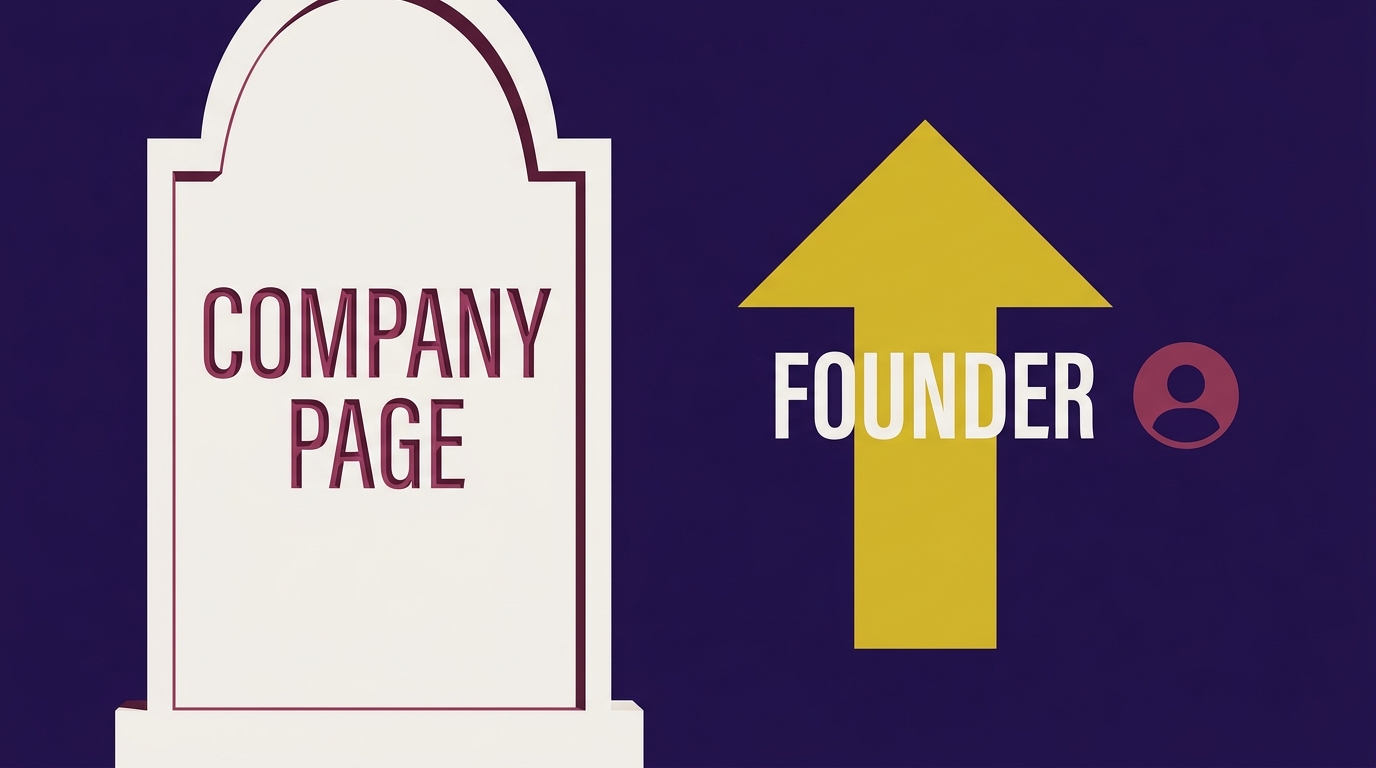
    I killed our company page last month. Not deleted — just stopped feeding it. Inbound tripled in 30 days. Not because I got smarter. Because I finally stopped hiding behind a logo.

    Here’s the part agencies won’t tell you: LinkedIn’s own creator team has said for years that personal profiles get dramatically more distribution than company pages. Pages exist so employees can tag an employer and buyers can verify you’re real. That’s it. They are not a growth channel. You are.

    Why company pages lose (and it’s not the algorithm’s fault)

    Three structural reasons pages get buried:

    • No dwell signal. Nobody comments on a logo. No comments = no reach.
    • No follow intent. People follow humans they want to learn from. They follow companies they’re already buying from.
    • No trust transfer. B2B buyers close with people. The logo is a receipt, not a relationship.

    LinkedIn confirms this in their own creator resources — the profiles that get pushed are the ones that generate conversation, not the ones that broadcast.

    The founder-led LinkedIn strategy, in one week

    Ignore the 5-post-a-day advice. You will burn out in nine days and start posting AI slop, which LinkedIn is actively demoting — I broke that down in The AI Slop Tell. Three posts a week, from you, on camera or in your voice, beats twenty scheduled brand posts.

    Here’s the cadence I run and give to every founder client:

    Monday — Teardown

    Pick one real workflow, funnel, ad, landing page, or process. Break it apart in public. What worked, what broke, what you changed. Screenshots. Numbers when you have them. This positions you as an operator, not a pundit.

    Example format: “I audited our onboarding this weekend. 3 things I killed, 1 thing I doubled down on.” Then deliver the four things.

    Wednesday — Ship log

    Something you actually built or launched that week. A feature, an SOP, a hire, an offer, a workflow. This is the post that generates DMs. Buyers want to work with people who ship. If you can’t point to something you shipped this week, that’s the real problem — see The 14-Day Feature Freeze for the fix.

    Friday — Opinion your peers will hate

    A real, defensible take that other people in your industry disagree with. Not contrarianism for engagement — an actual belief you’d argue for in a room. This is what earns follows. Playing safe on Friday is why your feed reads like everyone else’s.

    The setup (do this once, takes 40 minutes)

    1. Rewrite your headline. Not your job title. What you do for who, in plain language. “Helping [audience] do [outcome] with [mechanism].”
    2. Rewrite your About section in first person. Story, not resume. What you were doing before, what broke, what you build now.
    3. Featured section = 3 things. Your best post, your offer, your calendar link. Nothing else.
    4. Banner image with one sentence. What you help people do. Not your logo at 400% zoom.
    5. Turn on Creator Mode. Free. Adds a follow button and unlocks better analytics.

    The content system (so you don’t burn out by week 3)

    Three posts a week sounds small until you’re staring at Monday morning with nothing to say. Build a capture system before you need it:

    • Voice memos. Every time you say something interesting on a call, dictate it into a note within five minutes. Otherwise it’s gone.
    • A running “ship log” doc. Every Friday, write down what you actually did that week. That doc IS your Wednesday post source.
    • An “opinions” list. Every time you get annoyed reading something in your industry, write it down. That’s a Friday post.
    • Draft with AI, but don’t let it write. Feed it your voice memo, ask for structure, then rewrite in your own words. I walk through the setup in Voice Prompt Is the Moat.

    What happens to the company page?

    Leave it up. Post the occasional hire, product launch, or client win — once every two weeks is plenty. It exists for verification and recruiting. Stop measuring it. Stop feeding it. Redirect that time to your profile.

    If you have a team, get 2-3 employees posting from their profiles too. Their combined reach will destroy anything the page could do. Tools like Taplio or Shield can help with analytics if you want to track what’s working across profiles — but the content itself has to come from humans.

    The uncomfortable part

    Founder-led means your face, your name, your opinions. Not a ghostwriter’s version of you. Not a brand voice document. You.

    If that feels exposing, good. That exposure is the moat. Nobody can copy your specific take on the specific thing you’ve spent [X] years doing. They can copy your company page in an afternoon.

    Pick a Monday. Post the teardown. See what happens by Friday.

  • The AI Slop Tell: Why LinkedIn Is Demoting Your Posts

    The AI Slop Tell: Why LinkedIn Is Demoting Your Posts

    LinkedIn is quietly demoting your posts. It’s not because you used AI. It’s because you used AI the way everyone else uses AI — and the platform can smell the median from a mile away.

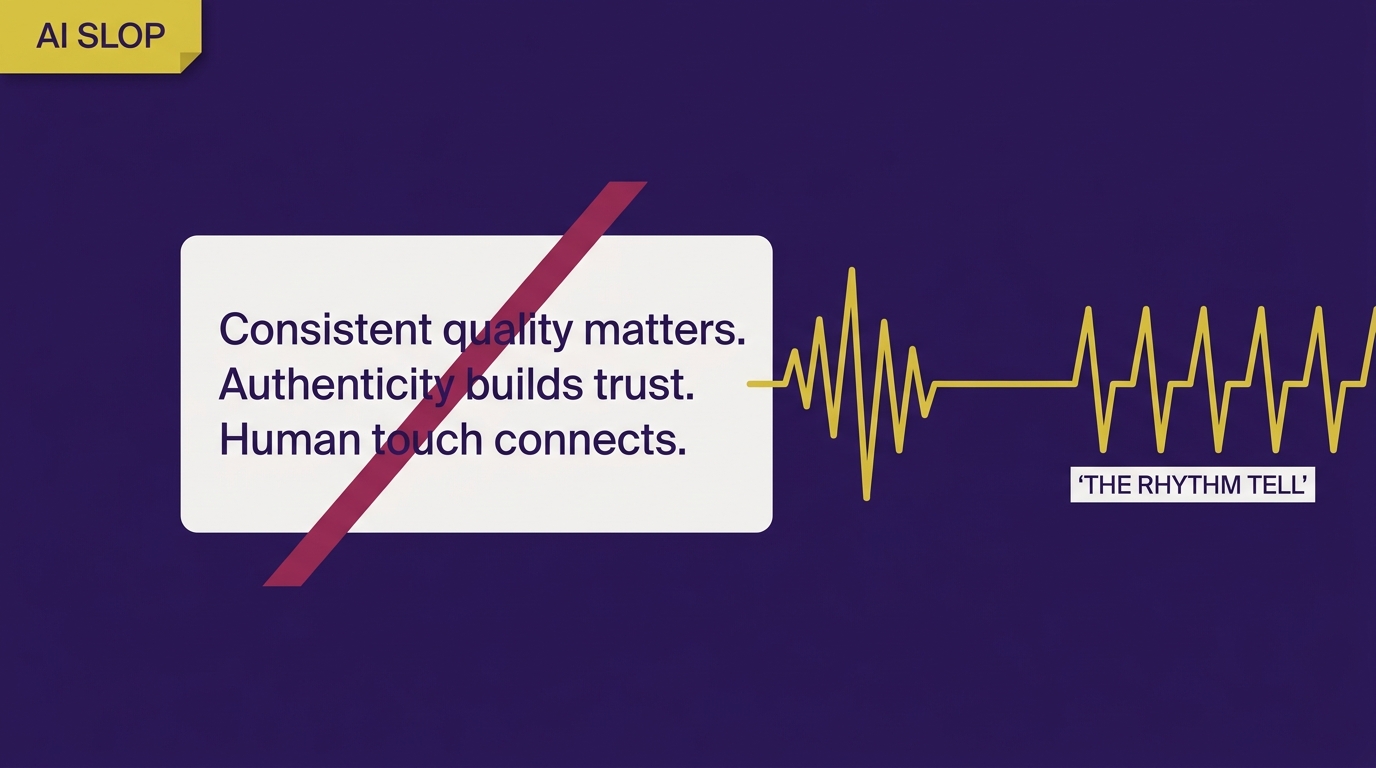
    The tell isn’t a word. It’s a rhythm. Once you see it, you can’t unsee it.

    The four-part fingerprint of AI slop LinkedIn posts

    Every default GPT-4 or Claude draft, unprompted, converges on the same skeleton. Not because the models are broken — because they’re trained to hit the average of what worked before. The average is now the penalty.

    Here’s the fingerprint:

    • Three-part lists. Everything comes in threes. Three reasons, three lessons, three shifts. Two would feel unfinished, four would feel messy, so the model always picks three.
    • Symmetrical sentence pairs. Short. Then shorter. Then a one-word line. It reads like a metronome.
    • The “It’s not X, it’s Y” pivot. Sometimes stacked twice. It’s not about the tool. It’s about the taste. It’s not what you build. It’s who you build it for. (Yes, I do this too. That’s the point — we all do, because the model does.)
    • The bait question close. “What would you add?” “Which one hit hardest?” “Am I wrong?” Engineered to farm a comment.

    Put those four together in one 180-word post and you’ve written the exact shape of ten thousand other posts published that hour. LinkedIn’s ranking model doesn’t need to detect AI. It just needs to detect sameness — and sameness gets buried.

    Why LinkedIn cares about rhythm, not tools

    LinkedIn has been public about wanting “knowledge and advice” content and downranking generic engagement bait. Their own engineering posts on feed quality describe filtering for content that feels personal, specific, and non-repetitive. They don’t say “we hate AI.” They say they hate low-effort patterns. Those are the same thing in 2026.

    The classifier doesn’t need to see your prompt. It sees:

    • Sentence-length variance (AI drafts cluster tight)
    • Opening n-grams that match ten thousand other posts that week
    • Comment patterns that look like question-bait harvesting
    • Zero named specifics — no tools, no numbers, no names, no timestamps

    The last one is the giveaway most founders miss. A human writing about their week names things. Claude 3.5 Sonnet. Tuesday. $[X]. My cofounder Sam. AI drafts describe. Humans point.

    How I actually use AI to write (and where I don’t)

    I run [14] agents in my business. Research pipelines, transcription, CRM enrichment, draft QA. I still write every hook by hand. Claude only touches the middle — research, structure, second draft. The voice stays mine.

    Here’s the actual split on a LinkedIn post:

    • Hook (1-2 lines): 100% me. Written cold, usually while walking. If I can’t write the hook without AI, the idea isn’t real yet.
    • Research + structure: Claude. I dump my raw voice memo, ask it to pull the 3-4 arguments and flag anything that contradicts itself.
    • Second draft: Claude, tightly prompted. With a voice prompt that explicitly bans three-part lists, symmetrical pairs, and closing questions. More on that in Voice Prompt Is the Moat — that’s the exact system prompt I use.
    • Final pass: me, out loud. If a sentence sounds like a LinkedIn coach wrote it, it dies.

    The rule I follow: AI can compress, AI cannot originate. The moment it originates, you get slop.

    The 60-second edit pass that removes the tell

    Run this on any AI-assisted draft before you post. It takes a minute.

    • Kill one item from every list of three. Make it two, or four. Odd asymmetry reads human.
    • Break one symmetrical pair. Where you have two 6-word sentences back to back, rewrite one as 14 words with a comma and a specific.
    • Delete every “It’s not X, it’s Y” except one. If you have zero, even better.
    • Replace your closing question with a statement or a receipt. “Here’s what I’m testing next week: [thing].” People comment on specificity more than on prompts.
    • Add three proper nouns. A tool name, a person, a place. AI drafts abstract; humans name.
    • Introduce one intentional “flaw.” A parenthetical aside. A sentence that starts with “And.” A number that isn’t round. This is the single highest-leverage move.

    Taste is the moat now, not the tool

    Everyone has Claude. Everyone has ChatGPT. The tools are commodity. What isn’t commodity is knowing which sentence to cut, which specific to add, and when the draft is trying to make you sound like everyone else.

    This is why founder-led accounts are pulling away from brand accounts and ghostwritten profiles right now — I broke down the reach data in Why Founder-Led Accounts Dominate Organic Reach in 2026. The founders winning aren’t the ones with the best prompts. They’re the ones whose taste survives the tooling.

    If you want the deeper systems side — how to feed AI enough context that it stops defaulting to the median in the first place — read The 91-Hour Context Tax. Bad context is the real reason your drafts sound like everyone else’s.

    The algorithm doesn’t hate AI. It hates the median. Stop writing to the middle and the reach comes back.

  • The 14-Day Feature Freeze: A Distribution Sprint for Founders

    The 14-Day Feature Freeze: A Distribution Sprint for Founders

    You don’t have a product problem. You have a nobody knows you exist problem. And shipping feature #47 will not fix it.

    I watched a founder friend ship 6 features in 8 weeks. MRR moved zero dollars. He called it iteration. It was hiding. Building feels safe. Posting feels naked. So we build.

    The fix is a feature freeze distribution sprint: 14 days, zero commits, zero "quick fixes," all attention pointed at the humans who might actually pay you. Below is the exact checklist I run with founders in my DMs.

    The Rules of the Freeze

    Before the tactics, the guardrails. Break one and the sprint is dead.

    • No commits. Not to main, not to a feature branch, not "just a config tweak." Push a README note that says "on freeze until [date]" and close the IDE.
    • No roadmap edits. Ideas go in a text file called after-freeze.md. You will look at it on day 15.
    • No new tools. The urge to "set up a better CRM" is the same avoidance as shipping features. It’s just wearing a marketing costume.
    • Public accountability. Post day 0 on LinkedIn or X. Now it’s real.

    If that already made you sweat, good. That’s the tell that you needed this.

    The Daily Stack (Repeat 14x)

    1. One founder video a day — raw, phone, 60 seconds

    Not edited. Not scripted. One take. Talk about a real problem your ICP has, a lesson from building, or a teardown of a decision you made this week. Post it to LinkedIn and repost to X and Instagram Reels.

    The goal isn’t virality. The goal is reps. By day 10 your hook gets sharper, your framing gets tighter, and you stop apologizing for existing on camera. If you want the deeper reasoning on why founder faces beat brand accounts right now, read why founder-led accounts dominate organic reach in 2026.

    2. Twenty manual DMs to your actual ICP

    Not other founders. Not "let’s collab" peers. The person whose credit card would actually charge. Twenty per day. Manual. No automation, no Instantly sequence, no Lemlist.

    Structure I use:

    • Line 1: Specific reference to their work or a post from the last 14 days.
    • Line 2: A question about their workflow — not a pitch.
    • Line 3: Nothing. No CTA. Let them reply.

    Roughly 3–5 out of 20 reply on a good day. Two turn into calls. If you want to see why this beats cold sequences right now, I broke it down in the cold DM autopsy.

    3. One teardown post — mid-sprint

    On day 7, publish one long-form teardown that shows how your product actually works. Screenshots. Real numbers where you have them. The specific problem it solves for a named ICP.

    This is the piece prospects will screenshot back to you three weeks later saying "this is what convinced me." Post it on LinkedIn as native text + carousel. Do not link out in the first post. Drop the link in comment #1.

    Why This Works (When Feature #47 Doesn’t)

    Two mechanisms are doing the heavy lifting:

    • You are creating surface area. Distribution is a compounding function of impressions × specificity × frequency. Fourteen straight days of a founder face saying specific things to a specific ICP does more for pipeline than any single feature launch. LinkedIn’s own marketing research keeps showing the same thing: consistency of person-led posts beats polish.
    • You are forced to learn the market. Twenty DMs a day for 14 days is 280 real conversations. You will hear the same objection 40 times. You will hear the same feature request 15 times. That is worth more than any analytics dashboard, and it retrains your roadmap on reality instead of vibes.

    The Light Automation That’s Allowed

    The freeze is on product code. It is not on your content ops. If you want to survive 14 days of daily video plus 20 DMs plus a teardown, you need a light stack behind you.

    • Transcription + repurposing: Run each 60-second video through Whisper or Otter, then have Claude rewrite it into a LinkedIn post using your voice prompt. If you don’t have one yet, build it — your voice prompt is the moat.
    • DM tracking: A dead-simple Airtable or Notion table. Name, handle, first message date, reply y/n, next step. That’s it.
    • Content queue: One n8n workflow that takes your daily transcript and drafts three post variants. Nothing fancy. If you want the order to build this in, I laid it out in automate in this order.

    What Usually Breaks

    Days 3–5 are where founders quit. A prospect will ask for a feature, and every fiber in your body will want to open the IDE and "just knock it out." Don’t. Write it in after-freeze.md. Reply to the prospect with a Loom of the current workaround.

    Days 8–10 are where the second wave hits — the videos aren’t going viral, DMs feel slow, and you convince yourself "this isn’t working." It is. You’re two-thirds through the compounding curve. Keep going.

    Day 15

    Open after-freeze.md. Half of what’s on it will feel stupid now because you talked to 280 people. The features you do keep are the ones the market actually asked for, in the words they used. That’s the real output of the sprint — not the follower count, not the DMs, but a roadmap that stops being fiction.

    Then, and only then, open the IDE.

  • The 100 True Fans Math: Monetize Before 10K Followers

    The 100 True Fans Math: Monetize Before 10K Followers

    Every small builder gets fed the same lie: get to 10K first, then monetize. So you grind for a year, burn out, and quit right before your audience was actually big enough to sell to.

    Nobody runs the real math for you. So let’s run it.

    The 100 true fans math

    Kevin Kelly wrote the original 1,000 True Fans essay in 2008. The premise: a creator only needs 1,000 people paying $100/year to make a real living. Cut that in half for a side income. Cut it again for a start.

    Here’s the builder version:

    • 100 true fans × $100/year = $10,000
    • 100 true fans × $500/year = $50,000
    • 100 true fans × $1,000/year = $100,000

    Ten thousand dollars is not a lifestyle business. But it is a real start — from an audience most creators would call "too small." And if you have 800 followers who actually read what you post, you almost certainly have 100 people in there who would pay you for the right thing.

    The move isn’t more followers. It’s figuring out what the followers you already have would actually pay for.

    Why the 10K gate is fake

    The 10K number came from ad-based creator economics — brand deals, YouTube monetization thresholds, sponsorship rates. That math doesn’t apply to you. You’re not selling attention to a third party. You’re selling a direct outcome to a human.

    Direct sales math works differently. A 2% conversion rate on 500 real followers is 10 customers. At $500, that’s $5,000. At $2,000, that’s $20,000. You don’t need scale — you need signal.

    This is the same reason founder-led accounts are dominating organic reach in 2026. The algorithm rewards specificity, and specific audiences buy at 10-20x the rate of general ones.

    The DM research process (with AI as the analyst)

    Most founders skip research because it feels slow. It isn’t — if you use the tools right. Here’s the exact process I run:

    Step 1: Pull your 50 warmest humans

    Open your DMs, comments, and email replies from the last 90 days. Anyone who replied to a post, sent a voice note, or asked a question. Copy their handles into a spreadsheet. Not followers — respondents.

    Step 2: Send one honest message

    No survey link. No Calendly. One question:

    "Hey — building something new and want to make sure it actually solves a real problem. What’s the single most annoying thing about [your niche topic] right now for you?"

    Expect a 30-50% reply rate on genuine relationships. If it’s lower, your content isn’t building trust — fix that first. Our writeup on why content is the new SDR covers that gap.

    Step 3: Feed replies to Claude for pattern extraction

    Paste all replies into a single doc. Prompt Claude (or GPT):

    "Here are 20-40 responses from my audience about their biggest pain in [niche]. Extract: (1) the top 3 recurring problems, (2) the exact language they use to describe each — verbatim phrases, not paraphrases, (3) any emotional words that repeat, (4) what they’ve already tried that didn’t work."

    The verbatim language is the whole point. That’s your sales page copy, your hook library, your offer name. If ten people used the phrase "I can’t tell what’s working," that becomes your headline — not your clever version of it.

    Step 4: Reverse-engineer the offer

    Pick the pain that (a) appeared most often and (b) you can genuinely solve in under 30 days. Price it at $100-$500 for a first offer. That’s the sweet spot: high enough to be real revenue, low enough to skip a discovery call.

    Structure: outcome + timeframe + delivery mechanism. Not "coaching." Not "consulting." Something like: "A 2-week done-with-you sprint to ship your first AI-drafted content system."

    How to actually make the offer

    You don’t need a launch. You don’t need a funnel. You need a post and a DM.

    • The post: Write one piece of content describing the exact pain in the exact words from your research. End with: "I’m running this for [X] people this month. Reply if you want details."
    • The DM: When people reply, send a 4-5 sentence offer — what they get, how long, price, how to pay. No PDF. No Zoom. Stripe link.
    • The delivery: Over-deliver on the first 3-5 customers. They’re your case studies, referrals, and testimonials for the next round.

    If you want to systematize the research-to-offer loop so you’re not starting from zero every time, our breakdown on building a persistent AI context stack covers how to keep your audience research, offer notes, and voice inside one reusable workspace.

    The math you should be running this month

    Stop asking "how do I get to 10K?" Start asking:

    • How many people in my DMs would I recognize by name?
    • What’s the one pain they’ve told me about more than three times?
    • What would I charge to solve it in 30 days?
    • What’s stopping me from posting the offer this week?

    The answer to the last one is almost never "audience size." It’s fear of the offer being wrong. The research process above kills that fear because the offer isn’t your idea — it’s their words, priced.

    100 true fans × $100 is $10,000. You probably already have the 100. You just haven’t asked them yet.

  • Cold DM Autopsy: Why Content Is the New SDR

    Cold DM Autopsy: Why Content Is the New SDR

    Cold DMs aren’t dead because DMs are broken. They’re dead because the starting point is broken. You’re a stranger sliding a 400-word pitch into a mute stranger’s inbox and hoping tone-of-voice tricks close the gap. It doesn’t. And sending more of them is screaming louder in a room that already muted you.

    Here’s the autopsy — what actually killed cold outbound for founders and agencies — and the system I’m using instead. No hype. Just the pipeline.

    What actually killed the cold DM

    Three things happened at once:

    • Volume collapsed trust. Every LinkedIn inbox now averages dozens of near-identical AI-personalized openers. The pattern is so obvious readers pattern-match and archive before finishing the first line.
    • Platforms started punishing it. LinkedIn throttles low-response senders. Instagram hides DMs from non-followers in Requests. Email providers are getting more aggressive on cold sends that don’t get engagement — see Google’s bulk sender guidelines for how tight the rails have gotten.
    • The buyer’s default changed. Buyers now check your profile, your last 5 posts, and your comments before replying. If those don’t exist or don’t sell, the DM is dead on arrival.

    So the fix isn’t a better opener. The fix is changing where the conversation starts.

    The shift: post does the selling, DM picks up the phone

    The mental model I use with the team at Alington Media:

    • Content = the SDR. It runs 24/7, qualifies at scale, and never asks for a raise.
    • The DM = the receptionist. Its only job is to move a warm hand-raise into a call.

    Cold outbound converts in the low single digits — 1–5% reply rates are normal, no matter how good the copy. DMs sent to people who had just commented on or reacted to a post? Those routinely land 5–10x higher. Same offer. Same message. Different starting point. That’s the entire game.

    This is also why founder-led accounts are dominating organic reach — the algorithm rewards the person, and the person converts strangers into inbound way more efficiently than a logo ever will.

    The content-first cold DM strategy (the actual system)

    1. Post 1 thing per day designed to trigger a hand-raise

    Not thought-leadership. Not vibes. Posts engineered so the right stranger self-identifies in the comments. Three formats that consistently work for me:

    • The autopsy post — you name a thing that’s broken (like this one), show data, offer the shift. Attracts operators who have the same pain.
    • The build-in-public post — show a specific workflow you shipped this week. Attracts people who want it built for them.
    • The contrarian teardown — take one popular tactic and show why it’s underperforming. Attracts people already frustrated with it.

    One post. One hand-raise mechanism. Every day.

    2. Track signals, not just likes

    Likes are noise. What I actually log in a Notion board (fed by an n8n webhook off my LinkedIn and X activity):

    • Who commented with a specific question (not “great post”)
    • Who reshared with commentary
    • Who viewed my profile within 24 hours of a post
    • Who saved the post (LinkedIn now surfaces this)

    Those are the four buying signals. Everyone else is an audience member, not a lead. If you want the deeper mechanics on signal-based routing, I broke it down in the 2026 cold email teardown.

    3. The DM is 3 lines, not 30

    Once someone hits a buying signal, the DM writes itself because the context already exists. My template:

    • Line 1: Reference the specific thing they engaged with. Not “loved your comment” — the actual point they made.
    • Line 2: One sentence connecting their point to something I’ve built or solved.
    • Line 3: A low-friction next step. Usually: “Want me to send the writeup?” or “Worth a 15-min call?”

    No pitch. No pdf. No calendar link in the first message. The post already did the selling.

    4. Automate the boring part, not the human part

    What I automate with n8n + Claude:

    • Pulling engagement into a single lead view
    • Drafting the first line of the DM based on the specific comment (I still edit every one)
    • Reminders 48 hours later if no reply

    What I do not automate: sending the DM, the actual conversation, the follow-through. The moment a prospect smells automation on the human side, you’re back in the muted room. If you’re using Claude for the drafting step, keep your voice and past context loaded — I wrote about the persistent context stack that prevents generic AI-sounding first lines.

    What to stop doing this week

    • Stop buying more leads. You don’t have a volume problem.
    • Stop A/B testing openers on strangers. You’re optimizing a dead channel.
    • Stop paying a ghostwriter to make you sound generic — that alone is killing your reach and your inbound.
    • Start posting one signal-triggering post per day. Track the four signals. DM only the hand-raisers.

    The honest tradeoff

    This is slower on day one and faster on day 30. Cold blasts give you 200 sends and 2 replies today. Content-warmed DMs give you 0 sends day one — and then 15 warm hand-raisers a week by day 30 that reply at multiples of cold.

    Content is the new SDR. The DM just picks up the phone when it rings.