
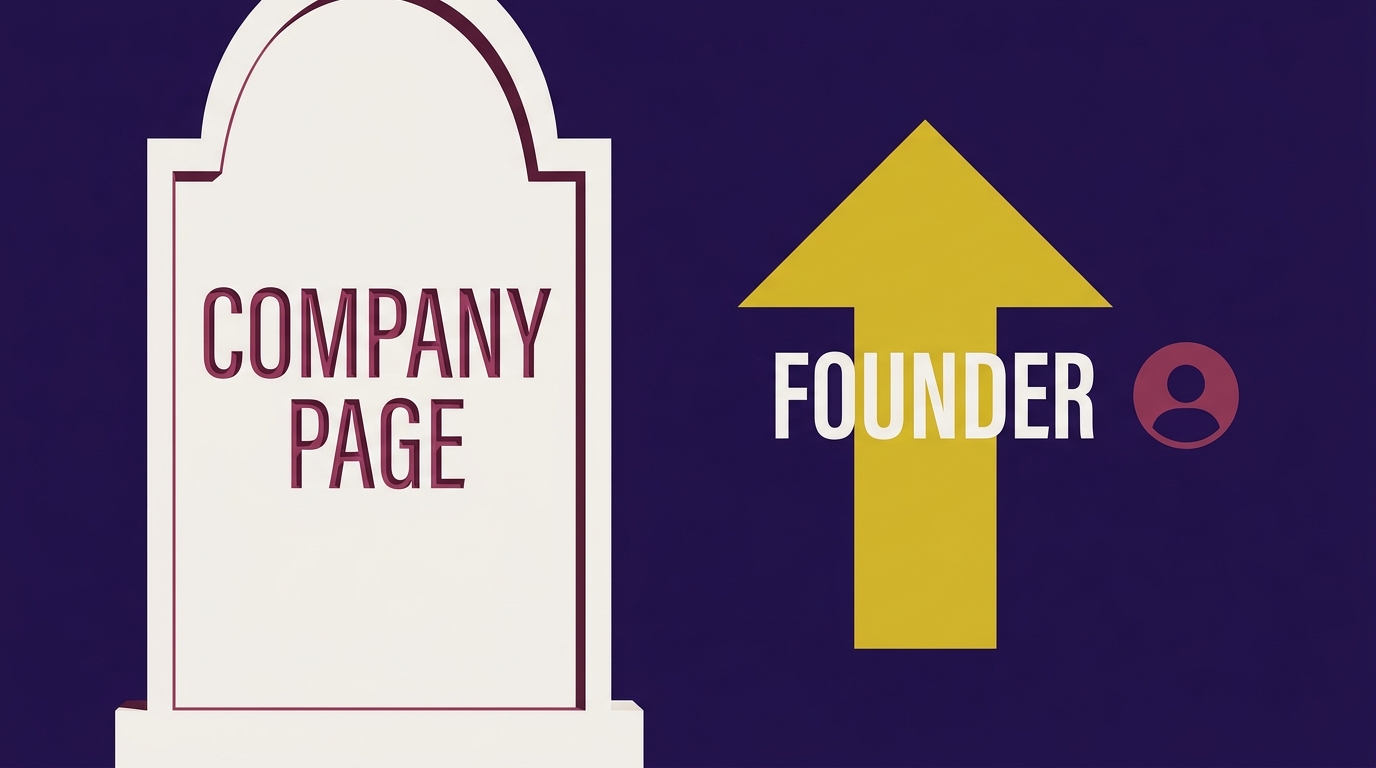
I killed our company page last month. Not deleted — just stopped feeding it. Inbound tripled in 30 days. Not because I got smarter. Because I finally stopped hiding behind a logo.
Here’s the part agencies won’t tell you: LinkedIn’s own creator team has said for years that personal profiles get dramatically more distribution than company pages. Pages exist so employees can tag an employer and buyers can verify you’re real. That’s it. They are not a growth channel. You are.
Why company pages lose (and it’s not the algorithm’s fault)
Three structural reasons pages get buried:
- No dwell signal. Nobody comments on a logo. No comments = no reach.
- No follow intent. People follow humans they want to learn from. They follow companies they’re already buying from.
- No trust transfer. B2B buyers close with people. The logo is a receipt, not a relationship.
LinkedIn confirms this in their own creator resources — the profiles that get pushed are the ones that generate conversation, not the ones that broadcast.
The founder-led LinkedIn strategy, in one week
Ignore the 5-post-a-day advice. You will burn out in nine days and start posting AI slop, which LinkedIn is actively demoting — I broke that down in The AI Slop Tell. Three posts a week, from you, on camera or in your voice, beats twenty scheduled brand posts.
Here’s the cadence I run and give to every founder client:
Monday — Teardown
Pick one real workflow, funnel, ad, landing page, or process. Break it apart in public. What worked, what broke, what you changed. Screenshots. Numbers when you have them. This positions you as an operator, not a pundit.
Example format: “I audited our onboarding this weekend. 3 things I killed, 1 thing I doubled down on.” Then deliver the four things.
Wednesday — Ship log
Something you actually built or launched that week. A feature, an SOP, a hire, an offer, a workflow. This is the post that generates DMs. Buyers want to work with people who ship. If you can’t point to something you shipped this week, that’s the real problem — see The 14-Day Feature Freeze for the fix.
Friday — Opinion your peers will hate
A real, defensible take that other people in your industry disagree with. Not contrarianism for engagement — an actual belief you’d argue for in a room. This is what earns follows. Playing safe on Friday is why your feed reads like everyone else’s.
The setup (do this once, takes 40 minutes)
- Rewrite your headline. Not your job title. What you do for who, in plain language. “Helping [audience] do [outcome] with [mechanism].”
- Rewrite your About section in first person. Story, not resume. What you were doing before, what broke, what you build now.
- Featured section = 3 things. Your best post, your offer, your calendar link. Nothing else.
- Banner image with one sentence. What you help people do. Not your logo at 400% zoom.
- Turn on Creator Mode. Free. Adds a follow button and unlocks better analytics.
The content system (so you don’t burn out by week 3)
Three posts a week sounds small until you’re staring at Monday morning with nothing to say. Build a capture system before you need it:
- Voice memos. Every time you say something interesting on a call, dictate it into a note within five minutes. Otherwise it’s gone.
- A running “ship log” doc. Every Friday, write down what you actually did that week. That doc IS your Wednesday post source.
- An “opinions” list. Every time you get annoyed reading something in your industry, write it down. That’s a Friday post.
- Draft with AI, but don’t let it write. Feed it your voice memo, ask for structure, then rewrite in your own words. I walk through the setup in Voice Prompt Is the Moat.
What happens to the company page?
Leave it up. Post the occasional hire, product launch, or client win — once every two weeks is plenty. It exists for verification and recruiting. Stop measuring it. Stop feeding it. Redirect that time to your profile.
If you have a team, get 2-3 employees posting from their profiles too. Their combined reach will destroy anything the page could do. Tools like Taplio or Shield can help with analytics if you want to track what’s working across profiles — but the content itself has to come from humans.
The uncomfortable part
Founder-led means your face, your name, your opinions. Not a ghostwriter’s version of you. Not a brand voice document. You.
If that feels exposing, good. That exposure is the moat. Nobody can copy your specific take on the specific thing you’ve spent [X] years doing. They can copy your company page in an afternoon.
Pick a Monday. Post the teardown. See what happens by Friday.