
LinkedIn just declared war on your writing style. If you draft posts in Claude or GPT with a stock prompt, you already lost round one.
You know the tells. The em dashes. The “it’s not X, it’s Y” setup. The tidy three-bullet insight. The smooth transition sentence nobody actually says out loud. That’s not writing. That’s a fingerprint. And the algorithm — plus every human who’s read 400 posts this week — is learning to spot it in under a second.
The fix isn’t better prompt engineering. It’s giving the model something it can’t invent: you, unpolished. Below is the exact system I run before any post ships.
Why generic AI prompts kill your reach
Every large model was trained on the same public internet, then reinforced on the same politeness rubric. Ask any of them to “write an engaging LinkedIn post about X” and you get a regression toward the mean of every business blog since 2019. Anthropic even documents this tendency in Claude’s prompt engineering guide — the model defaults to the most statistically likely phrasing unless you actively push it somewhere else.
Meanwhile the feed rewards the opposite. LinkedIn’s own creator guidance now openly discourages low-effort AI content, and the ranking model quietly demotes anything that reads like a template. The platform isn’t hunting AI. It’s hunting sameness. Your generic prompt is producing exactly that.
The voice prompt is the moat
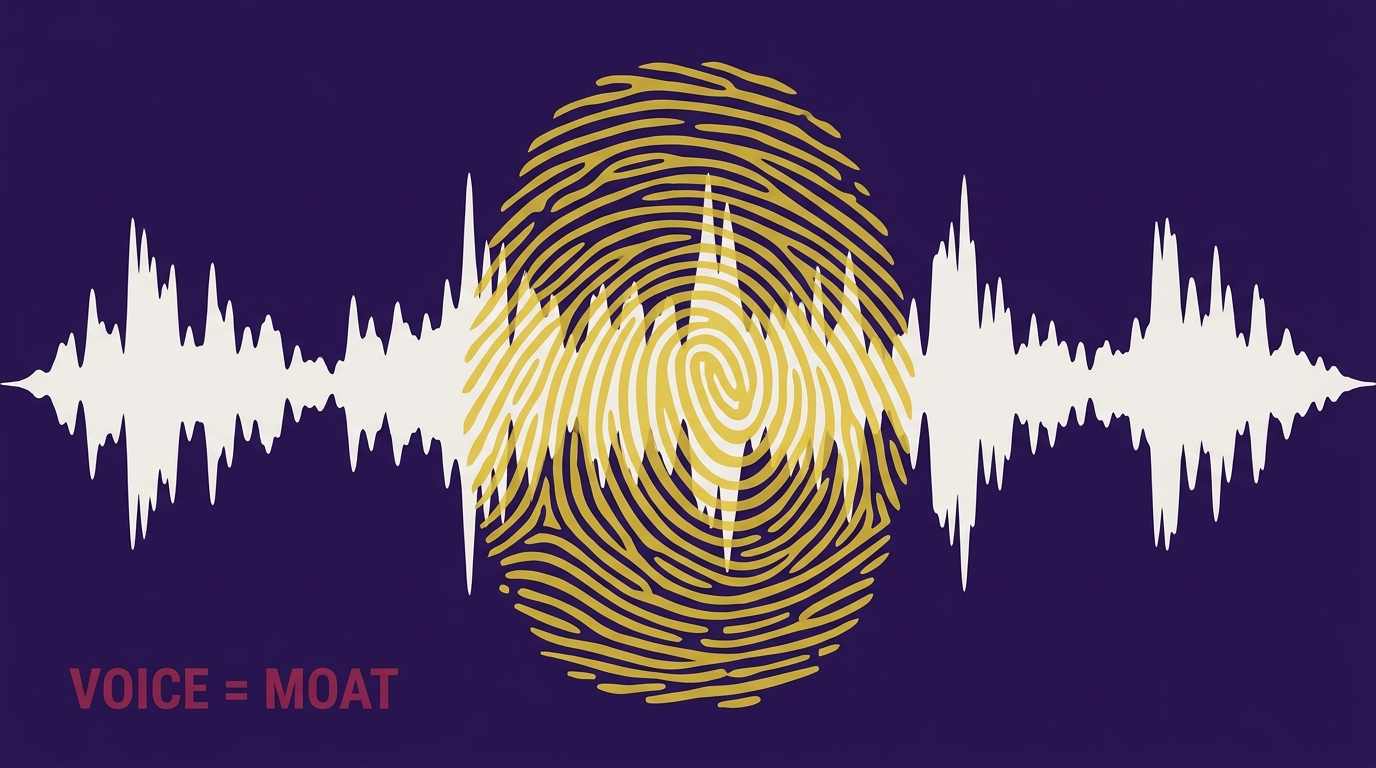
Anyone can subscribe to Claude. Nobody else has 20 of your raw voice notes. That’s the actual defensible input.
Here’s what I do:
- Record 20 voice notes. Not scripts. Not “content.” Actual half-finished thoughts I sent to a friend or dictated walking the dog. Two to four minutes each.
- Transcribe raw. I use Whisper via the OpenAI API or just Otter. Do not clean up the transcripts. The “ums,” the tangents, the weird word choices — that’s the training data.
- Build one voice document. One big file. Twenty transcripts, back to back. That’s your voice corpus.
- Prompt for rhythm, not polish. The instruction I give Claude is literally: “Match the rhythm, cadence, and word choices in the attached transcripts. Keep sentences uneven. Keep the weird phrasing. Do not smooth anything out. Do not add em dashes. Do not use ‘it’s not X, it’s Y.’ Do not summarize with three bullets unless I ask.”
My drafts got uglier. The reach went up. Because the model finally stopped writing like a marketer and started writing like the person the audience already follows.
The actual prompt I use in Claude
Paste this into a Claude Project (or a system prompt in the API) with your voice corpus attached as a knowledge file:
System: You are drafting short-form posts in my voice. The attached file is 20 of my raw voice-note transcripts. Study them for: sentence length variance, contractions, sentence fragments, filler words I actually use, topics I return to, and the way I open and close thoughts. Rules: (1) No em dashes. (2) No “it’s not X, it’s Y” constructions. (3) No smooth transition sentences. (4) Vary sentence length — some fragments, some long. (5) If you’d normally write a three-bullet insight, write it as one messy paragraph instead. (6) When in doubt, pick the uglier phrasing.
User: Draft a LinkedIn post about [topic]. Give me three versions, each under 180 words.
That’s it. No “engaging.” No “hook.” No “CTA.” The model already knows what those mean generically — that’s the problem. You’re overriding the defaults with your fingerprint.
Where this fits in the bigger stack
This is one piece of a persistent-context setup. If you’re constantly re-pasting who you are and what you sound like into every new chat, you’re paying what I’ve called the 91-hour context tax. Store the voice corpus once, reference it everywhere — Claude Projects, a custom GPT, an n8n workflow that pulls it into every drafting job.
Voice is also the reason personal accounts are eating brand pages alive right now. I broke down the mechanics in why founder-led accounts dominate organic reach in 2026 — the short version is that distinctiveness compounds and generic content decays. Your voice prompt is the input that makes the whole flywheel actually defensible.
And if you’re wondering where AI drafting even belongs in your workflow before you go automate everything, I’d start with this order of operations. Voice capture is step one. Not scheduling. Not scraping. Not agents. Capture first.
The test before you ship
Before any post goes out, I read it out loud. If a sentence feels like something I’d never actually say to a friend at a bar, it gets cut or rewritten. That’s the whole QA process. It takes 90 seconds. It catches the last 10% of AI residue that even a good voice prompt lets slip through.
Stop prompting for “engaging LinkedIn post.” Start prompting for you. The moat isn’t the model. The moat is the 20 voice notes only you can record.