
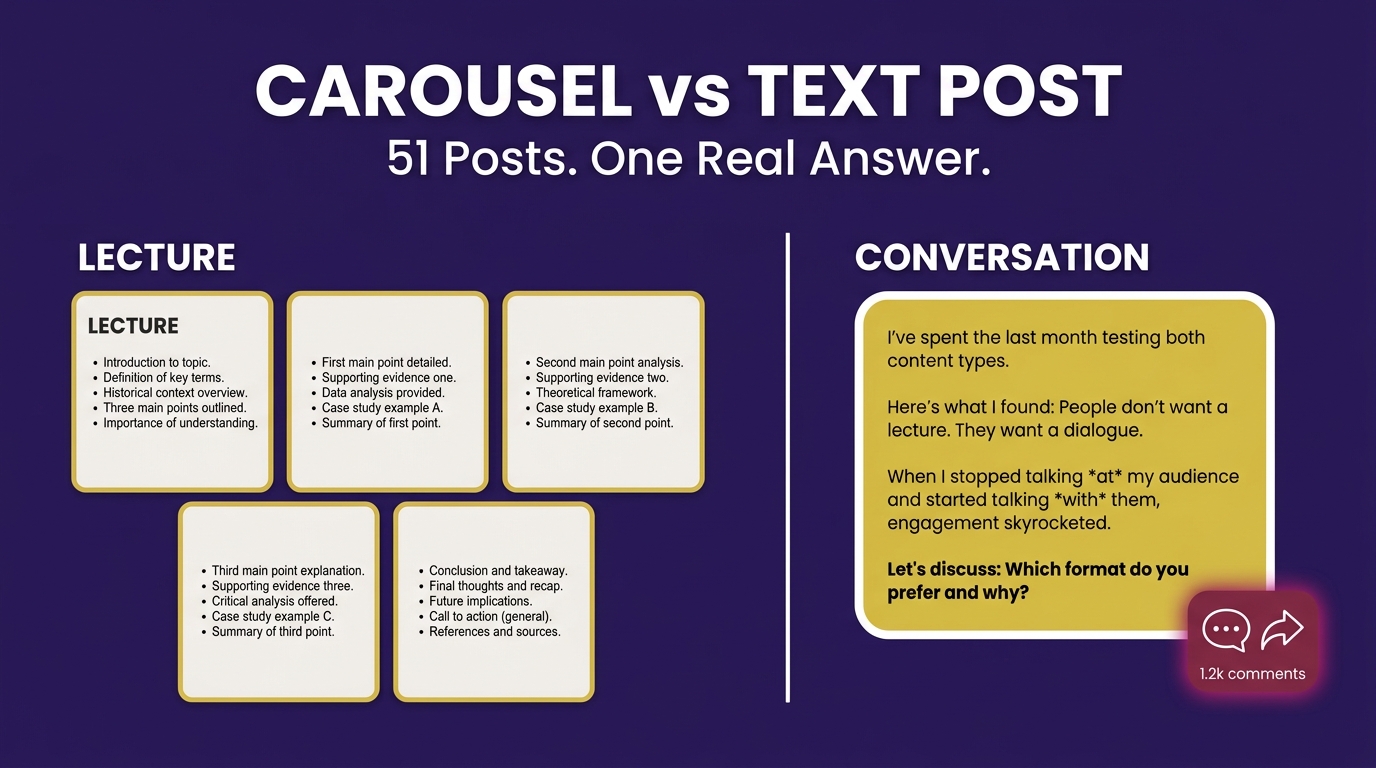
Everyone has an opinion on carousels vs text posts. Almost nobody has tested it on their own audience. I did, on my own page, same idea, same day, one carousel version and one text version. Then I went back and pulled the numbers on my last 51 posts to see if the pattern held. It did, but not for the reason I expected.
The Test: Same Idea, Two Formats
I took one insight I wanted to share and built two versions:
- A 5-slide carousel breaking the idea into steps, one point per slide, clean design.
- A plain text post, same idea, written the way I’d say it to one person over coffee.
Posted the same day, similar time window, no paid boost, no engagement pod nonsense. The text post won by a landslide — more reach, more comments, more saves.
My first instinct was “carousels are dead.” That’s the lazy conclusion, and it’s wrong. The real problem was how I wrote the carousel. I wrote it like a lecture: numbered points, no voice, no stakes, nothing that sounded like a person talking. The text post read like I was talking to one specific reader. That’s the actual variable. Format didn’t lose. Tone did.
Going Back Through 51 Posts
One test isn’t a pattern, so I pulled the last 51 posts on my personal page and ran the real numbers:
- 51 posts total, mixing text, carousels, and a few video clips.
- 56,487 people reached across all 51.
- My personal content — the posts written in first person, about something I was actually building or messing up — got shared 9.7x more than anything I posted for the business page in the same window.
- 20 of those posts reached over 22,000 people combined and got exactly zero comments.
That last stat is the one that made me stop and rewrite my whole approach. Reach with zero comments means the post got shown to a lot of people and none of them felt like responding. That’s not a small-sample fluke at 20 posts. That’s a pattern in how I was writing.
Why Reach Without Comments Is a Warning Sign
It’s easy to screenshot a big reach number and call it a win. But reach is a vanity checkpoint, not the goal — I’ve written about this before in The 200-Person Math: Why Reach Isn’t Revenue, and this test proved it again from a different angle. A post that reaches 22,000 people and gets zero comments isn’t failing at distribution. It’s failing at connection. LinkedIn’s own ranking signals lean heavily on early engagement velocity — comments and shares in the first hour matter more than raw impressions, which platforms like Hootsuite have documented in their LinkedIn algorithm breakdowns. If nobody comments, the algorithm reads that as “nobody cared,” and your next post gets throttled before it even starts.
The 4 Rules I Run Now
1. Write to one person, not a room
Every high-performing post in my 51 used “you” or told a story about one specific moment. The zero-comment posts used “we” or talked in general truths. Specificity forces a reaction. Generality invites scrolling past.
2. Personal beats branded, every time, in the feed
The 9.7x gap between personal and business content wasn’t close. If you’re building a company page and a personal page side by side, the personal one carries the business page’s reach. This is also why I’ve argued you don’t need to show your face to build a real personal brand — voice and specificity do the work, which I get into in Build a Personal Brand Without Showing Your Face.
3. End every post with a real question, not a fake one
“Thoughts?” gets ignored. A specific question tied to the post’s story gets answered. The comment prompt in my original post — “what’s the last post you argued about instead of testing” — is the same mechanic: give people something concrete to respond to, not an open floor.
4. Audit format only after you’ve audited voice
Before you run another carousel-vs-text debate, check if your last 10 posts sound like a press release or a person. If your writing sounds AI-generated or corporate, no format will save it — I broke down exactly how to fix that drift in The AI Voice Fingerprint Fix. Format is the last variable to test, not the first.
What to Do With Your Own Numbers
Pull your last 30-50 posts. Sort by reach, then sort by comments. Look for the posts that got both. Read them side by side with the posts that got reach and nothing else. You’ll find your own version of the lecture-vs-conversation gap within ten minutes. Stop arguing about carousels. Go run the test on your own page — the answer’s already sitting in your analytics tab.