
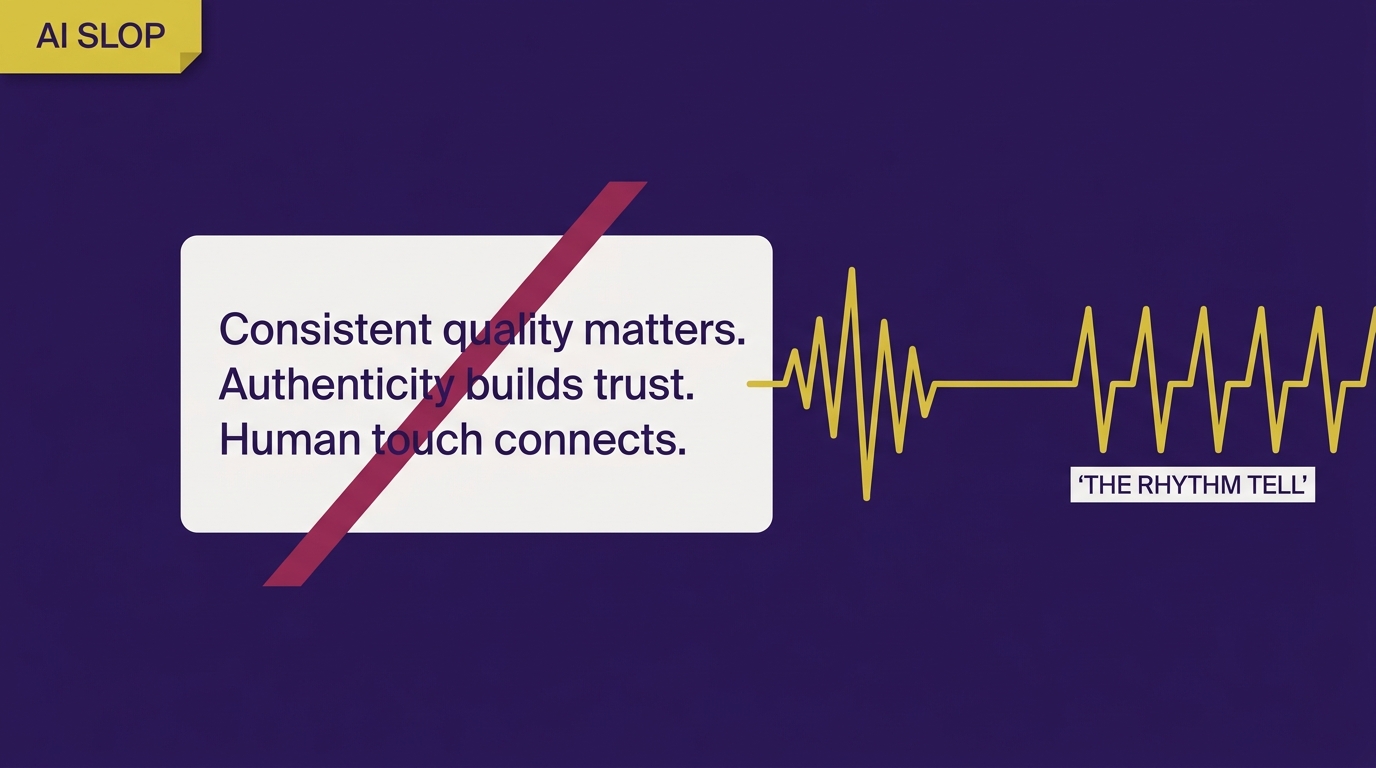
LinkedIn is quietly demoting your posts. It’s not because you used AI. It’s because you used AI the way everyone else uses AI — and the platform can smell the median from a mile away.
The tell isn’t a word. It’s a rhythm. Once you see it, you can’t unsee it.
The four-part fingerprint of AI slop LinkedIn posts
Every default GPT-4 or Claude draft, unprompted, converges on the same skeleton. Not because the models are broken — because they’re trained to hit the average of what worked before. The average is now the penalty.
Here’s the fingerprint:
- Three-part lists. Everything comes in threes. Three reasons, three lessons, three shifts. Two would feel unfinished, four would feel messy, so the model always picks three.
- Symmetrical sentence pairs. Short. Then shorter. Then a one-word line. It reads like a metronome.
- The “It’s not X, it’s Y” pivot. Sometimes stacked twice. It’s not about the tool. It’s about the taste. It’s not what you build. It’s who you build it for. (Yes, I do this too. That’s the point — we all do, because the model does.)
- The bait question close. “What would you add?” “Which one hit hardest?” “Am I wrong?” Engineered to farm a comment.
Put those four together in one 180-word post and you’ve written the exact shape of ten thousand other posts published that hour. LinkedIn’s ranking model doesn’t need to detect AI. It just needs to detect sameness — and sameness gets buried.
Why LinkedIn cares about rhythm, not tools
LinkedIn has been public about wanting “knowledge and advice” content and downranking generic engagement bait. Their own engineering posts on feed quality describe filtering for content that feels personal, specific, and non-repetitive. They don’t say “we hate AI.” They say they hate low-effort patterns. Those are the same thing in 2026.
The classifier doesn’t need to see your prompt. It sees:
- Sentence-length variance (AI drafts cluster tight)
- Opening n-grams that match ten thousand other posts that week
- Comment patterns that look like question-bait harvesting
- Zero named specifics — no tools, no numbers, no names, no timestamps
The last one is the giveaway most founders miss. A human writing about their week names things. Claude 3.5 Sonnet. Tuesday. $[X]. My cofounder Sam. AI drafts describe. Humans point.
How I actually use AI to write (and where I don’t)
I run [14] agents in my business. Research pipelines, transcription, CRM enrichment, draft QA. I still write every hook by hand. Claude only touches the middle — research, structure, second draft. The voice stays mine.
Here’s the actual split on a LinkedIn post:
- Hook (1-2 lines): 100% me. Written cold, usually while walking. If I can’t write the hook without AI, the idea isn’t real yet.
- Research + structure: Claude. I dump my raw voice memo, ask it to pull the 3-4 arguments and flag anything that contradicts itself.
- Second draft: Claude, tightly prompted. With a voice prompt that explicitly bans three-part lists, symmetrical pairs, and closing questions. More on that in Voice Prompt Is the Moat — that’s the exact system prompt I use.
- Final pass: me, out loud. If a sentence sounds like a LinkedIn coach wrote it, it dies.
The rule I follow: AI can compress, AI cannot originate. The moment it originates, you get slop.
The 60-second edit pass that removes the tell
Run this on any AI-assisted draft before you post. It takes a minute.
- Kill one item from every list of three. Make it two, or four. Odd asymmetry reads human.
- Break one symmetrical pair. Where you have two 6-word sentences back to back, rewrite one as 14 words with a comma and a specific.
- Delete every “It’s not X, it’s Y” except one. If you have zero, even better.
- Replace your closing question with a statement or a receipt. “Here’s what I’m testing next week: [thing].” People comment on specificity more than on prompts.
- Add three proper nouns. A tool name, a person, a place. AI drafts abstract; humans name.
- Introduce one intentional “flaw.” A parenthetical aside. A sentence that starts with “And.” A number that isn’t round. This is the single highest-leverage move.
Taste is the moat now, not the tool
Everyone has Claude. Everyone has ChatGPT. The tools are commodity. What isn’t commodity is knowing which sentence to cut, which specific to add, and when the draft is trying to make you sound like everyone else.
This is why founder-led accounts are pulling away from brand accounts and ghostwritten profiles right now — I broke down the reach data in Why Founder-Led Accounts Dominate Organic Reach in 2026. The founders winning aren’t the ones with the best prompts. They’re the ones whose taste survives the tooling.
If you want the deeper systems side — how to feed AI enough context that it stops defaulting to the median in the first place — read The 91-Hour Context Tax. Bad context is the real reason your drafts sound like everyone else’s.
The algorithm doesn’t hate AI. It hates the median. Stop writing to the middle and the reach comes back.