
47 unfinished takes. Every one deleted before it hit post. Not because the audio was bad — because you hated how you looked on screen.
Every growth guide says the same thing: just get on camera. As if confidence is a switch you flip. It isn’t, and treating it like one is why so many founders sit on months of unposted content.
Here’s the actual fix: a personal brand is a distribution system, not a face. Below is the system — formats ranked by how much of you they require, the tools that make each one work, and the order to actually attempt them in.
The Format Ladder: Start Where the Fear Is Lowest
Don’t start with ‘no camera ever.’ Start with the format that scares you least, prove it works, then decide if you ever need to move up the ladder.
Level 1: Text Posts With One Brutal, Specific Line
No editing, no recording, no face. Just a specific, honest sentence about something you actually did — a number, a mistake, a decision. The trap here is sounding like every other LinkedIn post. If your drafts read generic, that’s a voice problem, not a content problem — fix the AI voice fingerprint issue before you scale volume, or you’re just publishing more of the same slop faster.
Level 2: Document Carousels That Read Like a Story
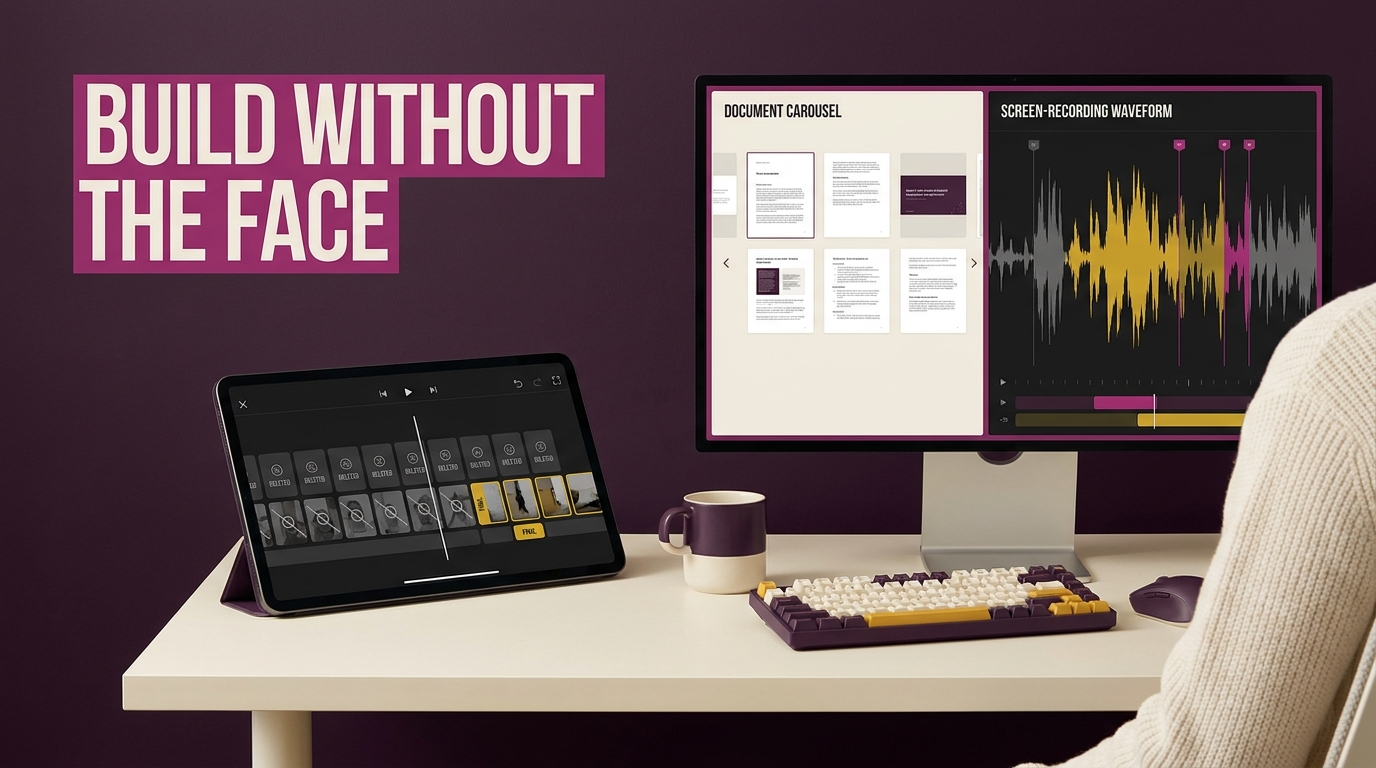
Carousels work because they’re read, not watched — no vocal delivery to second-guess. The mistake most people make: they build a slide deck, not a story. Structure every carousel the same way: slide 1 is the hook (a claim or a number), slides 2-7 are the build (the mistake, the fix, the mechanism), the last slide is the takeaway or a question. Build these in Canva with a locked template so you’re not redesigning from scratch every time.
Level 3: Voiceover Over Screen Recordings
This is the unlock most camera-shy founders skip past too fast. You record your screen — your dashboard, your workflow, your product, your notes app — and narrate over it. Nobody sees you. They see your work and hear your thinking. Tools: Descript for recording + editing in one pass, or Loom for the raw capture. If your speaking voice is the actual blocker (not just your face), record audio-only first, then layer screen footage over it after — separating the two removes half the pressure.
Level 4: B-Roll First, Script Second
This is the format that gets mistaken for ‘faceless is limiting.’ It isn’t. Shoot loose, unscripted b-roll of your actual day — typing, whiteboard, walking to a meeting, your setup — before you write a word. Then write the script to match footage you already have, instead of trying to perform a script live. This flips the anxiety order: you’re never on camera reciting anything, you’re narrating footage after the fact, calm, in as many takes as you want.
Why This Actually Builds Trust (Not Just Views)
None of these formats require you to like your reflection. All of them build trust the same way face-first content does — through specificity and consistency, not through eye contact. Content researchers have found repeatedly that format diversity, not personality performance, is what sustains audience growth over time; see Ahrefs’ content marketing research on how varied formats outperform single-format strategies long term.
The trust comes from the pattern being real and repeated — the same brutal honesty in the text post, the same specific mistake in the carousel, the same actual dashboard in the screen recording. That’s the system. The face is optional.
The Pipeline: How to Actually Ship This Weekly
- Monday: Write 3 text posts from things that happened last week — a decision, a number, a mistake.
- Wednesday: Turn your best text post into a 6-8 slide carousel using a locked Canva template.
- Friday: Record one screen-recording voiceover walking through something you built or fixed that week.
If you’re automating any part of this — repurposing one piece into three formats, scheduling, drafting first passes — treat the automation the same way you’d treat any other workflow: know what’s safe to hand off and what still needs your judgment. That distinction is covered in depth in this teardown of what to automate vs. rewrite, and once the system is producing consistent reach, the real leverage is turning that attention into pipeline — which is exactly what inbound-led outbound is built for.
The Face Can Come Later, If It Ever Needs To
Most founders who start with formats 1-4 never feel pressure to add their face — the system already works. If you do eventually go on camera, you’ll do it because the content proved itself, not because a growth guide told you confidence is a switch. It isn’t. Distribution is the switch. Flip that one first.