
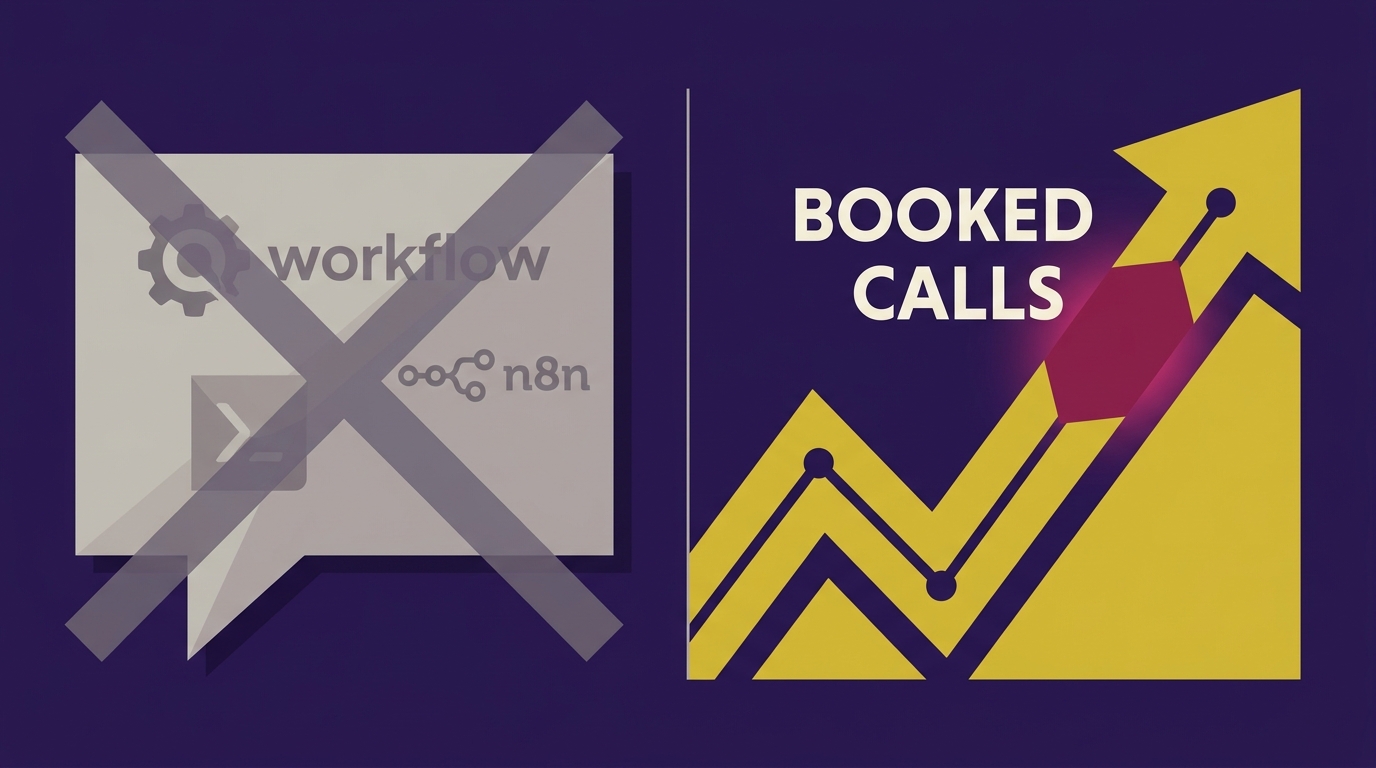
The pitch that never gets a callback
You walk in, open your laptop, and say something like: “We build automations with n8n and Claude that connect your CRM to your inbox.” The prospect nods. Says “interesting.” You never hear from them again.
This isn’t a tone problem. It’s a sequencing problem. You led with the mechanism when the prospect only cares about the result. Nobody wakes up wanting an automation. They wake up wanting more booked calls, fewer hours buried in invoices, and a lead that doesn’t slip through the cracks at 11pm on a Friday.
Why the tool-first pitch fails every time
When you open with n8n, Claude, or “workflow,” you’re asking a non-technical buyer to do two things at once: trust a tool they’ve never heard of, and imagine an outcome they can’t see yet. Most people can’t do both in the same breath. So they default to the safe response — “interesting, let me think about it” — which is a polite no.
Compare that to opening with the result: “Right now, when a lead fills out your form at 9pm, nobody responds until 9am the next day. That’s a [X]% drop in show-up rate. Here’s what happens if that lead gets a text back in 90 seconds instead.” You haven’t said the word automation. You’ve shown them their own problem, quantified, with a visible fix. That’s the whole pitch.
The exact shift: build the demo before you say the word
The fix isn’t better slides. It’s sequencing the meeting so the tool never comes up until after they’ve already said “how do I get this.”
- Step 1 — Pull their real data before the call. Their missed calls, their form fills, their invoice turnaround, their DM response time. Not a hypothetical. Their numbers.
- Step 2 — Build a live demo on that data. Show the lead that fell through last Tuesday. Show what a 90-second auto-response would have done. Use their name, their business, their actual gap.
- Step 3 — Show the outcome on screen first. The booked call. The invoice that got paid three days faster. The lead that didn’t ghost. Let them react to the result.
- Step 4 — Only then, name the mechanism. “This runs on a workflow tool called n8n, connected to an AI model called Claude.” By now it’s a footnote, not the headline.
The tool was never the offer. The result is. This is the same principle behind good copywriting and good ads — you sell the after-state, not the mechanism that gets you there. It’s why cold email that leads with the outcome outperforms cold email that leads with the offer almost every time — same psychology, different channel.
What to actually say in the first 90 seconds
Kill any sentence that starts with “we use” or “we build.” Replace it with a sentence that starts with “right now, you’re losing.” Some real openers that work:
- “You’re currently responding to leads in [X] hours. Every hour past five minutes cuts your close rate roughly in half.”
- “You’re spending [X] hours a week on invoicing that could be sitting in your inbox instead of on your calendar.”
- “Last month you had [X] leads come in after hours. Here’s how many of those never got a reply.”
Every one of those is a number, not a noun. Numbers create urgency. Nouns like “automation” and “AI” create curiosity at best and skepticism at worst — especially with buyers who’ve already been burned by a wrapper pitch. If you want to understand why so many of those pitches fall flat, read the AI wrapper moat teardown — most of what gets pitched as “AI automation” is a thin layer over someone else’s API, and prospects are starting to smell it.
Where this shift changes your pricing conversation too
Once you’re anchored on outcome, pricing gets easier, not harder. You’re not justifying an hourly rate for building a workflow. You’re pricing against a booked-call value, a time-saved value, a leads-recovered value. That’s a completely different negotiation, and it’s exactly why outcome-first pricing models tend to hold margin better than flat build fees — covered in more detail in how to price an AI agent without bleeding margin.
The mistake most agencies still make
Even after they hear this advice, most agency owners still slip the tool name into slide two out of habit. The fix is mechanical: write your pitch deck or talk track, then delete every instance of “n8n,” “Claude,” “AI,” and “automation” from the first three minutes. If the pitch still makes sense — if the prospect would still lean forward — you’ve built an outcome pitch. If it falls apart without the tool name, you were never selling the result. You were selling the plumbing.
The mechanism is real, and it matters — n8n and Claude are genuinely good tools for this work. But they’re the how, not the why. Say the why first. Let the how earn its place in the room after the prospect has already decided they want the result.