
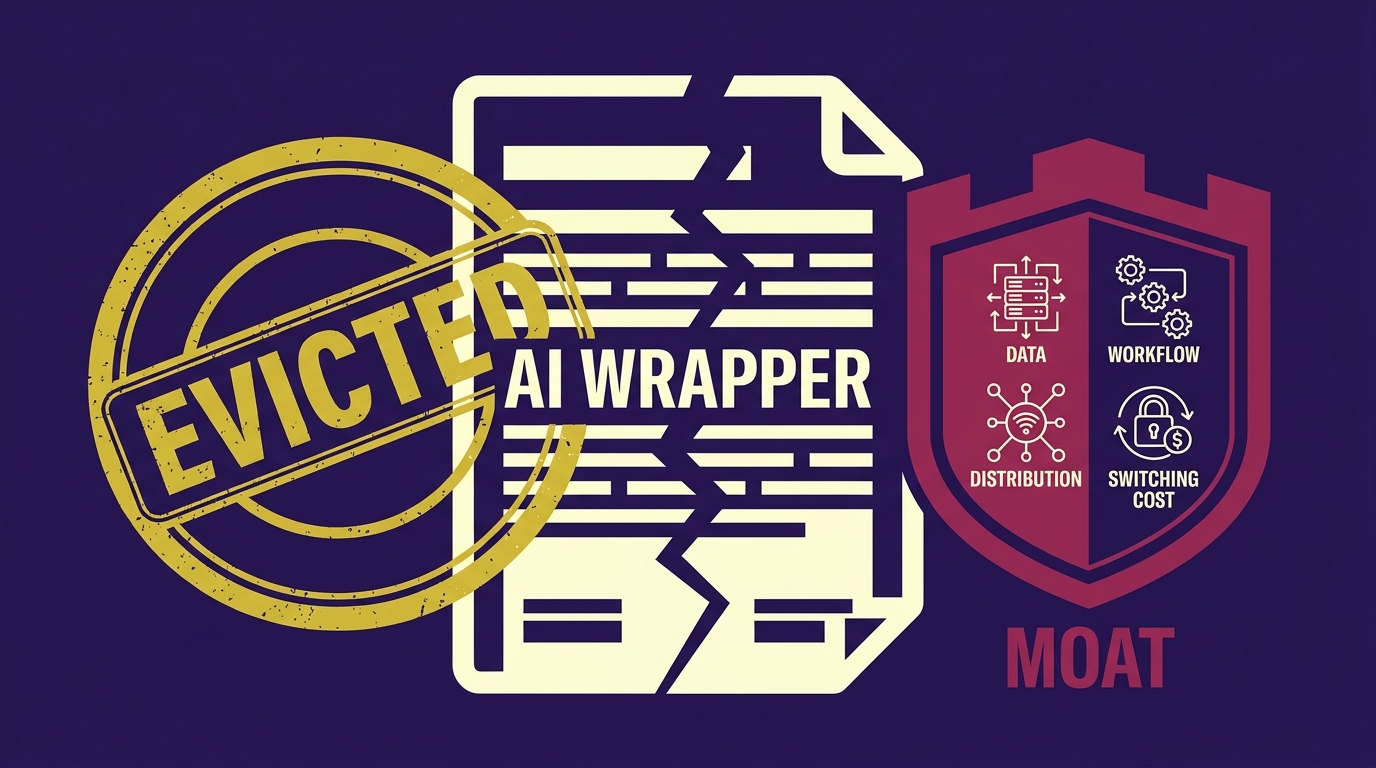
I went through 50 AI tools built on top of GPT-4 and Claude. 43 of them had the same problem: the only thing standing between the user and the raw model was a prompt and a nice UI. That’s not a business. That’s a rental, and the landlord can evict you with one changelog entry.
This isn’t theoretical. Model providers ship features that quietly kill wrapper products every few months — better memory, native file search, built-in agents, structured outputs. If your entire value prop was “we made ChatGPT easier to use for X,” you were always going to lose that bet eventually. The question isn’t if, it’s when.
The 5-Minute Moat Audit
Before you ship your next feature, run this test on your current product:
If OpenAI or Anthropic shipped this exact feature natively and for free tomorrow, what happens to your business?
- If the answer is “we’re fine, people still pay us” — you have a moat.
- If the answer is “we’re done” — you built a rental, and you need to know that today, not after it happens.
Run this question against every core feature, not just the flagship one. Most wrappers fail on the main feature and pass on nothing else, which means the whole product is one update away from irrelevant. Model providers publish their own deprecation and update cadence publicly — OpenAI’s deprecations page is worth bookmarking so you’re not caught off guard by what’s coming.
The Four Real Moats
Out of the 50 tools, the 7 that would survive a native feature drop all had one of these — usually more than one.
1. Proprietary Data
Not “we store your chat history.” Actual proprietary data that gets better the longer someone uses your product and that the model provider has no access to. A tool that learns a client’s brand voice across 200 pieces of content and stores that as structured data is defensible. A tool that just holds a system prompt in a database is not — that’s a config file wearing a moat costume.
2. Workflow Lock-In
This is the difference between a chatbox and a pipeline. If your product sits inside someone’s actual operations — pulling from their CRM, triggering their invoicing, syncing to their scheduling tool — ripping it out costs them real operational pain, not just a subscription cancellation. This is exactly why context engineering beats prompt engineering: the moat isn’t the prompt, it’s everything wired around the model that the model itself can’t replicate.
3. Distribution and Relationship
Do you own the customer relationship, or does the platform you’re built on own it? If a user would go find you again even if your product disappeared for a month, you have distribution. If they’d forget you existed within a week, you don’t. This is the same reason cold outbound is dying while relationship-first channels compound — see why inbound-led outbound is replacing cold email. Owning attention is a moat. Renting someone else’s inbox or someone else’s model is not.
4. Switching Cost That Compounds
Every month a customer uses your tool, does it get harder for them to leave, or does it stay exactly as easy to cancel as day one? Compounding switching cost looks like: historical data they’d lose, integrations they’d have to rebuild, a team that’s been trained on your interface. If canceling you is as easy in month twelve as it was in month one, you don’t have retention, you have a trial that never ends.
Why This Matters More Than It Used To
Clients are getting sharper about this too. A lot of them have already been burned by a thin wrapper that broke trust the first time it hallucinated something that mattered — that’s the exact failure mode in the hallucination that ended the retainer. If your only pitch is “AI, but easier,” you’re now competing against free native features AND against buyer skepticism at the same time. That’s a brutal combination for a rental.
It also changes how you should price. A tool with zero moat has to price low because the perceived value is thin and comparable to the raw API cost. A tool with real lock-in and data can charge for the outcome, not the API call — this is the whole logic behind pricing an AI agent without bleeding margin. Moat and pricing power are the same conversation.
What to Do This Week
Don’t rebuild everything. Pick the one feature in your product that’s closest to “just the model with a UI on top” and do one of these:
- Attach it to a workflow the user already can’t live without.
- Start capturing structured data from every use that compounds over time.
- Move the relationship somewhere you own — email, a portal, a community — not just inside a chat window.
You don’t need all four moats. You need one that’s real, and you need to know honestly which one you’re missing. The tools that survive the next model update aren’t the ones with the best prompt. They’re the ones where the model was never the whole product.