
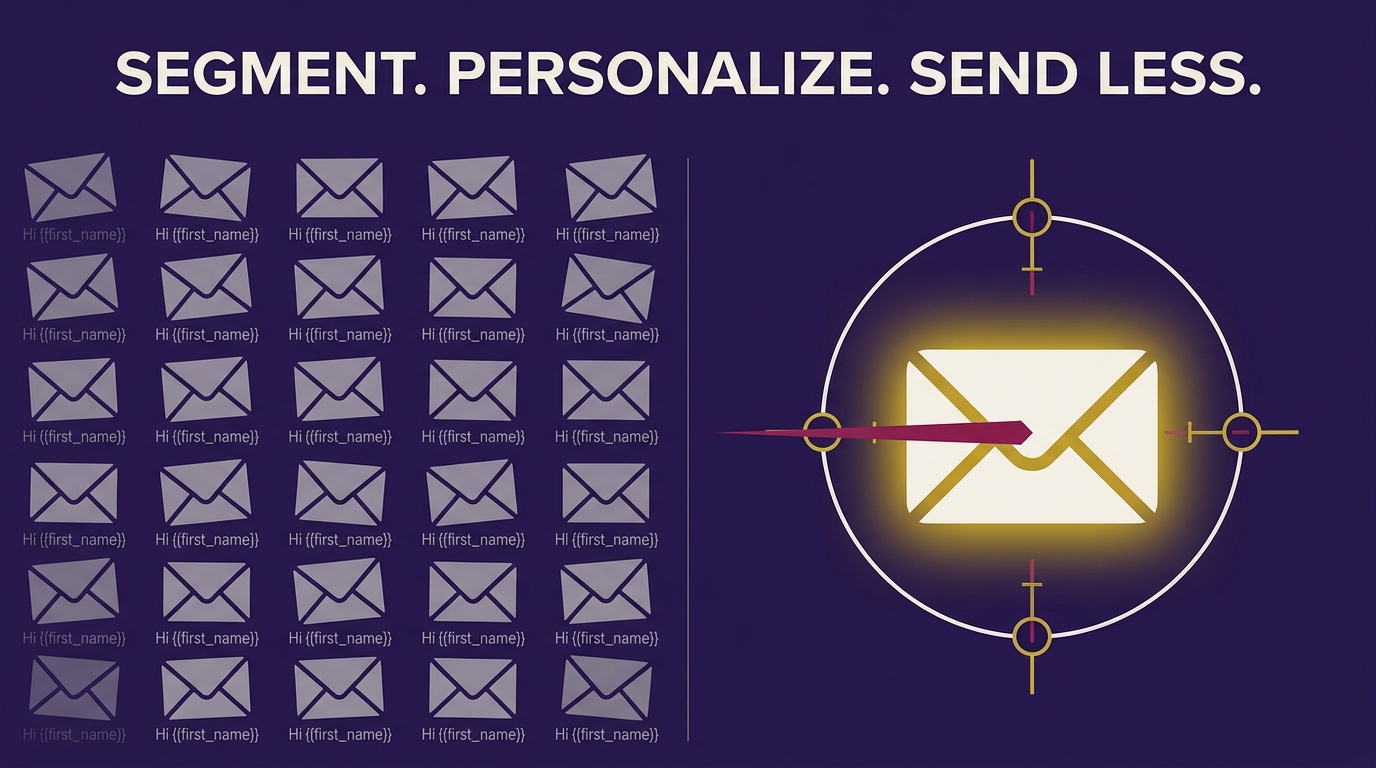
Everyone declared cold email dead the same year their reply rate hit 1%. Convenient timing. Nobody looked at the actual emails going out — same subject line, same three sentences, same \”I noticed you’re the [Title] at [Company]\” opener that a script generated in four seconds. The channel didn’t break. The version of it that treats 500 strangers like one person did.
I’ve watched founders kill their only lead source over this, then rebuild the exact same pipeline a few weeks later with the exact same tool, just aimed better. Same Instantly account. Same Apollo list source. Completely different outcome. The difference wasn’t the channel. It was three decisions made before a single email got sent.
Why your reply rate actually cratered
Cold email reply rates dropping industry-wide isn’t a mystery — deliverability got harder, inboxes got smarter, and prospects got faster at pattern-matching a mail-merge. Google and Yahoo’s 2024 bulk sender requirements alone forced a filtering shift that punishes generic, high-volume blasts specifically (Ahrefs has good data on how inbox algorithms weight relevance now). The tools didn’t get worse. The bar for “relevant enough to open” got higher, and most outbound never adjusted.
So the founders blaming the channel are half right about the symptom and completely wrong about the cause. The fix isn’t a new platform. It’s three changes to how you use the one you already have.
Fix 1: Segment the list until it hurts
Most lists are built by firmographic filter — industry, company size, title — and stop there. That’s not a segment, that’s a category. A real segment is small enough that you could write one sentence true of everyone in it and false of everyone outside it.
- Instead of “marketing agencies, 10-50 employees,” try “agencies that just posted a job for a paid media buyer in the last 30 days” — pulled via a scraper into Clay or a simple n8n workflow watching job boards.
- Instead of “SaaS founders,” try “SaaS founders who churned a competitor’s tool according to a G2 review posted this month.”
- If your list has more than 200 people and no shared, specific, recent trigger event, it’s not a list. It’s a spray.
Smaller lists feel worse on a dashboard. They convert better in an inbox, because everyone on it actually fits the pitch.
Fix 2: One line that proves you looked
Personalization tokens aren’t personalization. Swapping {{first_name}} into a template a prospect has seen from four other vendors this month reads as exactly what it is. The fix is one sentence, written by a human or a well-prompted model, that references something true and specific: a recent post, a job listing, a product change, a review they left somewhere public.
This is where a lot of founders lean on AI and immediately sound like every other founder leaning on AI — same rhythm, same “I noticed that…” opener, same em-dash cadence. If your personalized line reads like it came out of the same model everyone else is using, it defeats the point. Worth fixing that before you scale the send — I wrote a full breakdown on how to stop your AI-written copy from sounding like ChatGPT, and the same fixes apply directly to cold email lines.
Fix 3: Send fewer emails to fewer, better people
Volume is the easiest lever to pull and the worst one for reply rate. Sending 2,000 emails a week to a loosely-defined list feels productive. Sending 150 emails a week to a list you built from a real trigger event, with a line that proves you read something specific, will out-reply it every time — because the math isn’t emails-sent-over-replies, it’s fit-over-noise.
Cut volume by 70% before you touch copy. Most founders do the reverse — they rewrite the template and keep blasting the same 2,000-person list, then wonder why nothing moved. The list is upstream of the copy. Fix it first.
The actual system, tool by tool
- Sourcing: Apollo or Clay for the base list, filtered down to a trigger-event segment, not a static firmographic one.
- Enrichment: Clay tables pulling recent posts, job changes, or review mentions per contact — this is the raw material for the one-line personalization.
- Personalization draft: Claude or GPT generating a first-draft line per contact from the enriched data, then a human pass to strip the AI cadence out.
- Sending: Instantly or Smartlead, capped low, warmed properly, one segment at a time instead of one giant blast.
- Orchestration: n8n tying sourcing, enrichment, and sending together so the pipeline runs without you babysitting it daily — just make sure your error handling actually catches failures instead of silently passing them, which is a more common failure point than people expect.
If you’re automating this pipeline in n8n, it’s worth checking your workflow doesn’t have the exact failure mode I wrote about in the green checkmark lie — a workflow that reports success while quietly skipping the enrichment step is worse than no automation at all, because you won’t know your personalization line never got written.
What this actually buys you
A smaller, sharper outbound motion isn’t just better reply rates — it’s the difference between cold email being your only lead source and it being one channel among several that all reinforce each other. If you want to stop depending on volume entirely and build a pipeline where inbound demand does the qualifying for you before the email ever goes out, that’s a deeper shift worth reading — I covered the full model in Inbound-Led Outbound: Kill Cold Email in 2026.
The channel isn’t dead. The mass-blast version of it just finally stopped working, which was overdue. Segment until it hurts, prove you looked, send less. The reply rate follows.