
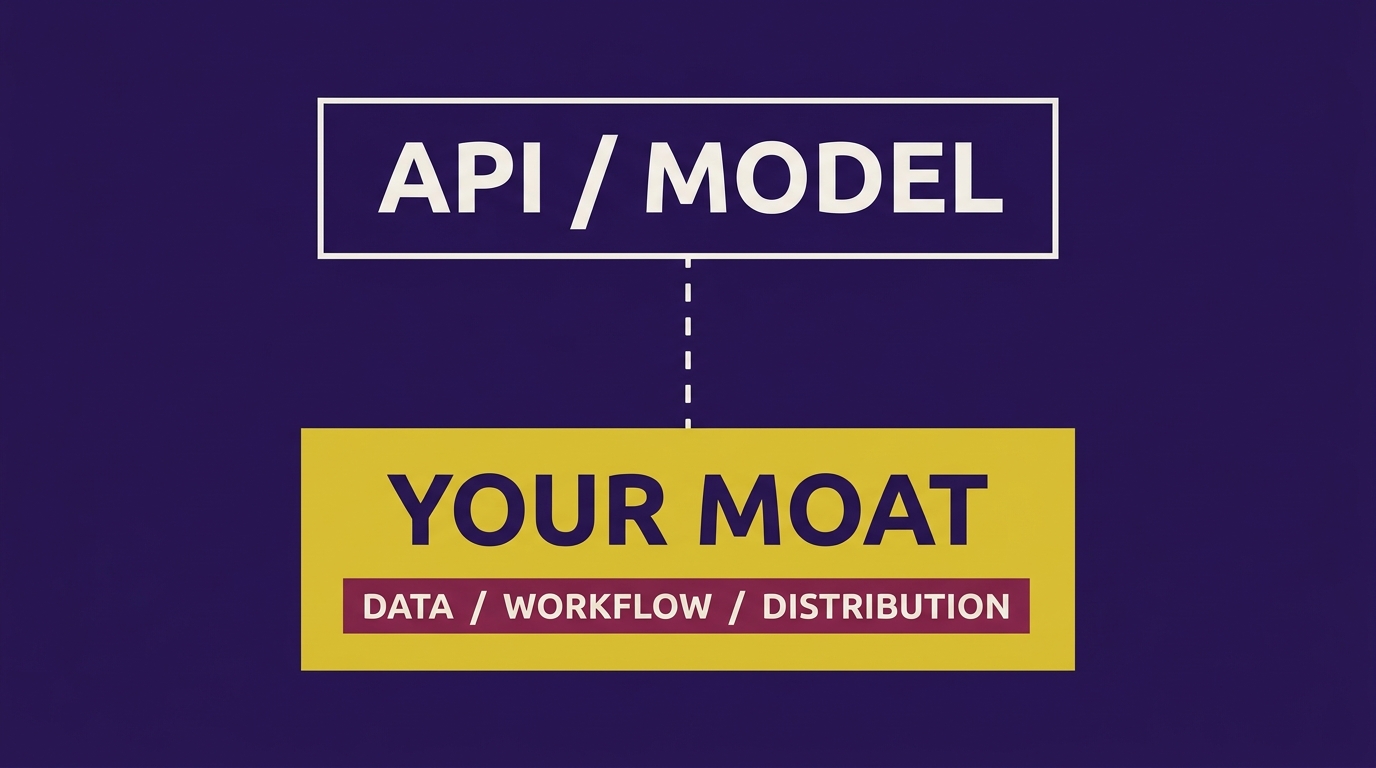
You didn’t build a business. You built a UI on top of someone else’s model, and you’ve been calling it a product for a year.
That’s not an insult. It’s the default outcome of shipping fast on GPT-4o or Claude. The API does the hard part, you wrap a prompt, a dashboard, and a Stripe checkout around it, and you call it done. The problem shows up later, when Anthropic ships your exact feature for free inside their consumer app, or OpenAI changes pricing tiers and your unit economics stop working in an afternoon.
If a client could rebuild your tool in a weekend with a ChatGPT subscription and a Sunday afternoon, you don’t have a moat. You have a demo with a monthly invoice attached.
Why “the model” was never your moat
The model is infrastructure. It’s rented, and rented things get repriced, deprecated, or commoditized on someone else’s schedule, not yours. OpenAI’s own pricing page has changed multiple times in the last two years, and every time it does, every thin wrapper built on top of it has to renegotiate its own survival. You don’t control that timeline. You can’t build a business on a foundation someone else can move without asking you.
So the fix isn’t a better prompt or a nicer frontend. It’s figuring out what layer of your stack the model can’t touch, and building your actual business there.
The four things you can actually own
1. The data the model touches
Every time your tool runs, it should get smarter about that specific client, not just smarter in general. That means you’re storing structured history — past outputs, corrections, preferences, outcomes — somewhere the model never sees directly. A Postgres table, an Airtable base, a Supabase instance. Six months of accumulated context on a client is something a competitor can’t replicate by signing up for the same API key. That’s your first real moat: proprietary data compounding over time.
2. The workflow that gets people to the output
This is the piece most builders skip because it’s less glamorous than the AI part. The model generates a paragraph. Your business is everything that happens before and after that paragraph — the intake form, the approval step, the routing logic, the notification that fires when something needs a human. That’s orchestration, and it’s usually built in something like n8n, Make, or Zapier sitting around the API call, not the API call itself.
If that orchestration layer breaks silently, you lose the moat and the client’s trust in the same afternoon. Worth reading how that failure mode actually plays out and how to catch it before a client does, in this breakdown on n8n’s silent failures.
3. The distribution that gets the tool in front of people
A model can be copied. An audience that trusts you and finds you first cannot. If your only distribution channel is a listing on someone else’s marketplace or a cold outbound list you rent, you have the same rental problem one layer up. Owned distribution — your email list, your following, your inbound from content you’ve published — is a moat because a competitor with the same API access still has to start from zero on trust.
4. The relationship, not the tool
This is the one that actually changes how you sell. Clients don’t pay for automation, they pay for the outcome the automation produces. If your pitch is “I built you a GPT wrapper,” you’re one comparison shop away from losing the deal to whoever quotes a cheaper wrapper. If your pitch is the specific business result — hours saved, leads converted, revenue recovered — the model becomes invisible and the relationship becomes the product. This is exactly the pitch shift covered in Sell the Outcome, Not the Automation.
The audit: run this on your own stack today
- Data test: If I deleted my database and kept only my API key, would tomorrow’s output be worse than today’s? If no, you have no data moat.
- Rebuild test: Could a competent freelancer, given the same API access, rebuild this in under two weeks? If yes, your workflow isn’t complex enough to be a moat.
- Distribution test: If your top client churned tomorrow, do you have a pipeline that replaces them without cold outreach from scratch? If no, you’re renting your customers too.
- Pricing test: If OpenAI or Anthropic cut their API price by 80% tomorrow (they’ve done bigger cuts before), does your value prop still hold, or was the wrapper itself the entire pitch?
If you fail two or more of these, you don’t have a business yet. You have a proof of concept with a payment processor attached — worth fixing before you scale it, not after.
What to build instead, starting this week
Pick one moat and go deep before you touch anything else. If you have zero data infrastructure, spend this week wiring a Supabase or Airtable layer that logs every interaction your AI tool has with a client, even if you don’t yet know what you’ll do with it. If your workflow is a single Zapier trigger, spend the week mapping the full client journey and finding the two or three steps that actually require judgment — those are the ones worth automating with real branching logic, not the whole thing end to end.
None of this is about the model getting better or worse. It’s about making sure that when it does change — and it will — your business is still standing on something you own. For a deeper teardown of what real defensibility looks like across different AI product types, see the full AI Wrapper Moat Teardown.
The model is rented. Everything you build around it doesn’t have to be.