
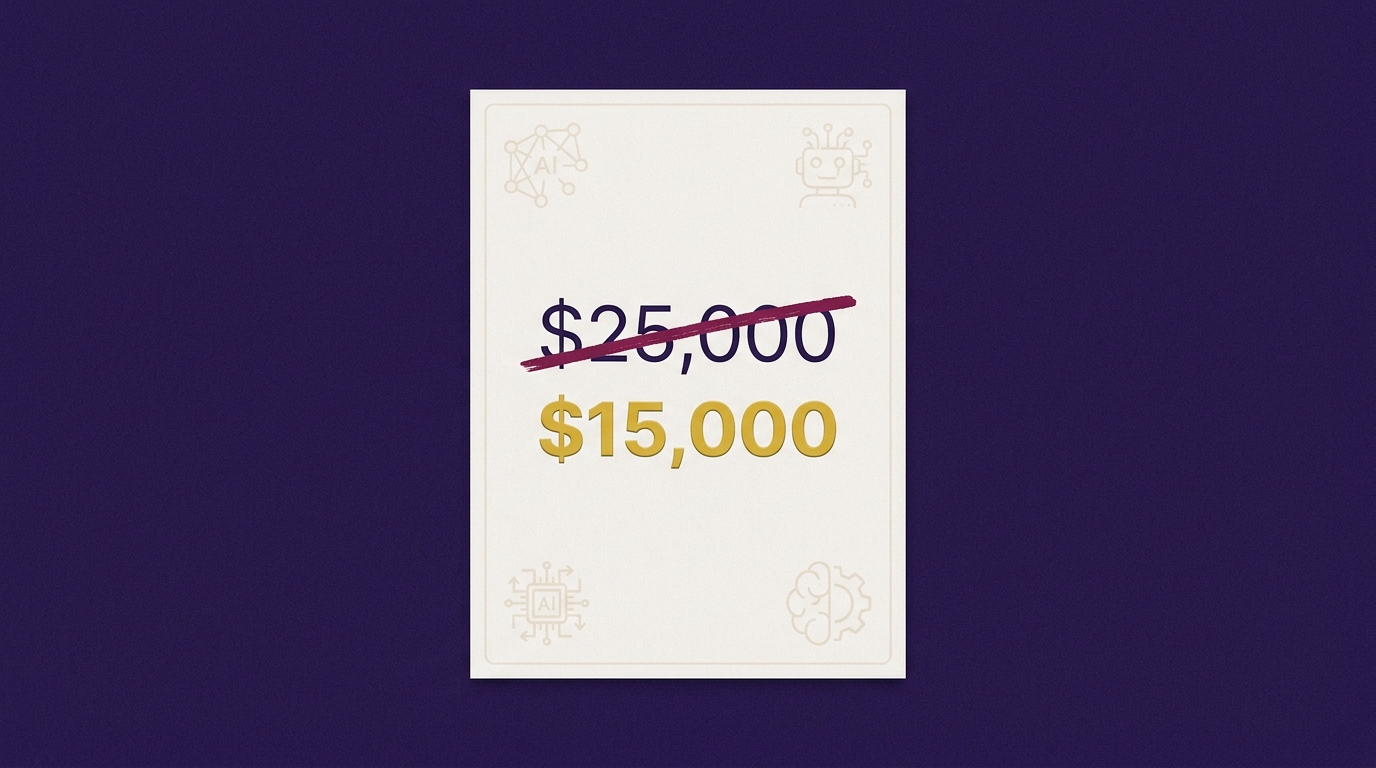
Your best client isn’t going to fire you. They’re going to cut you from [$25k] to [$15k] and call it “budget.”
What actually happened: their junior marketer discovered Claude. Their ops lead built a Zap over the weekend. The deliverables you’ve been charging for — the newsletter, the reporting doc, the ad variants, the SEO briefs — suddenly feel optional. Not bad. Optional.
The relationship survives. The economics don’t. And because there’s no formal churn event, you don’t get a chance to fight for it. You just watch MRR drift down one “scope conversation” at a time.
This is the stealth retainer cut. Here’s how to see it coming and what to actually do about it.
Why this is happening in 2026, not 2022
Two years ago, the ceiling on in-house AI was “we tried ChatGPT and the outputs were mid.” That ceiling is gone. Claude 3.5+ writes usable long-form. GPT-4o handles multimodal. A non-engineer can wire up n8n or Make in an afternoon. Anthropic even publishes their own prompt engineering guides aimed at business users, not devs.
Which means the marketing coordinator who used to send you a Loom asking for “3 more hooks” now just… does it. Badly, sometimes. But good enough that your $8k content line item becomes a $2k “review and polish” line item.
The commodity layer of agency work is being absorbed in-house. Fast.
The signal you’re about to get cut
You almost never get a heads-up. But there are tells:
- They ask for the raw prompts you use, or “how we structured the brief.”
- A new hire on their side has “AI” or “automation” in the title.
- Feedback shifts from strategic to production (“can you match this tone better?”).
- Meetings get shorter. Slack goes quieter.
- They start asking what specifically is included in the retainer.
That last one is the loudest siren. When a happy client starts itemizing, they’re building the internal case to unbundle you.
Stop selling deliverables. Start selling the thing they can’t hire for.
Their in-house team can now produce the artifact. What they still can’t do is orchestrate. Their junior can prompt Claude. They can’t design a workflow that ingests CRM data, routes through a research agent, applies brand voice, checks against past posts, and outputs into their CMS with QA gates.
That’s the work you keep. Everything downstream of it is the deliverable you used to charge for — and now you give away as a byproduct.
The four-step reprice
1. Audit what their team is already trying to automate
Ask directly: “What has your team built with AI in the last 90 days?” You’ll get a list of half-finished Zaps, a Claude Project no one maintains, a Notion AI setup someone abandoned. That list is your scope map. It tells you exactly where they’ve hit the ceiling of what a non-specialist can build.
2. Build the workflow their junior can’t
Real orchestration, not a Zap. Multi-step, stateful, with memory and evals. n8n or a custom Python service, not a linear trigger-action chain. The test: could a smart intern rebuild it in a weekend? If yes, you haven’t gone deep enough. For a framework on which internal processes are worth rewriting vs. just automating, this teardown is a good starting point: AI Slop Workflow Teardown: What to Automate, What to Rewrite.
3. Own the tooling, the training, and the strategic review
Three lock-in layers, in order of stickiness:
- Tooling: the workflows live in your infra or under your account. You maintain them.
- Training: you teach their team how to operate what you built. Monthly working sessions.
- Strategic review: quarterly, you audit what’s working, what to kill, what to build next.
The output isn’t a deck. It’s a system they depend on and a person (you) who understands it end-to-end. A huge part of this is voice and context — the pieces AI can’t guess. If they’re going to run content through your workflow, your context engineering and voice prompt become the moat.
4. Reprice as a strategic retainer, not a production retainer
Rewrite the SOW. New line items:
- AI systems ownership: [$X]/mo
- Team enablement + training: [$X]/mo
- Strategic review + roadmap: [$X]/quarter
- Production output: included, not itemized
You’ll usually land at the same or higher number, but the client can’t unbundle it. They can’t fire the “content person” and keep you. You are the operating system, not a supplier feeding it.
What to do this week if you feel the drift
Don’t wait for the budget conversation. Book a working session framed as: “Let’s map what your team is building with AI so I can plug into it, not duplicate it.” That single meeting reframes you from vendor to systems partner before the CFO ever gets involved.
Then go home and rebuild your offer.
The agencies that survive the next 18 months aren’t the ones producing the best deliverables. They’re the ones whose systems the client can’t operate without.