
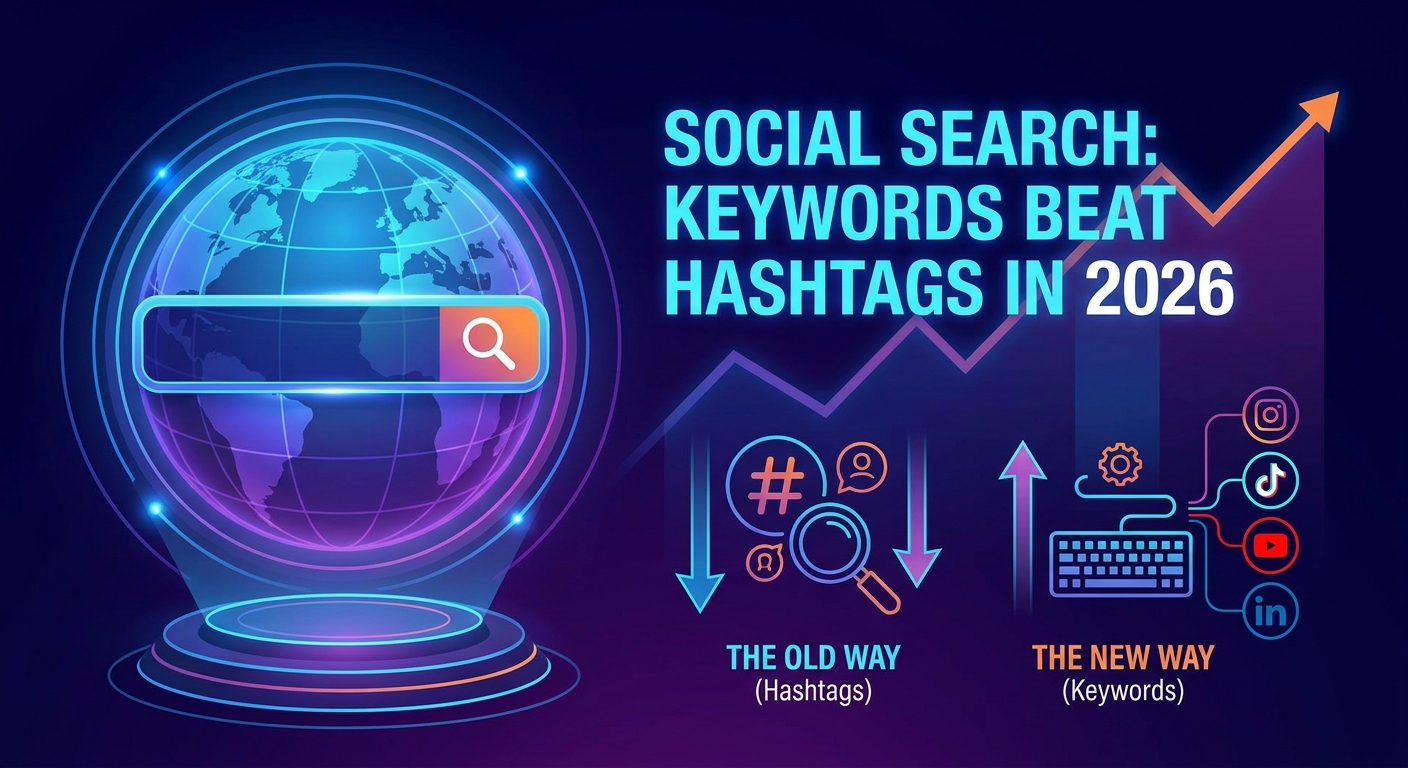
Social platforms now function as search engines first, content feeds second. Social search optimization—the practice of embedding discoverable keywords directly into captions, video descriptions, and profile copy—has replaced hashtag-first strategies as the primary lever for organic reach. For B2B marketers in 2026, keyword-led captions and platform-native search behaviors dictate visibility more than follower count or paid boost ever did.
The Death of Hashtag-First Strategy
Hashtags still exist. They just don’t drive discovery the way they did three years ago.
Instagram, TikTok, and YouTube have all deprioritized hashtag crawling in favor of natural language processing that scans full captions, on-screen text, and spoken audio. The Instagram search algorithm now parses sentence structure and semantic intent. TikTok discovery operates on query matching, not topic clusters. YouTube search optimization has always been keyword-centric, but the shift is in how users now treat Instagram and TikTok like Google—typing questions, not tapping tags.
The old playbook—stuffing 20–30 hashtags below the fold—generates negligible reach compared to a single well-crafted sentence with embedded search terms. Keyword-led captions win because they mirror how users actually search: “fractional CFO for SaaS” outperforms #SaaSFinance.
How Platform Algorithms Rewired for Search Intent
Every major platform rebuilt its discovery engine between 2023 and 2025 to prioritize user queries over passive scrolling.
Meta confirmed in Q4 2024 that Instagram’s Explore tab and search results now weight “contextual relevance” over engagement velocity. That means a post with 50 saves from high-intent searchers can outrank a post with 5,000 likes from passive scrollers.
TikTok’s “Search Insights” dashboard, launched in early 2025, gives creators real-time data on which queries surfaced their videos. The feature exists because TikTok knows its users treat the app as a visual search engine. Queries like “email sequence template” or “how to pitch investors” return video results ranked by keyword match, watch time, and saves—not follower count.
YouTube remains the blueprint. Its recommendation engine has always been search-intent-driven, but younger platforms finally adopted the same architecture. Social media SEO is no longer optional—it’s the default distribution model.
Why Keywords in Captions Drive Discovery Now
Captions are the new meta descriptions.
When a user searches “demand gen tactics for B2B,” platforms scan every word in your caption, not just your hashtags. If your caption says “Three demand gen tactics we’re testing this quarter” and uses related terms like “pipeline velocity” or “buying intent,” the algorithm indexes that post as relevant.
This shift rewards long-form captions that read like micro-blog posts. Founders and marketers who write 150–300 word captions with embedded keywords see higher impressions from search than from followers. The content is structured for humans but optimized for machine readability.
Voice search compounds this. As users dictate queries into TikTok or Instagram, natural phrasing matters. “Show me cold email examples” performs better than #coldemail. If your caption mirrors conversational search language, you rank.
Platform-native content now means writing for search intent first, aesthetic second. The caption isn’t an afterthought—it’s the distribution engine.
Data: Search Behavior Across Instagram, TikTok, and YouTube
According to a [2024 Pew Research study](https://www.pewresearch.org/internet/2024/09/18/how-americans-navigate-politics-on-tiktok-x-facebook-and-instagram/), nearly 40% of adults aged 18–29 now use TikTok or Instagram as a primary search tool for product research and how-to queries. This isn’t passive consumption—it’s active problem-solving.
Google’s own internal data, shared at I/O 2023, revealed that Gen Z users are twice as likely to start a search on TikTok or Instagram than on Google for categories like restaurants, local services, and visual tutorials. While that data predates 2026, the trajectory has only intensified.
YouTube continues to hold the crown for long-tail search. A [2023 report from HubSpot](https://www.hubspot.com/marketing-statistics) found that 68% of marketers investing in video cite YouTube as their top-performing channel for organic reach—largely because YouTube’s search bar is the second-largest search engine globally.
The takeaway: users treat social platforms like answer engines. If your content isn’t optimized for queries, it’s invisible.
What B2B Marketers Must Do Differently in 2026
Stop treating social like a megaphone. Start treating it like a content library with a search index.
First, audit your caption strategy. Replace vague CTAs with keyword-rich sentences that answer common questions. Instead of “New post on our blog,” write “How to build a content engine without a full-time team—three frameworks we use.”
Second, map search intent to content formats. Use Instagram carousel posts for step-by-step guides. Use TikTok for quick-answer videos. Use YouTube for deep dives. Each format should include spoken or written keywords that match how your audience searches.
Third, optimize profile bios and video descriptions. These fields are crawled heavily. A LinkedIn bio that says “Founder” is less discoverable than “Founder | B2B demand gen for AI tools | ex-VP Marketing.”
Fourth, lean into founder voice and subject-matter expert content. Platforms and AI answer engines reward credible, first-person perspectives. Generic brand posts lose to expert-led commentary. If your CEO or head of product can publish short-form insights with embedded keywords, that content will outperform agency-written captions.
Fifth, track search impressions, not just engagement. Instagram Insights now breaks out “reached through search.” TikTok shows query sources. YouTube Studio has always offered search analytics. Optimize for those metrics, not likes.
Social search optimization isn’t a tactic—it’s the core distribution model. Hashtags are metadata. Keywords are the map.
—
FAQ
What is social search optimization?
Social search optimization is the practice of embedding discoverable keywords into social media captions, bios, and video descriptions so content ranks in platform search results. It mirrors SEO principles but applies to Instagram, TikTok, YouTube, and LinkedIn.
Do hashtags still matter in 2026?
Hashtags still function as topical markers, but they no longer drive primary discovery. Platform algorithms now prioritize natural language in captions and spoken audio over hashtag crawling. Use 3–5 relevant hashtags, but invest effort in keyword-rich sentences.
How do I find the right keywords for social captions?
Use platform search bars to see autocomplete suggestions. Check TikTok’s Search Insights or YouTube’s keyword planner. Monitor questions your audience asks in comments, DMs, or sales calls. Write captions that answer those queries verbatim.
Which platforms prioritize search the most?
YouTube has always been search-first. TikTok and Instagram now function as visual search engines for Gen Z and millennial users. LinkedIn search ranks profiles and posts by keyword relevance, especially for B2B topics.
Should B2B brands change their content strategy for social search?
Yes. Shift from broadcast messaging to answer-engine thinking. Publish founder-led insights, use keyword-led captions, and structure content around common search queries. Social media SEO is now as critical as Google SEO for discoverability.
—
Want weekly breakdowns on where B2B marketing is heading? [Subscribe to our newsletter](https://alingtonmedia.com/newsletter) or reach out to talk strategy.