
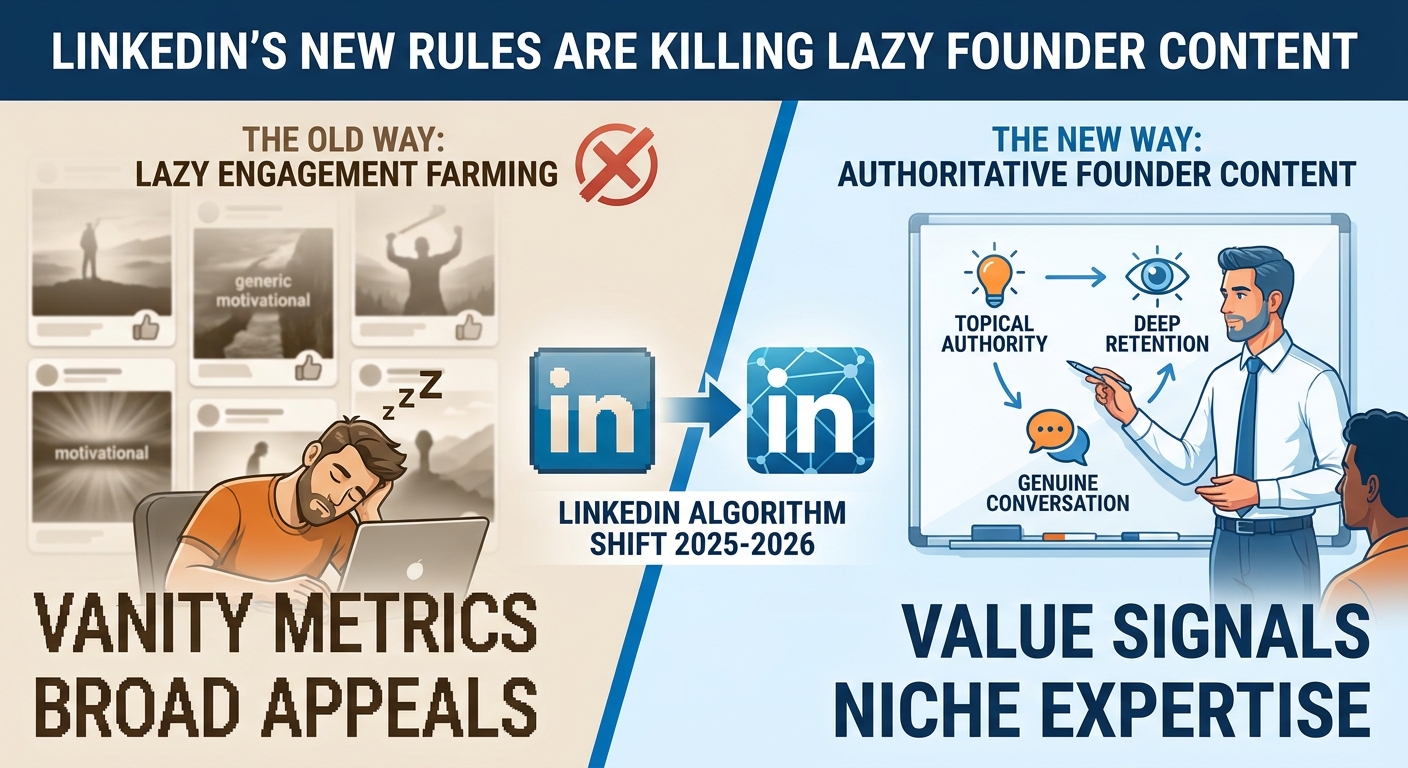
LinkedIn’s 2025-2026 algorithm updates have fundamentally changed what works for founder-led content, penalizing broad engagement farming while rewarding topical authority, retention, and genuine conversation. This shift means most B2B founders need to completely rethink their LinkedIn founder-led content strategy or watch their reach collapse.
Why LinkedIn Changed the Game (And Why Most Founders Missed It)
LinkedIn quietly rolled out significant changes to its engagement algorithm throughout 2025, but most founders were too busy posting motivational carousels to notice. The platform started prioritizing what it calls “knowledge and advice” signals over vanity metrics like comment counts and reaction volume.
The change wasn’t announced in a single press release. Instead, LinkedIn embedded the shift across multiple product updates: stricter live video rules, heavier penalties for engagement bait, and a dramatic boost to posts that drive saves, shares, and longer dwell time.
Here’s what actually changed: LinkedIn now tracks how long people spend reading your post, whether they share it privately via DM, and if they return to your profile after engaging. These retention signals matter infinitely more than someone dropping a “Great post!” comment.
The platform is explicitly modeling its feed around topical authority marketing. If you post consistently in a tight niche and drive substantive discussion, you win. If you’re a generalist posting inspirational fluff three times a week, your distribution just fell off a cliff.
The Death of Vanity Metrics: What LinkedIn Actually Rewards Now
Comment counts are dead as a success metric. LinkedIn’s current ranking system actively discounts single-word or emoji-only comments because they’re easy to game and don’t signal genuine value.
What the algorithm favors instead: long-form comments that extend the conversation, shares to someone’s network with added context, and saves for later reference. These behaviors indicate your content actually delivered something worth revisiting or discussing seriously.
Private shares have become the new currency of B2B video marketing strategy and written posts alike. When someone sends your post directly to a colleague via LinkedIn messaging, that’s a stronger signal than ten public reactions. It tells the algorithm this content is valuable enough to risk someone’s professional reputation by forwarding it.
Dwell time matters more than ever. If people scroll past your post in two seconds, LinkedIn reads that as low quality. If they stop, read the full thing, and click through to comments, your distribution multiplies. This is why founder content distribution can’t rely on generic hooks anymore.
The shift has killed the “post everywhere about everything” playbook. Founders who built audiences posting about productivity on Monday, leadership on Wednesday, and random life lessons on Friday are watching engagement crater. The algorithm now wants to understand what you’re an expert in, and it punishes topic inconsistency.
How Stricter Live Video Rules Separate Signal From Noise
LinkedIn’s new live video rules, implemented in early 2025, require creators to apply for live access and demonstrate consistent posting history in their claimed expertise area. You can’t just flip on a camera and stream anymore.
This isn’t gatekeeping for fun. LinkedIn saw too many low-effort live sessions that drove poor viewer retention. The platform learned that most spontaneous lives had terrible audio, no clear value proposition, and single-digit sustained viewership.
Now, LinkedIn evaluates your topic consistency, average post engagement, and follower retention before granting live privileges. If you’ve been all over the map with your content topics, you’re probably not getting approved.
The upside: live video that does get approved sees dramatically better distribution. LinkedIn is clearly boosting authenticated expert voices in live format because the quality floor is higher.
For B2B marketers, this means LinkedIn live video rules now favor the prepared over the spontaneous. You need a content angle, a repeating format, and production value. The “let’s just go live and riff” era is over.
The Founder Content Playbook That Actually Works in 2026
Pick one lane and own it completely. If you’re a SaaS founder, decide whether you’re talking about product development, sales strategy, or vertical-specific challenges. Don’t rotate between all three hoping to maximize reach.
Lead with a direct answer in your first two sentences. AI search engines and LinkedIn’s own algorithm both favor posts that immediately deliver value. Skip the storytelling windup and the “I’ll never forget when…” openers. Say the useful thing first.
Video content needs stronger hooks than ever. The first three seconds determine whether someone keeps watching or scrolls. Your B2B video marketing strategy should open with the specific problem you’re solving or the surprising insight you’re sharing, not your face talking in a car.
Write for saves and shares, not likes. Structure posts so they’re genuinely reference-worthy. Frameworks, step-by-step processes, and contrarian takes with clear reasoning all drive saves. Motivational platitudes don’t.
Comment depth beats comment count. Instead of trying to inspire dozens of “Love this!” replies, ask questions that require nuanced answers. Better yet, drop a strong take that forces people to explain their agreement or disagreement with substance.
Founder content distribution should prioritize consistency over frequency. Three thoughtful posts per week in your niche will outperform daily posts that jump between unrelated topics. LinkedIn’s algorithm is watching your posting pattern and categorizing your expertise.
What This Means for Your B2B Content Strategy Moving Forward
Your LinkedIn founder-led content strategy needs an immediate audit. Look at your last 20 posts and ask: would an outsider immediately understand what specific expertise you’re building authority around? If the answer is unclear, you’re getting algorithmically penalized.
Content calendars need tighter thematic structure. Plan monthly content themes rather than scattering topics. If March is about outbound sales strategy, every post that month should reinforce that topical authority. April can be different, but it also needs coherence.
Repurposing content across platforms requires more customization now. The LinkedIn algorithm can detect when you’re copy-pasting from Twitter or Instagram. Platform-native content, written specifically for LinkedIn’s professional context, gets measurably better distribution.
Video production standards just went up. Phone videos are fine, but bad audio will kill retention. Invest in a basic lavalier mic and shoot in decent lighting. The barrier isn’t expensive gear, it’s caring enough to not post garbage.
Engagement farming tactics will actively hurt you. “Tag someone who needs to see this” or “Comment below if you agree” might have worked in 2023, but LinkedIn now treats them as spam signals. Let conversation emerge naturally from valuable content.
The winning move is deeper expertise in narrower domains. The founders who’ll dominate LinkedIn through 2027 are the ones willing to be known for one specific thing rather than trying to be thought leaders on everything.
—
FAQ
What counts as “topical authority” on LinkedIn’s new algorithm?
Topical authority means consistently posting about the same narrow subject area and demonstrating expertise through the depth and quality of your content. LinkedIn’s system looks at keyword consistency, engagement patterns within specific professional communities, and whether other recognized experts interact with your posts.
Are video posts still worth it compared to text on LinkedIn?
Yes, but only if production quality meets the higher 2026 standards. Native LinkedIn video with good audio and a strong first three seconds gets better reach than text, but low-effort video now gets penalized harder than it would have in 2024.
How often should founders post to maintain algorithm favorability?
Two to four times per week is the current sweet spot for founder content distribution. Daily posting can work if every post maintains topical consistency and quality, but frequency without focus will hurt you more than help.
Do I need LinkedIn live access to compete in B2B marketing now?
No. Live access helps if you have a repeatable format worth streaming, but excellent written posts and native video still drive strong results. Focus on getting live access only after you’ve established clear topical authority through standard posts.
How long before I see results from switching to a niche-focused strategy?
Most founders see distribution improvements within three to four weeks of posting consistently in a single domain. The algorithm needs time to recategorize your profile and surface your content to the right audience, but the shift happens faster than rebuilding from scratch.
—
Want the full breakdown on where B2B platforms are heading? Subscribe to Alington’s weekly strategy brief at alingtonmedia.com or reach out if you’re rethinking your founder content approach.