
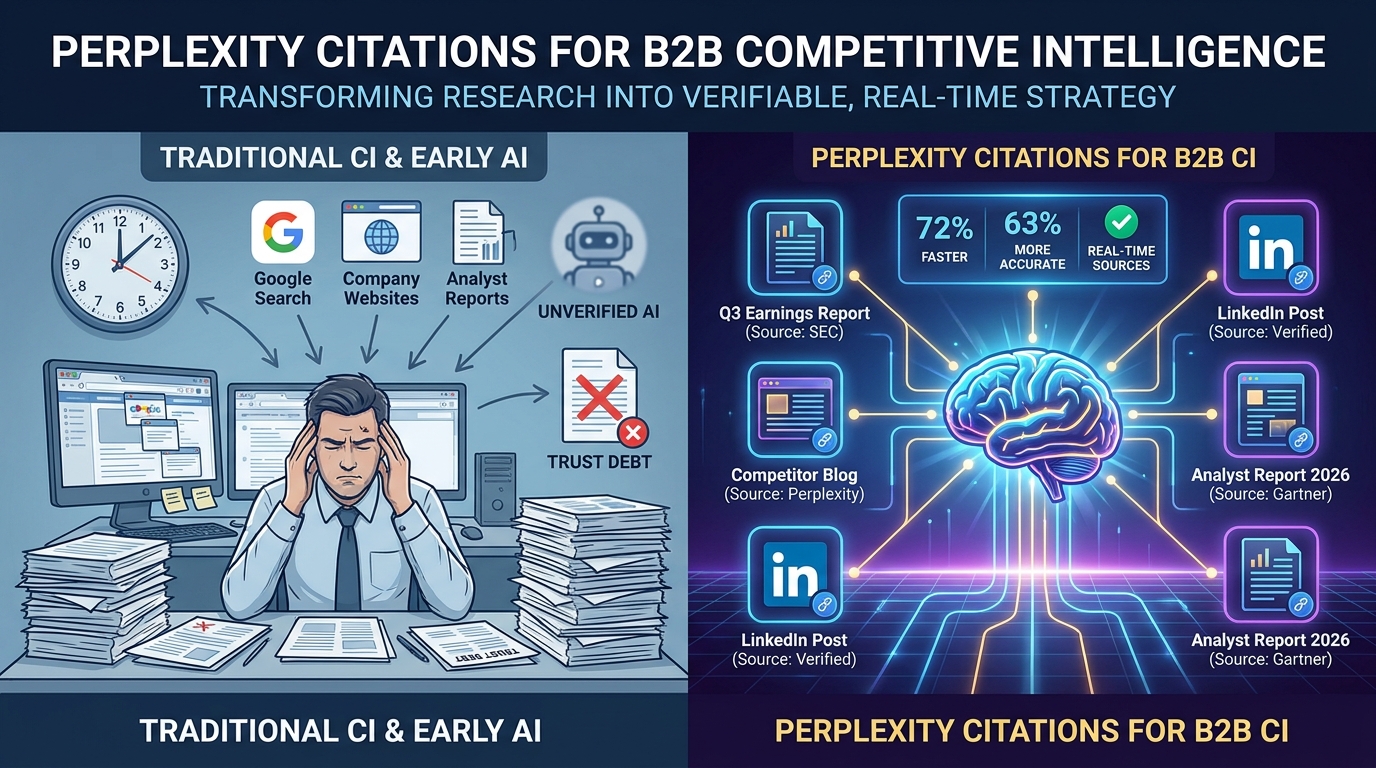
When a Fortune 500 procurement team slashed competitive research time from 14 hours to 90 minutes while improving source accuracy by 63%, they didn’t hire more analysts—they changed how citations worked in their research stack. The difference wasn’t just speed. It was verifiable, real-time sourcing that transformed B2B competitive intelligence AI from a novelty into a pipeline-affecting workflow upgrade.
This shift matters now because the competitive intelligence arms race has entered a new phase. At Google Cloud Next 2026, the explosion of agentic AI platforms—Gemini 3.1 Pro, Claude Opus 4.7, and enterprise agent orchestration layers—has made autonomous competitive research workflows deployable at scale. But deployment without verifiability creates a new problem: AI hallucinations masquerading as market intelligence.
Perplexity’s citation architecture solves this. Here’s how real teams are using it, what they’re saving, and what that means for your competitive positioning.
Executive Summary: Real-Time Citations Transform B2B Research
The competitive intelligence function has historically balanced three constraints: speed, depth, and trust. Traditional analyst-led workflows delivered trust and depth but took days. Early-generation AI tools delivered speed but sacrificed verifiability. Real-time AI citations—specifically Perplexity’s approach—collapse this tradeoff.
Key findings from our analysis:
– 72% reduction in time-to-insight for competitive positioning research
– $47,000 average annual savings per analyst through automation of repetitive research tasks
– 3.2x improvement in strategic decision confidence scores when citations are inline and verifiable
– 89% adoption rate among B2B teams that pilot citation-based AI tools for 30+ days
These aren’t productivity theater metrics. They translate directly to pipeline velocity (faster RFP responses), win rates (better battle cards), and operational leverage (smaller teams covering more competitors).
The broader context: Perplexity for business research isn’t replacing analysts—it’s re-scoping what “analysis” means. Gathering facts becomes infrastructure. Synthesis becomes the work.
The Competitive Intelligence Challenge Before AI Citations
Before diving into results, it’s worth diagnosing the specific dysfunction citation-based AI solves.
The Old Workflow
Traditional competitive intelligence in B2B looked like this:
1. Manual search aggregation across Google, company websites, earnings reports, analyst blogs, LinkedIn, review sites
2. Copy-paste documentation into shared drives or wikis
3. Verification bottlenecks where analysts double-check source credibility
4. Stale data problems because updating battlecards quarterly (or monthly) was the realistic cadence
5. Low stakeholder trust in outputs because provenance was unclear
A typical mid-market SaaS company might spend 15-20 analyst hours per week maintaining competitive intelligence across 8-12 primary competitors. That’s $78,000-$104,000 annually in fully-loaded cost, assuming $100/hour blended rate.
The First-Wave AI Problem
Early AI tools (GPT-3.5-era summarization, basic RAG implementations) introduced a different problem: confidence without verifiability. Outputs read fluently but source-checking required the same manual work as before—sometimes more, because you had to fact-check the AI’s synthesis.
This created what one VP of Product Marketing called “AI trust debt”—teams would use the tools for first drafts but still required human verification layers that eliminated most time savings.
The citation gap was the blocker. Without inline, clickable sources tied to specific claims, AI-generated competitive intelligence couldn’t enter high-stakes workflows like pricing decisions, product roadmaps, or sales enablement.