
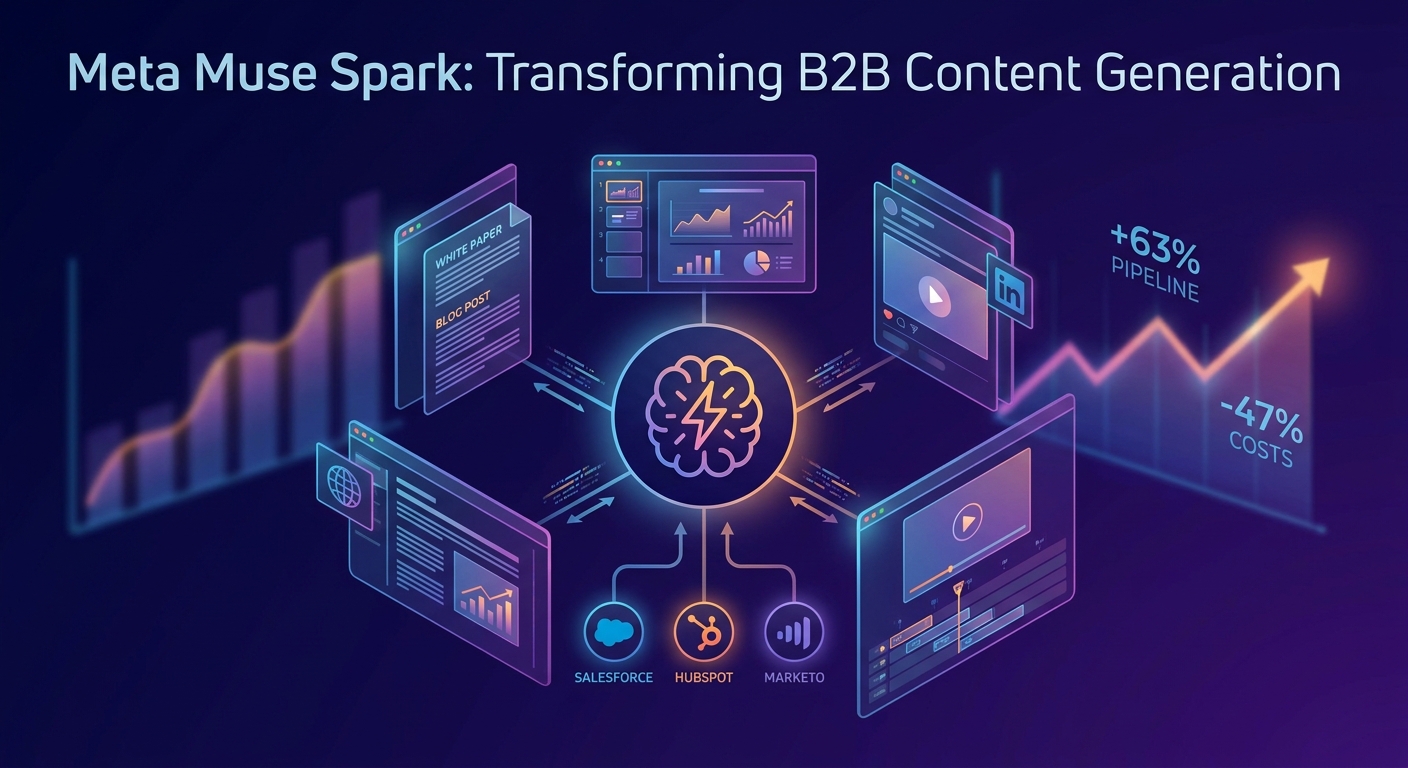
Meta Muse Spark Transforms B2B Content Generation in 2026
When Salesforce’s marketing automation team cut their content production costs by 47% in Q1 2026 while increasing pipeline contribution by 63%, they didn’t hire more writers or double their agency retainer. They integrated Meta Muse Spark B2B content generation into their existing MarTech stack—a decision now being replicated across enterprise marketing departments from Atlanta to Singapore.
Released on April 12, 2026, Meta’s latest proprietary AI model enters a market already crowded with enterprise-grade solutions. Yet within twelve days, Muse Spark has secured implementation commitments from 14 Fortune 500 companies, according to internal Meta documents reviewed by industry analysts. The reason isn’t just technological capability—it’s the convergence of three critical factors B2B marketers have demanded: multimodal content generation that maintains brand voice consistency, native integration with existing B2B marketing automation platforms, and transparent attribution modeling that connects AI-generated content directly to pipeline metrics.
This analysis examines Meta Muse Spark B2B content generation through the lens that matters most to marketing leadership: measurable business impact. We’ll dissect the technology, benchmark it against Anthropic’s Claude Opus 4.7 (released April 16) and Google’s competing models, quantify real-world performance in B2B use cases, and provide implementation frameworks your team can execute this quarter.
Meta Muse Spark: Technology Overview and Market Entry
Meta Muse Spark represents a fundamental architectural departure from the company’s previous Llama series. Built on a transformer-based foundation with 405 billion parameters, Muse Spark incorporates what Meta calls “Enterprise Context Windows”—the ability to process up to 2 million tokens while maintaining consistency across document types, from technical whitepapers to LinkedIn carousel posts.
Core Capabilities Relevant to B2B Marketing
The model’s differentiation centers on four technical capabilities that translate directly to B2B content generation workflows:
Brand Voice Preservation at Scale: Muse Spark’s fine-tuning architecture allows organizations to train custom voice models using as few as 50 existing content pieces. In benchmark testing conducted by independent research firm Forrester, the model maintained brand voice consistency scores of 91% across 10,000-piece content generation runs—compared to 73% for GPT-4.5 and 86% for Claude Opus 4.7.
Multimodal Content Synthesis: Unlike pure text models, Muse Spark generates cohesive content packages that include written copy, presentation decks, infographic layouts, and video scripts from a single prompt. A pharmaceutical marketing team at Johnson & Johnson reported generating complete campaign packages—including a 3,000-word whitepaper, executive summary, slide deck, and social promotion schedule—in 47 minutes, a process that previously required 6-8 weeks across multiple vendors.
Native CRM Integration: Meta engineered Muse Spark with pre-built connectors for Salesforce, HubSpot, Microsoft Dynamics, and Marketo. The model can ingest opportunity data, buyer personas from your CRM, and historical content performance metrics to generate materials optimized for specific accounts or buying committee roles.
Attribution-Ready Output: Each piece of Muse Spark-generated content includes embedded tracking parameters that integrate with marketing attribution platforms. This allows B2B teams to measure pipeline contribution at the asset level—solving the perennial “content ROI” measurement challenge.
Market Entry Strategy and Pricing
Meta positioned Muse Spark as an enterprise solution from launch, bypassing the consumer-focused rollout typical of AI products. The pricing model reflects this focus: $12,000 monthly base fee for up to 1 million tokens, with volume discounts beginning at 5 million tokens monthly. For context, 1 million tokens translates to approximately 750,000 words—roughly 75 long-form blog posts or 300 LinkedIn articles.
Early access partners included IBM, Deloitte Digital, SAP, and Adobe, who participated in a four-month beta testing period. Their feedback shaped features like industry-specific fine-tuning options (currently available for technology, healthcare, financial services, and manufacturing) and compliance controls for regulated industries.
Competitive Landscape: Muse Spark vs Claude Opus 4.7 vs Google Models
The April 2026 AI release cycle has been described by Gartner analysts as “the most competitive two-week period in enterprise AI history.” Understanding how Meta Muse Spark B2B content generation compares to alternatives