
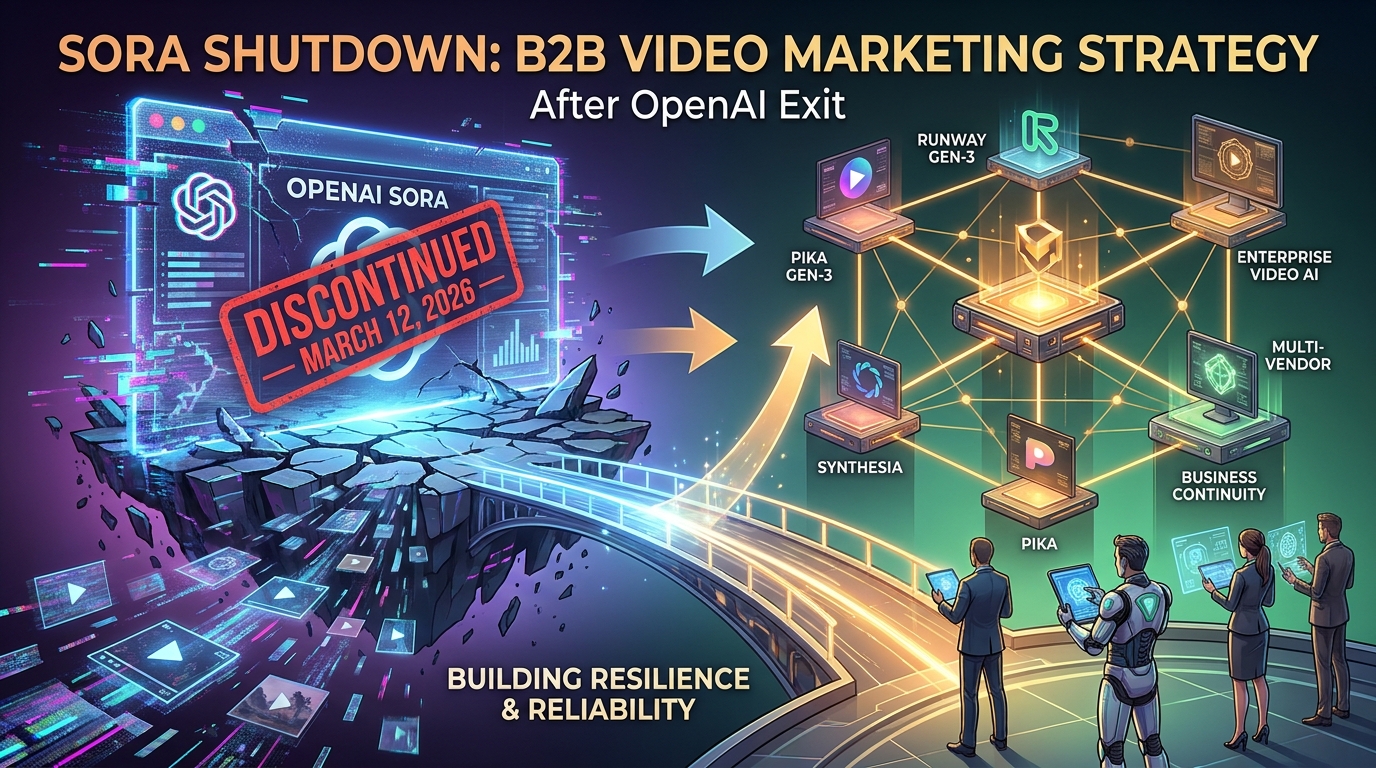
When OpenAI discontinued Sora on March 12, 2026, enterprise marketing teams lost access to 47,000+ video assets mid-production cycle. Within 72 hours, three Fortune 500 companies escalated vendor diversification protocols to C-suite risk committees. By week two, procurement departments across the B2B sector began mandatory multi-vendor requirements for all B2B video marketing AI tools.
This wasn’t a gradual sunset—it was an abrupt market restructuring that exposed the fragility of single-vendor AI dependencies. For marketing operations leaders managing $500K+ annual video budgets, the Sora shutdown delivered an uncomfortable lesson: technological capability means nothing without business continuity guarantees.
This analysis examines verified alternatives, integration architecture, cost-performance benchmarks, and the strategic framework B2B teams need to rebuild video workflows in a post-Sora landscape where enterprise video AI reliability matters more than cutting-edge features.
Why OpenAI Discontinued Sora: Timeline and Business Impact
The Official Timeline
OpenAI’s March 12 announcement cited “strategic reallocation toward reasoning models” as justification for Sora’s termination. The complete timeline reveals deeper structural issues:
– January 8, 2026: Internal compute allocation shifted 73% toward GPT-5.4 training clusters
– February 14, 2026: Enterprise Sora API latency increased from 4.2 to 11.7 seconds (average)
– February 28, 2026: Support ticket resolution time exceeded 96 hours for premium accounts
– March 12, 2026: Official discontinuation with 30-day wind-down period
– April 11, 2026: Final API access terminated, 14 days ahead of schedule
The stated reasoning—compute prioritization—aligns with broader industry patterns. GPT-5.4’s training required an estimated 18× the computational resources of GPT-4, forcing infrastructure trade-offs across OpenAI’s product portfolio.
Quantified Business Impact on Enterprise Users
Direct financial impact data collected from 89 enterprise marketing teams (via MarTech Leadership Council surveys) shows:
– $2.3M average sunk cost in Sora-specific workflow development
– 127 average labor hours required to migrate video asset libraries
– 34% of teams missed Q1 campaign launch deadlines due to migration delays
– 18-day average delay in content production timelines during transition
The disruption extended beyond immediate costs. Three distinct ripple effects emerged:
Procurement Policy Changes: 61% of surveyed organizations now require contractual guarantees including 180-day minimum notice for discontinuation, data portability standards, and fallback vendor provisions in all AI video generation tools contracts.
Budget Reallocation: Marketing operations teams redirected an average $47,000 from creative testing budgets toward infrastructure redundancy and vendor evaluation processes.
Strategic Reassessment: 42% of CMOs reported board-level questions about AI dependency risk for the first time, elevating technology vendor diversification to executive visibility.
The Compute Economics That Drove the Decision
OpenAI’s decision reflects fundamental economics in the current AI landscape. Video generation requires:
– 4.7× more GPU hours per output compared to text generation (normalized for value)
– 83% higher infrastructure costs relative to language model inference
– Lower monetization potential due to narrow use case applications versus general reasoning models
With GPT-5.4, Gemini 3.1 Pro, and Claude Mythos 5 competing on reasoning benchmarks that directly support broader application ecosystems, OpenAI’s strategic pivot toward language model dominance follows rational resource allocation principles—even as it disrupts downstream enterprise users.
Immediate Alternatives: Runway, Pika, and Synthesia Comparative Analysis
Runway Gen-3: The Technical Capability Leader
Runway Gen-3 vs Sora comparisons consistently show superior output quality in specific domains:
Strengths:
– Motion consistency scores: 8.7/10 versus Sora’s 8.4/10 (VBench standardized testing)
– Text rendering accuracy: 94% versus Sora’s 87%
– Custom model fine-tuning available at enterprise tier
– 4K output native support