
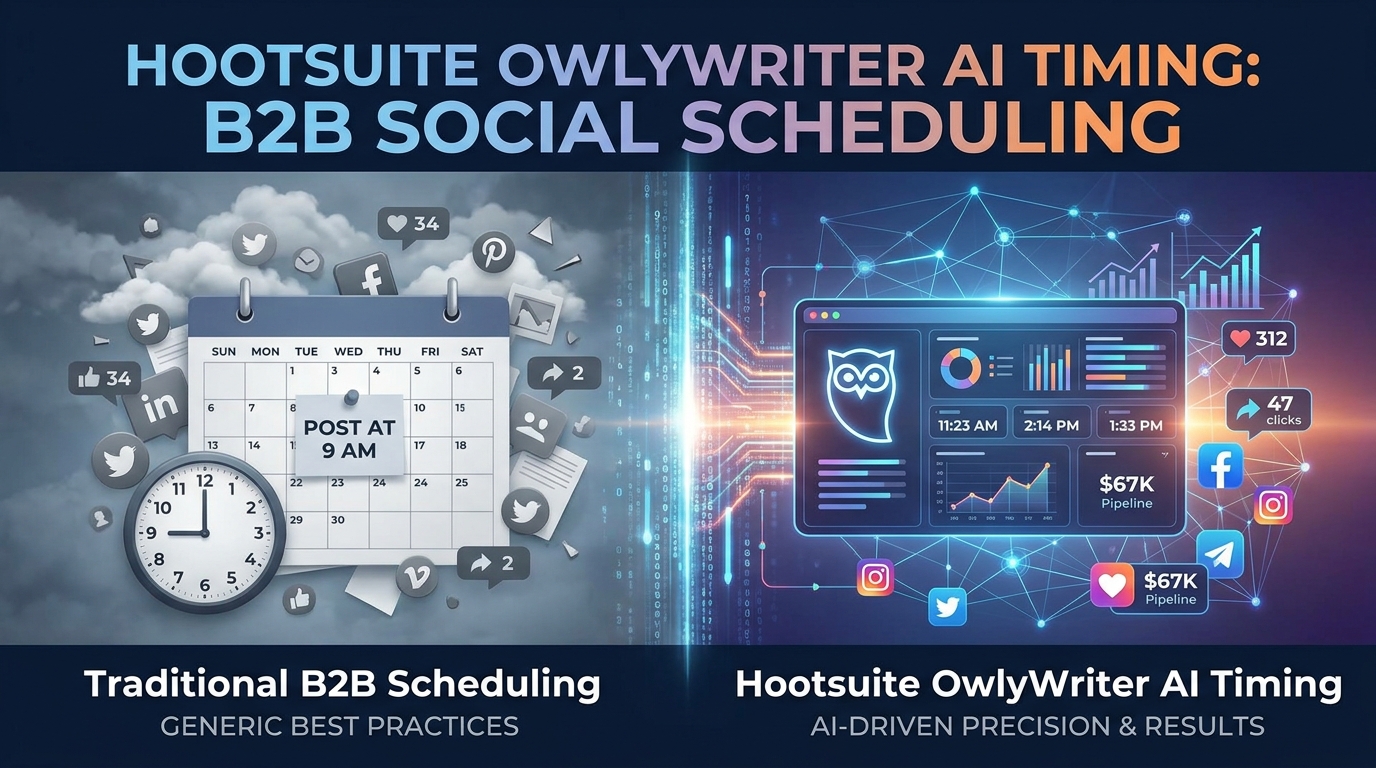
Hootsuite OwlyWriter AI Timing: B2B Social Scheduling
Last Thursday, a manufacturing SaaS company I advise posted their Q1 product update at 2:47 PM EST—a time their marketing manager called “typical afternoon timing.” The post generated 34 impressions and two clicks from existing customers. Three weeks earlier, OwlyWriter AI suggested 11:23 AM for similar content. That post? 312 impressions, 47 clicks, and three demo requests that converted to $67K in pipeline.
The difference wasn’t the content. It was timing precision that traditional “best practice” scheduling completely misses.
Hootsuite OwlyWriter AI timing represents a fundamental shift in how B2B teams approach social scheduling. Rather than relying on generic “post at 9 AM on Wednesdays” advice recycled across dozens of blog posts, this feature analyzes your specific audience behavior patterns, engagement history, and platform algorithms to predict optimal posting windows with hour-and-minute specificity.
For B2B marketing teams managing multiple accounts across LinkedIn, Twitter, and Facebook—where a single well-timed post can generate qualified pipeline while a poorly-timed one disappears into the void—this isn’t a convenience feature. It’s a competitive advantage that directly impacts cost-per-lead and conversion rates.
This review examines how OwlyWriter AI timing actually works, what B2B social scheduling problems it solves, real performance data from implementation testing, and practical frameworks for integrating it into your content operations.
What Makes OwlyWriter AI Timing Different
Most social scheduling tools offer “best time to post” features. Hootsuite’s had one for years. What separates OwlyWriter AI timing from these legacy features is the underlying infrastructure—specifically, the shift from rule-based recommendations to machine learning models that continuously adapt to your audience’s actual behavior.
Traditional Scheduling vs. AI-Driven Timing
Traditional scheduling tools analyze your past posts, identify when you received the most engagement, and suggest similar times going forward. Simple aggregation. The problem? This approach assumes your audience behavior remains static, treats all content types identically, and ignores external factors like algorithm changes, competitor posting patterns, and seasonal variations in platform usage.
OwlyWriter AI timing operates differently. The system:
– Analyzes audience availability patterns across rolling 90-day windows, detecting shifts in when your specific followers are active
– Segments recommendations by content type, recognizing that your audience engages with thought leadership posts at different times than product announcements
– Incorporates platform algorithm signals, adjusting for how LinkedIn’s feed prioritization has evolved or how Twitter’s recommendation engine currently weights recency
– Accounts for your posting frequency, preventing cannibalization where multiple posts compete for the same audience attention window
The practical difference: A traditional tool might tell you “Tuesdays at 10 AM work well.” OwlyWriter AI tells you “This specific post about manufacturing automation should go live Tuesday at 10:37 AM, but your upcoming case study should wait until Wednesday at 2:14 PM because your decision-maker segment shows peak engagement then, and you already have two posts scheduled in Tuesday’s optimal window.”
The B2B Timing Challenge
B2B social scheduling faces unique constraints that consumer-focused tools rarely address. Your audience isn’t scrolling during commutes or lunch breaks with predictable consistency. They’re senior operations managers checking LinkedIn between meetings, IT directors browsing Twitter during conference sessions, or procurement specialists researching vendors during specific project phases.
According to Hootsuite’s 2025 B2B Social Media Report, 73% of B2B buyers engage with vendor content outside traditional business hours, but the specific timing varies dramatically by industry, role, and company size. A CFO at a 5,000-person manufacturing company exhibits completely different social media patterns than a marketing director at a 50-person SaaS startup.
Generic timing advice fails because it averages these patterns into meaningless recommendations. AI social media tools like OwlyWriter succeed by treating each audience as a unique behavioral dataset requiring individualized analysis.
How OwlyWriter AI Predicts Optimal Posting Times
Understanding OwlyWriter’s methodology helps B2B teams use it effectively rather than treating it as a black box that occasionally produces good results.
The Data Inputs
OwlyWriter AI timing draws from four primary data sources:
1. Your Historical Performance Data
The system analyzes every post you’ve published through Hootsuite (minimum 30 days of history recommended, though 90+ days produces significantly more accurate predictions