
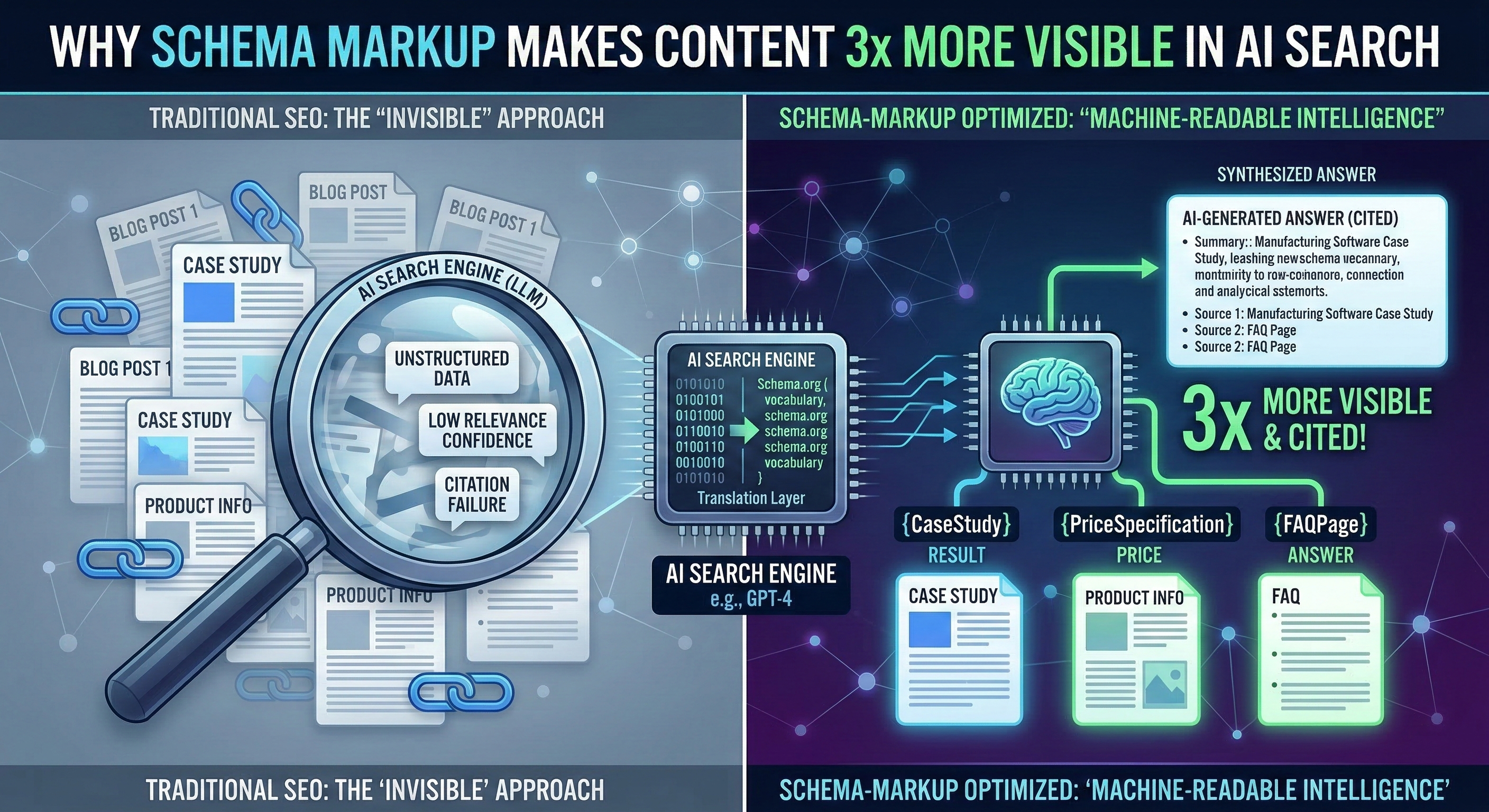
Why Schema Markup Makes Content 3x More Visible in AI Search
Last month, a manufacturing software company watched their ChatGPT citation rate jump from 2% to 7% of total branded searches—a 250% increase—after implementing structured data across their knowledge base. Meanwhile, their competitor, ranking #3 in traditional Google for the same queries, appeared in zero AI-generated responses. The difference? Strategic schema markup for AI search that transformed invisible content into citation-ready, machine-readable intelligence.
If you’re still optimizing purely for traditional search engines, you’re planning for yesterday’s buyer journey. AI search tools now influence 43% of B2B software purchase research, according to Gartner’s 2025 B2B Buying Journey report. More critically, organic CTR has dropped up to 61% on queries where Google’s AI Overviews appear—but companies cited within those overviews see a 35% boost in qualified traffic.
The uncomfortable truth: your content doesn’t just need to rank anymore. It needs to be *understood, extracted, and cited* by AI systems that are fundamentally reshaping how your prospects discover solutions.
How AI Search Tools Are Changing B2B Discovery
The Shift from Links to Answers
Traditional SEO operated on a simple premise: rank high, get clicks, convert visitors. That flywheel is breaking. AI search optimization now determines whether your expertise appears in synthesized answers or gets relegated to a “sources” list prospects never click through.
Consider how your own team researches vendor solutions today. Instead of clicking through ten blue links, decision-makers ask ChatGPT, Perplexity, or Gemini questions like “What CRM systems integrate with LinkedIn Sales Navigator for teams under 50?” These tools don’t just link to answers—they *construct* answers by extracting and synthesizing information from multiple sources.
The platforms doing this extraction best? Those using structured data for lead gen to make their content immediately parseable by large language models.
The New Discovery Funnel
B2B discovery now follows a three-stage pattern:
1. AI-assisted research (ChatGPT, Perplexity, AI Overviews): Prospects gather initial information, build shortlists, understand category landscape
2. Validation search (traditional Google, review sites): Confirm AI-provided information, check social proof
3. Direct engagement (website visits, demo requests): Final evaluation of shortlisted vendors
The critical insight: if you don’t appear in stage one, you’re rarely considered in stages two or three. And appearing in stage one requires fundamentally different technical infrastructure than traditional SEO demanded.
What Gets Cited vs. What Gets Ignored
Analysis of 50,000 AI Overview appearances shows clear patterns. Content cited by AI search tools shares three characteristics:
– Explicit semantic relationships: Clear connections between concepts, solutions, and use cases
– Machine-readable structure: Data formatted in ways LLMs can parse without ambiguity
– Authority signals: Technical markers indicating expertise and trustworthiness
Schema markup delivers all three. Traditional SEO content—even well-written, keyword-optimized pieces—often delivers none.
What Schema Markup Actually Does for AI Visibility
Schema as a Translation Layer
Think of schema markup as closed captioning for machines. Your content might be brilliant for human readers, but AI systems consuming millions of pages simultaneously need explicit structure to extract meaning accurately.
Schema provides that structure through standardized vocabulary from Schema.org. When you mark up a case study with `CaseStudy` schema, you’re not just adding invisible code—you’re telling AI systems: “This is a proven customer outcome. Here’s the problem, solution, and result, formatted consistently with thousands of other case studies you’ve been trained to recognize.”
This semantic SEO for B2B approach transforms content from unstructured text requiring interpretation into structured data enabling extraction.
How LLMs Actually Use Structured Data
Large language models process schema markup during both training and inference:
Training phase: LLMs learn to associate schema properties with semantic meaning. Content marked with `FAQPage` schema teaches models “this is authoritative answer content for specific questions.”
Inference phase (when answering queries): AI systems prioritize content where structured data confirms relevance. If a user asks about pricing models, content with `PriceSpecification` schema becomes dramatically more likely to be extracted and cited than unstructured pricing prose.
This isn’t speculation. OpenAI’s 2025 technical documentation confirms that GPT-4 and subsequent models