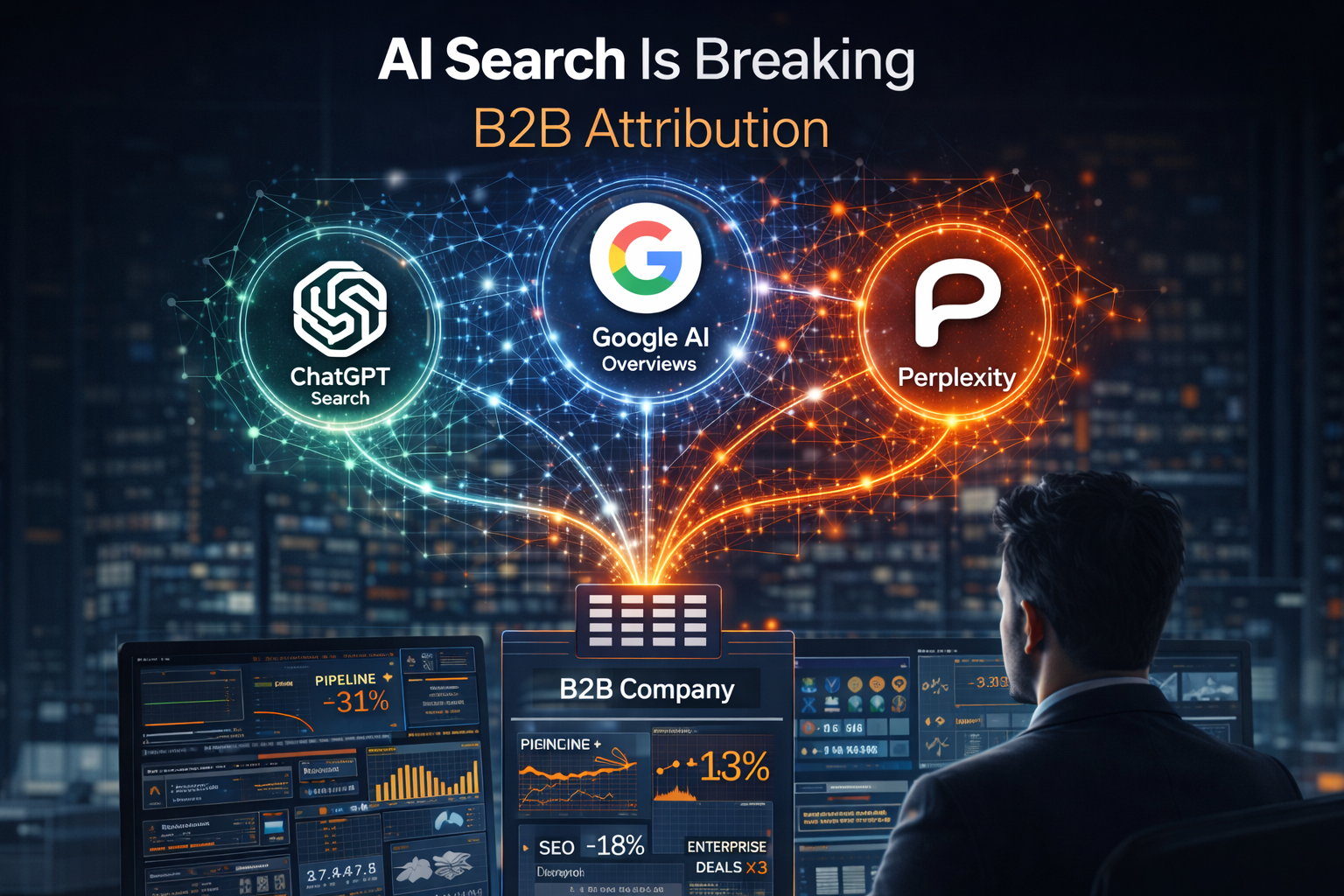
Your head of demand gen just sent you last month’s analytics report. Marketing-attributed pipeline is down 31%, but sales conversations mention your brand more than ever. Your SEO traffic dropped 18% year-over-year, yet three enterprise deals closed citing “research” that never touched your site. If you’re running a B2B go-to-market operation in 2026, this isn’t an anomaly—it’s the new baseline reality of AI search attribution.
The rise of AI Overviews has fundamentally broken the attribution systems that B2B marketers have relied on for the past decade. When prospects gather information through ChatGPT, Perplexity, Google’s AI-generated summaries, and Bing’s Deep Search without ever clicking through to your content, traditional last-touch and multi-touch attribution models can’t capture the journey. You’re losing visibility into what’s actually driving pipeline, which makes budget allocation feel like throwing darts blindfolded.
This isn’t a future-state problem. AI search attribution is the single most urgent infrastructure challenge facing B2B marketing teams today. Here’s how to rebuild your systems before your competitors do.
The 527% AI Search Explosion: What Changed in 18 Months
In September 2024, AI-assisted search represented approximately 8% of all search queries across major platforms. By March 2026, that number hit 50.2% according to Similarweb’s latest industry report. That’s not gradual adoption—that’s a market shift that renders legacy playbooks obsolete.
The growth isn’t evenly distributed. AI Overviews B2B queries show even steeper adoption curves:
- Technology sector: 61% of searches now trigger AI-generated responses
- Financial services: 54% AI Overview appearance rate
- Healthcare/pharma: 49% AI-synthesized answer delivery
- Manufacturing/industrial: 43% AI response integration
What changed? Three simultaneous platform shifts converged:
Google’s AI Overview rollout reached saturation. After cautious testing throughout 2024, Google deployed AI Overviews across virtually all informational and commercial investigation queries by Q1 2025. Unlike featured snippets that still showed source links prominently, AI Overviews synthesize 4-8 sources into a single narrative—with citations buried in expandable modules most users never click.
ChatGPT Search broke the search engine duopoly. OpenAI’s search integration didn’t just add features to ChatGPT—it fundamentally changed how millions of knowledge workers begin research. Instead of Googling “best marketing attribution software for B2B,” they now ask ChatGPT “what attribution platform should a 50-person B2B SaaS company with $8M ARR use?” The question format changed, the interaction model changed, and the traffic distribution changed.
Perplexity reached enterprise penetration. What started as a niche tool for early adopters became standard research infrastructure. Perplexity’s Pro Business tier now has 340,000+ company subscriptions, meaning entire organizations conduct competitive research, vendor evaluation, and market analysis without generating a single trackable referral to the sources they’re actually reading.
The traffic impact is measurable and severe. Ahrefs reported that among B2B SaaS companies with historically strong organic search performance, average organic sessions declined 23% between Q1 2025 and Q1 2026—while brand search and direct traffic increased 14%. People are finding you. You’re influencing decisions. But the connection between content investment and revenue outcome has gone dark.
Why Traditional Attribution Models Break Under AI Search
Multi-touch attribution was already imperfect. AI search traffic growth has made it borderline fictional.
Traditional B2B attribution relies on a fundamental assumption: prospects interact with trackable assets (website visits, content downloads, email clicks, ad impressions) that create a data trail connecting marketing activity to revenue outcome. The standard models—first-touch, last-touch, linear, time-decay, U-shaped, W-shaped—all require visibility into the touchpoints.
AI search severs that connection in three specific ways:
The Zero-Click Research Journey
A VP of Sales at a $40M ARR company needs to understand conversation intelligence platforms. Her research journey looks like this:
- Asks Claude: “Compare conversation intelligence platforms for sales teams”
- Reads AI-synthesized comparison drawing from Gong, Chorus, Clari documentation
- Asks a follow-up: “Which is best for teams under 25 reps?”
- Gets a recommendation with no clicks to any vendor site
- Books a demo with her top choice—who has zero attribution data on this prospect
Your CRM shows this as a direct traffic conversion. Your attribution model credits no marketing touchpoint. Your demand gen team gets no credit for the content that actually educated and converted her.
The Dark Funnel Expands at Scale
Dark funnel—the untrackable portion of the B2B buyer journey—was previously estimated at 30-40% of all touchpoints. With AI search adoption at current levels, that number is closer to 60-70% for mid-market and enterprise buyers. Buyers are doing more research than ever. They’re more informed when they reach your sales team than at any point in the past decade. And almost none of it shows up in your attribution data.
The irony: companies investing heavily in thought leadership, product documentation, and educational content are likely benefiting most from AI search—and have the least visibility into that ROI. If your content is being cited in Perplexity answers and Google AI Overviews, you’re generating real pipeline influence that your current systems can’t see.
Budget Misallocation Compounds the Problem
When attribution models undercount content’s contribution to pipeline, the natural response is to shift budget toward channels with cleaner attribution—paid search, direct mail, outbound SDR sequences. This creates a feedback loop: you defund the content that’s actually working in AI search, reduce your AI search presence, generate less dark funnel influence, and see pipeline drop further.
Teams that don’t adapt their measurement systems will systematically defund the most effective parts of their B2B go-to-market motion over the next 18 months.
Rebuilding Attribution Infrastructure for AI Search Reality
The fix isn’t patching your existing attribution model. It’s building a parallel measurement system that captures influence beyond the click. Here’s the framework:
1. Shift from Touch-Based to Signal-Based Attribution
Instead of trying to track every touchpoint, measure downstream signals that correlate with marketing influence. These include sales cycle velocity (influenced deals close faster), win rate by content engagement, brand search volume growth, and deal source self-reporting from discovery calls.
Add a standard question to every discovery call: “How did you first hear about us, and what did you look at before booking this call?” This qualitative data, aggregated at scale, tells you more about AI search influence than any pixel-based tracking system.
2. Monitor AI Search Presence Directly
Tools like Profound, Brandwatch AI Search, and BrightEdge’s AI search monitoring now track how frequently your brand and content appear in AI-generated responses across ChatGPT, Perplexity, and Google AI Overviews. This is the equivalent of organic search ranking data for the AI era—it measures influence, not just traffic.
Track: citation frequency in AI Overviews for target queries, brand mention sentiment in AI-synthesized responses, share of AI-generated answers in your category versus competitors, and which specific content assets are being cited most frequently.
3. Implement Closed-Loop Revenue Attribution
Connect your content performance data to closed revenue, not just pipeline. This requires tighter integration between your CMS, CRM, and revenue intelligence platform—but the payoff is a measurement model that shows content ROI even when the path is indirect.
Specifically: tag every closed deal with the content assets the account engaged with (even retroactively via sales rep input), build a content-to-revenue correlation model by segment and ICP, and report on content-influenced revenue as a separate metric from content-attributed revenue.
4. Optimize for AI Search Inclusion, Not Just SEO
The content that gets cited in AI Overviews and used by ChatGPT to answer user questions shares characteristics: it’s authoritative, structured, specific, and cites primary sources. This means moving beyond keyword-optimized blog posts toward comprehensive reference content—comparison pages, detailed methodology documentation, original research, and data-backed frameworks.
Your goal isn’t just to rank on page one. It’s to be the source that AI platforms cite when they synthesize answers for your buyers.
The Competitive Window Is Now
Most B2B marketing teams are still running attribution models designed for a 2018 buyer journey. They’re making budget decisions based on incomplete data, defunding high-influence content, and ceding AI search presence to competitors who figure this out first.
The teams that adapt fastest will build a durable advantage: higher brand recall in AI-synthesized research, better sales conversations with better-educated buyers, and content investments that actually compound over time rather than being written off as unmeasurable.
The attribution model overhaul isn’t optional. The only question is whether you do it before or after your competitors do.
Start with one change: add the discovery question to every sales call this quarter. In 90 days, you’ll have more signal about AI search influence on your pipeline than all your current attribution tools combined