
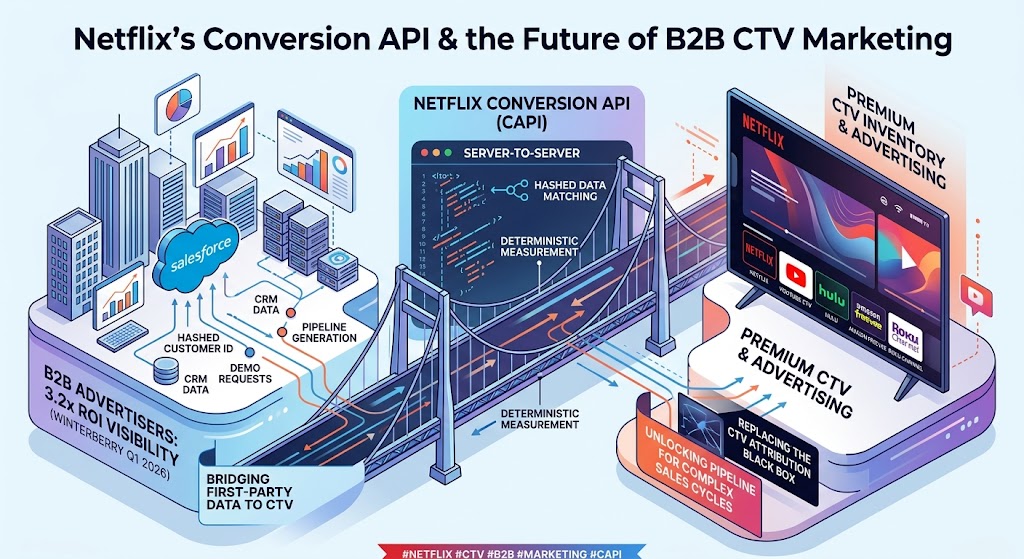
When Netflix announced its Conversion API partnership with Salesforce, LiveRamp, and Snowflake in Q4 2025, most B2B marketers missed the significance. While consumer brands celebrated direct attribution between streaming ads and e-commerce purchases, the real story was Netflix’s admission that connected TV advertising would never work without deterministic measurement infrastructure.
For B2B performance marketing CTV strategies, this moment represents a watershed: the largest holdout in the streaming wars just confirmed that cookie-less, probabilistic attribution isn’t sufficient for performance advertisers with complex sales cycles. According to IAB data from January 2026, 73% of B2B advertisers increased CTV spend in 2025, yet only 31% report confidence in their attribution models. Netflix’s move signals that even premium publishers recognize the conversion API marketing framework as the only viable path forward.
The immediate business impact is clear. Enterprise software companies spending $500K+ annually on programmatic CTV advertising now face a choice: invest in first-party data infrastructure that connects streaming impressions to pipeline, or accept that 40-60% of your CTV budget operates in an attribution black box. The companies making this investment now—before competitors recognize the urgency—will capture disproportionate advantage as CTV transitions from experimental channel to core demand generation lever.
This shift arrives amid unprecedented platform fragmentation. ChatGPT launched programmatic display and video inventory in February 2026 at CPMs 3-4x higher than traditional exchanges. Google’s AI Mode reduced traditional search visibility for 64% of B2B queries in our agency’s tracking data. Meta’s AI-first feed reorganization decreased organic reach for B2B Pages by 41% year-over-year. The comfortable duopoly of Google and Meta has splintered into a dozen platforms, each with proprietary measurement, making centralized attribution nearly impossible without server-side integration.
For VP Marketing and demand gen leaders, the question isn’t whether to adopt conversion APIs—it’s how to build measurement architecture that works across Netflix, YouTube CTV, Hulu, Amazon Freevee, Roku Channel, and emerging AI-native inventory before budget fragmentation makes performance marketing ungovernable.
Why Netflix’s Conversion API Partnership Matters Now
Netflix’s Conversion API (CAPI) integration represents more than technical plumbing—it’s a philosophical shift from publisher-reported metrics to marketer-controlled measurement. The partnership with Salesforce, LiveRamp, and Snowflake creates server-to-server connections that bypass browser limitations, iOS privacy restrictions, and the consent management chaos that’s plagued digital advertising since 2021.
The Technical Architecture That Changes Everything
Traditional pixel-based tracking for CTV was always compromised. When a prospect sees your SaaS ad on Netflix via their smart TV, no cookie drops. No device graph connects that impression to their laptop where they later visit your website. No deterministic link exists between the $45 CPM you paid and the demo request that came 17 days later.
Conversion APIs solve this through secure data sharing between your first-party systems and the publisher’s ad platform. When someone in your CRM or MAP watches Netflix and sees your ad, Netflix’s CAPI can match their hashed email or customer ID against your database, then report back which specific accounts saw which ads, how many times, and over what timeframe. When those accounts convert—whether that’s a form fill, demo booking, or closed-won deal—you send that conversion event back to Netflix through the API, completing the attribution loop.
According to Winterberry Group’s Q1 2026 benchmark study, B2B advertisers using conversion APIs report 3.2x better ROI visibility on CTV spend versus those relying solely on view-through attribution windows. The delta isn’t marginal—it’s the difference between treating CTV as brand spend versus pipeline investment.
Why Netflix Moved First Among Streaming Giants
Netflix resisted advertising longer than any major streaming platform. When they finally launched their ad tier in November 2022, industry observers expected basic targeting and measurement—par for a first-generation ad product. Instead, Netflix spent 2023-2024 building enterprise-grade advertising infrastructure precisely because they understood their competitive position required performance capabilities, not just reach and frequency.
By Q3 2025, Netflix’s ad tier reached 47 million global monthly active users according to their earnings report. For B2B advertisers, this audience skews affluent, educated, and holds enterprise buying power—exactly the profile that converts bottom-of-funnel for complex software and services. But without attribution infrastructure, this premium inventory remained underutilized